



The month of Ramadan opens a floodgate of memories for 81-year-old Bava Haji Pandalingal, who moved to Abu Dhabi from India in 1968, before the UAE was formed.
Mr Pandalingal, originally from Kerala, is the President of the Indian Islamic Centre — a social and cultural organisation of Keralite residents in Abu Dhabi.
He vividly remembers his first face-to-face with the UAE Founding Father, the late Sheikh Zayed bin Sultan, during one of his first Ramadans in the country.
“I was in my mid-20s and new to the country. I remember standing in line outside his palace in Abu Dhabi along with other residents and Emiratis to meet him,” Mr Pandalingal told The National.
“When my turn came, I greeted him 'Ramadan Kareem' and he gave me a handful of dates.”
“It was a norm for people to greet the ruler. People used to look forward to that opportunity every Ramadan. The month was spent in prayer and spiritual introspection, otherwise.”
Reminiscing about how people observed fasting during those times, when there was no air conditioning or efficient water supply, Mr Pandalingal said it was all about making the most from the modest means at their disposal.
In the 1960s, after the first barrel of oil was exported, workers from different parts of the world arrived in Abu Dhabi to help build the many infrastructure projects that had started.
Concrete buildings were rising from the desert, but many families still lived in shanties or mud houses. Desalination of seawater had begun and people were storing fresh water in sand pits or metal cans.

“Donkeys carrying fresh water in leather pouches were used to supply households,” said Mr Pandalingal, who has witnessed the country’s transformation over the last half a century.
“A gallon would cost equivalent to a dirham. We were so careful while using water. But during Ramadan our water supplies lasted longer because we were fasting during the day.
“There were no big shopping malls to hang out in all night or elaborate iftars or suhoors. Ramadan was much quieter.”
Mr Pandalingal worked in the planning section of Abu Dhabi municipality and later started his own contracting company in 1994. His wife Khadeeja joined him after a few years. The couple has four children, all grown up and settled in the UAE and India.
He said they used to live in temporary tents in a compound shared with many other India nationals.

“There were not many families at that time. We used to cook but as bachelors we mostly relied on the few cafes and small restaurants that sold Indian snacks during iftar,” said Mr Pandalingal.
“Shopping was not a pastime, like it is today. But we used to hang out with friends in the souq in the central market, which was the main shopping and trading hub.
“Vendors would have a special display during Ramadan and we used to buy some incense, spices and some clothes.
“There are not as many mosques too. There was one big mosque near the central market, and people would gather there for prayers.
“Over the years, everything changed — even the way people break fast and how they spend the evenings. But change is inevitable and I feel lucky I get to experience both worlds.”
Making Ramadan special
Pakistani couple Khawar Saleem Aslam and Shabana Khawar also lived through an era when modern amenities and extravagant lifestyles were a distant dream.
Mr Aslam, an engineer, came to Abu Dhabi in 1976 to work in Umm Al Nar oil refinery in Sas Al Nakhl. The couple has four daughters and all of them have joined their parents in Abu Dhabi this Ramadan.
But when they were starting their life in a new country, nearly 50 years ago, they only had friends and community members to make Ramadan special.

“I was 25 at that time and my wife joined me a year later,” Mr Aslam, from Lahore, told The National.
“We were a young couple building a new life in a faraway country. Our first Ramadan together in Abu Dhabi was very special as it was the first time we were away from our families.
“There was nothing dramatic during Ramadan. I remember we had to walk a bit to reach the closest mosque for morning prayers. People quietly went about doing their work.
“By evening, small street-side stalls would spring up in our neighbourhood, selling hot samosas, pakoras [spicy fritters] and other traditional snacks. Dinner was mostly at home with a few other neighbours and friends.”
Mrs Khawar said she had to work around some recipes because fresh milk was not available in Abu Dhabi in the 1970s.
“We were using milk powder and desserts like Kheer [sweet rice pudding] would taste different,” she said.
“We were sharing an apartment with another Pakistani family. Me and my friend used to go shopping when our husbands were away and we used to explore the souq.
“We enjoyed cooking and joint iftars because there were friends who were like family.”
Mr Alam said one big difference he has seen over the years is how the community has become more tolerant and inclusive, even during Ramadan.
“All the restaurants remained closed during Ramadan and it was difficult for non-Muslims to find food or eat during the holy month,” he said.
“But as the country grew and is home to people from all over the world and of different religions, races and belief systems, I see that we have also become more open and tolerant in the true spirit of the holy month.”
Ramadan in the UAE — in pictures
-
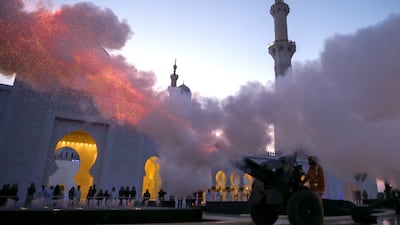
A cannon is fired at the Sheikh Zayed Grand Mosque to mark the end of fasting and start of Iftar on the first day of Ramadan. Victor Besa / The National -
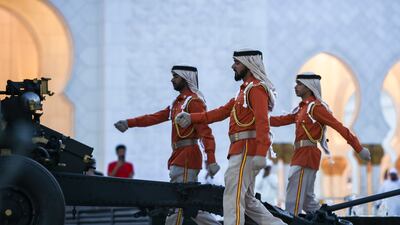
First day of Ramadan at the Sheikh Zayed Grand Mosque in Abu Dhabi. Victor Besa / The National -
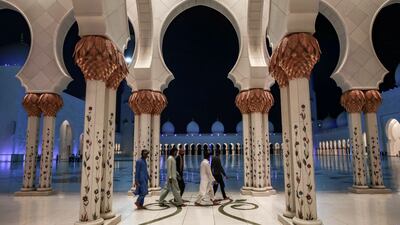
Worshippers at the Sheikh Zayed Grand Mosque on the first evening of Ramadan. Victor Besa / The National -

Worshippers at the Sheikh Zayed Grand Mosque on the first evening of Ramadan. Victor Besa / The National -
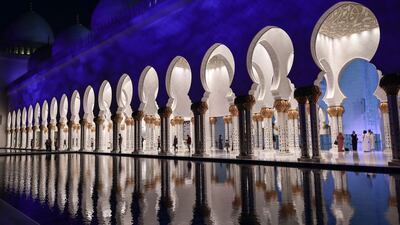
The illuminated Sheikh Zayed Grand Mosque. Victor Besa / The National -

A cannon is ready to fire at Expo City Dubai to signal the end of fasting on the first day of Ramadan. Chris Whiteoak / The National -

A cannon is fired at Expo City Dubai to signal the beginning of iftar. Chris Whiteoak / The National -

A boy covers his ears as a cannon is fired at Expo City Dubai to mark the beginning of iftar on the first day of Ramadan. Chris Whiteoak / The National -

Water and dates being offered after the cannon is fired. Chris Whiteoak / The National -

Officers prepare to fire a cannon at Expo City Dubai. Chris Whiteoak / The National -
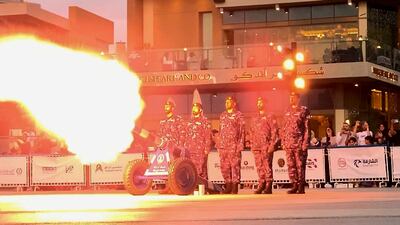
Sharjah Police personnel fire a cannon to break the fast at the Al Majaz waterfront on the first day of Ramadan. Pawan Singh / The National -

Worshippers break their fast at the Al Majaz waterfront in Sharjah. Pawan Singh / The National -
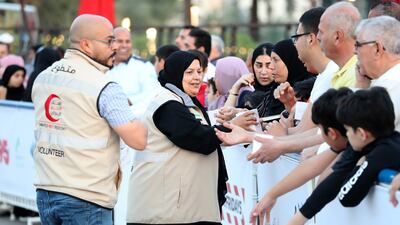
Emirates Red Crescent members distribute dates and water at the Al Majaz waterfront in Sharjah. Pawan Singh / The National -
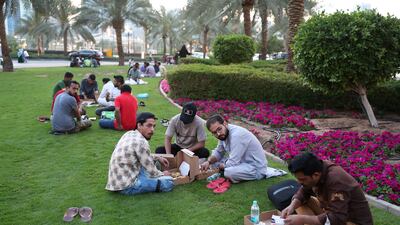
People break their fast at the Al Majaz waterfront in Sharjah. Pawan Singh / The National -
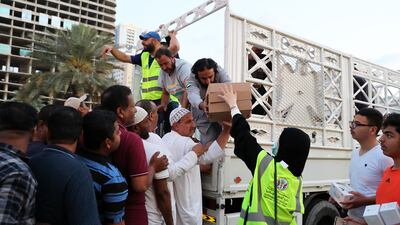
Iftar meals being distributed at the Al Majaz in Sharjah waterfront on the first day of Ramadan. Pawan Singh / The National



