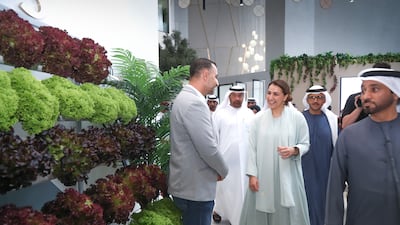
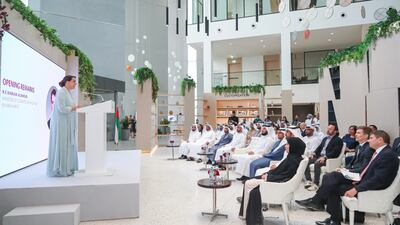
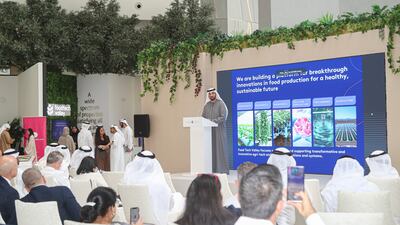
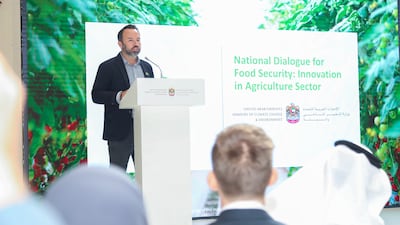
The first session of the National Dialogue for Food Security was launched by the Ministry of Climate Change and Environment. Photo: MOCCAE

UAE outlines plan to increase domestic food production and consumption


Nick Webster
  • English
  • Arabic

Salmon farming on land, Fitbit-style devices for cattle and acres of greenhouses producing vegetables in a Mediterranean environment — the face of farming in the UAE is changing fast.

With a 70 per cent increase in global food demand expected by 2050, and climate change affecting agricultural production, innovation is proving the key to easing food insecurity.

A campaign by the Ministry of Climate Change and Environment aims to unite businesses with innovation and funding to tackle such issues.

Local farms are at the heart of the National Dialogue for Food Security, which will be supported to become major suppliers in the UAE to help reduce the reliance on imported goods.

There is potential to localise sourcing for many of the UAE's food needs and to do so in a way that is sustainable, economic and environmentally sound
Sky Kurtz,
Pure Harvest chief executive

The project will develop a platform for emerging innovation in food production to improve the use of hydroponic, aeroponic and aquaponic farming that uses minimal resources to produce a high yield of fresh fruit and vegetables while providing a gateway into the mass market.

The drive aims to increase domestic production and self-sufficiency of selected food items and improve the income of UAE farms without compromising food trade.

Under the plan, bodies will increase their purchases of fresh national food products to 50 per cent by the end of this year, 70 per cent by 2025 and 100 per cent by 2030.

Food products and plant varieties identified in the first phase include red meat, poultry, eggs and other dairy products, dates, leafy vegetables, tomatoes, cucumbers, peppers and aubergine. A study is currently being conducted to identify more products for the second phase.

  • A special initiative by the Ministry of Climate Change and Environment aims to unite businesses with innovation and funding to tackle food security issues. All Photos: Ministry of Climate Change and Environment
    A special initiative by the Ministry of Climate Change and Environment aims to unite businesses with innovation and funding to tackle food security issues. All Photos: Ministry of Climate Change and Environment
  • Mariam Al Mheiri, Minister of Climate Change and Environment and Minister of State for Food Security, said recent global crises have underlined the need for promoting food security in the UAE
    Mariam Al Mheiri, Minister of Climate Change and Environment and Minister of State for Food Security, said recent global crises have underlined the need for promoting food security in the UAE
  • Local farms are at the heart of the National Dialogue for Food Security
    Local farms are at the heart of the National Dialogue for Food Security
  • Sky Kurtz, chief executive of Pure Harvest, said there is the potential to localise sourcing for many of the UAE's food needs
    Sky Kurtz, chief executive of Pure Harvest, said there is the potential to localise sourcing for many of the UAE's food needs

Mariam Al Mheiri, Minister of Climate Change and Environment, Minister of State for Food Security, said recent global crises have underlined the need for promoting food security in the UAE.

"To promote food security, the UAE has taken strategic steps, such as deploying advanced technology to strengthen the local food production sector, enhancing its contribution to closing the food gap and tackling food loss and waste by launching several initiatives, like Ne'ma, to promote the sustainability of national farms," she said.

"These initiatives aim to enhance food security in the UAE by boosting production and marketing effectiveness for local farms, particularly those following a modern and sustainable approach."

Ne'ma — Arabic for blessing — is a campaign aimed at curbing food loss and waste by encouraging responsible consumption.

At a meeting on Monday to discuss the latest developments, it was revealed a farm in Maliha in Sharjah had produced more than 15,000 tonnes of protein-enriched wheat.

It is the latest example of how staple foods can be produced sustainably in the UAE.

The planet’s population is expected to swell to 9.5 billion by 2050, with climate change continuing to cause extreme weather events and drought which heavily impact food production.

With freshwater sources also depleting, scientists have turned to innovation to solve these global issues.

The Ministry of Climate Change and Environment's recent statistics show there are 38,000 farms operating in the UAE.

Total UAE vegetable production is about 156,000 tonnes annually, with more than 500 tonnes of field crops and feed, while fruit production is about 200,000 tonnes.

Domestic production of vegetables currently meets more than 20 per cent of the total demand in the country.

Precision farming, using data science and agricultural engineering, has increased yields, while high-tech greenhouses and vertical farms are reducing the need for water.

In livestock agriculture, gene editing, bio-engineering and smart tech to monitor cattle more closely are being used to increase meat production to keep up with consumer demand and close the food price gap.

Alternative proteins with more food derived from non-animal sources are also likely to become more common, using insects and plant-based meats.

Farming innovation

Health trackers worn by dairy cattle — known as rumination collars — keep track of their health and food consumption, monitoring production and allowing farm managers to oversee a large herd more effectively.

An innovation already in widespread use across the country is salmon farming on land, using huge tanks to replicate the fish’s life-cycle in the wild.

Fish were identified as one of the UAE’s strategic food items under the 2018 Food Security Strategy.

At about 30kg per capita, it has among the fish highest consumption in the GCC, according to the UN Food and Agriculture Organisation.

In 2019, domestic fish made up only 8 per cent of UAE consumption but that is beginning to change, with farmed salmon controlled in freshwater tanks (which are transferred to seawater as they grow) proving an efficient method of sustainable production.

Pure Harvest's temperature-controlled farming tunnels and domes create the perfect Mediterranean climate to produce impressive yields. Photo: Pure Harvest Smart Farms

Added to these innovative farming methods, the growing of fruit and vegetables in the arid desert has become one of the biggest success stories.

In huge temperature-controlled farming tunnels and domes, Pure Harvest Smart Farms has created the perfect Mediterranean climate to produce impressive yields of fruit and vegetables in Al Ain.

With temperatures regulated to between 14°C-32°C, tomatoes, green leafy vegetables and berries are produced using only a 30th of the amount of water usually required.

“This shows what can be done,” said Sky Kurtz, chief executive of Pure Harvest, a smart farm producing around 18 metric tonnes of food a week.

“Change [in the way we produce food] will require investment and re-education.

"There is potential to localise sourcing for many of the UAE's food needs and to do so in a way that is sustainable, economic and environmentally sound.”

By the end of this year, the UAE hopes local farms and producers will be able to supply half of some basic food requirements, such as greens, tomatoes, meat and poultry, with an ambition to double that target by 2030.

“This will require a co-ordinated effort between the government and the private sector,” said Mr Kurtz.

"Many of the technology-enabled food production solutions that are necessary to produce food year-round in the UAE require capital, scale and know-how to deliver.

“The more that the government can do to support the many elements that underpin the fundamental business cases of these solutions, the better.”


Mercer, the investment consulting arm of US services company Marsh & McLennan, expects its wealth division to at least double its assets under management (AUM) in the Middle East as wealth in the region continues to grow despite economic headwinds, a company official said.

Mercer Wealth, which globally has $160 billion in AUM, plans to boost its AUM in the region to $2-$3bn in the next 2-3 years from the present $1bn, said Yasir AbuShaban, a Dubai-based principal with Mercer Wealth.

Within the next two to three years, we are looking at reaching $2 to $3 billion as a conservative estimate and we do see an opportunity to do so,” said Mr AbuShaban.

Mercer does not directly make investments, but allocates clients’ money they have discretion to, to professional asset managers. They also provide advice to clients.

“We have buying power. We can negotiate on their (client’s) behalf with asset managers to provide them lower fees than they otherwise would have to get on their own,” he added.

Mercer Wealth’s clients include sovereign wealth funds, family offices, and insurance companies among others.

From its office in Dubai, Mercer also looks after Africa, India and Turkey, where they also see opportunity for growth.

Wealth creation in Middle East and Africa (MEA) grew 8.5 per cent to $8.1 trillion last year from $7.5tn in 2015, higher than last year’s global average of 6 per cent and the second-highest growth in a region after Asia-Pacific which grew 9.9 per cent, according to consultancy Boston Consulting Group (BCG). In the region, where wealth grew just 1.9 per cent in 2015 compared with 2014, a pickup in oil prices has helped in wealth generation.

BCG is forecasting MEA wealth will rise to $12tn by 2021, growing at an annual average of 8 per cent.

Drivers of wealth generation in the region will be split evenly between new wealth creation and growth of performance of existing assets, according to BCG.

Another general trend in the region is clients’ looking for a comprehensive approach to investing, according to Mr AbuShaban.

“Institutional investors or some of the families are seeing a slowdown in the available capital they have to invest and in that sense they are looking at optimizing the way they manage their portfolios and making sure they are not investing haphazardly and different parts of their investment are working together,” said Mr AbuShaban.

Some clients also have a higher appetite for risk, given the low interest-rate environment that does not provide enough yield for some institutional investors. These clients are keen to invest in illiquid assets, such as private equity and infrastructure.

“What we have seen is a desire for higher returns in what has been a low-return environment specifically in various fixed income or bonds,” he said.

“In this environment, we have seen a de facto increase in the risk that clients are taking in things like illiquid investments, private equity investments, infrastructure and private debt, those kind of investments were higher illiquidity results in incrementally higher returns.”

The Abu Dhabi Investment Authority, one of the largest sovereign wealth funds, said in its 2016 report that has gradually increased its exposure in direct private equity and private credit transactions, mainly in Asian markets and especially in China and India. The authority’s private equity department focused on structured equities owing to “their defensive characteristics.”

Results

4.30pm Jebel Jais – Maiden (PA) Dh60,000 (Turf) 1,000m; Winner: MM Al Balqaa, Bernardo Pinheiro (jockey), Qaiss Aboud (trainer)

5pm: Jabel Faya – Maiden (PA) Dh60,000 (T) 1,000m; Winner: AF Rasam, Tadhg O’Shea, Ernst Oertel

5.30pm: Al Wathba Stallions Cup – Handicap (PA) Dh70,000 (T) 2,200m; Winner: AF Mukhrej, Tadhg O’Shea, Ernst Oertel

6pm: The President’s Cup Prep – Conditions (PA) Dh100,000 (T) 2,200m; Winner: Mujeeb, Richard Mullen, Salem Al Ketbi

6.30pm: Abu Dhabi Equestrian Club – Prestige (PA) Dh125,000 (T) 1,600m; Winner: Jawal Al Reef, Antonio Fresu, Abubakar Daud

7pm: Al Ruwais – Group 3 (PA) Dh300,000 (T) 1,200m; Winner: Ashton Tourettes, Pat Dobbs, Ibrahim Aseel

7.30pm: Jebel Hafeet – Maiden (TB) Dh80,000 (T) 1,400m; Winner: Nibraas, Richard Mullen, Nicholas Bachalard

SPECS
%3Cp%3E%3Cstrong%3EEngine%3A%3C%2Fstrong%3E%201.5-litre%204-cylinder%3Cbr%3E%3Cstrong%3EPower%3A%3C%2Fstrong%3E%20101hp%3Cbr%3E%3Cstrong%3ETorque%3A%3C%2Fstrong%3E%20135Nm%3Cbr%3E%3Cstrong%3ETransmission%3C%2Fstrong%3E%3A%20Six-speed%20auto%3Cbr%3E%3Cstrong%3EPrice%3A%3C%2Fstrong%3E%20From%20Dh79%2C900%3Cbr%3E%3Cstrong%3EOn%20sale%3A%3C%2Fstrong%3E%20Now%3C%2Fp%3E%0A
The White Lotus: Season three

Creator: Mike White

Starring: Walton Goggins, Jason Isaacs, Natasha Rothwell

Rating: 4.5/5

Awar Qalb

Director: Jamal Salem

Starring: Abdulla Zaid, Joma Ali, Neven Madi and Khadija Sleiman

Two stars

Best Foreign Language Film nominees

Capernaum (Lebanon)

Cold War (Poland)

Never Look Away (Germany)

Roma (Mexico)

Shoplifters (Japan)

The biog

Mission to Seafarers is one of the largest port-based welfare operators in the world.

It provided services to around 200 ports across 50 countries.

They also provide port chaplains to help them deliver professional welfare services.

ILT20%20UAE%20stars
%3Cp%3E%3Cstrong%3ELEADING%20RUN%20SCORERS%3C%2Fstrong%3E%3Cbr%3E1%20Nicholas%20Pooran%2C%20261%3Cbr%3E%3Cstrong%3E2%20Muhammad%20Waseem%20(UAE)%2C%20248%3C%2Fstrong%3E%3Cbr%3E3%20Chris%20Lynn%2C%20244%3Cbr%3E4%20Johnson%20Charles%2C%20232%3Cbr%3E5%20Kusal%20Perera%2C%20230%3Cbr%3E%3Cbr%3E%3Cstrong%3EBEST%20BOWLING%20AVERAGE%3C%2Fstrong%3E%3Cbr%3E(minimum%2010%20overs%20bowled)%3Cbr%3E%3Cstrong%3E1%20Zuhaib%20Zubair%20(UAE)%2C%209%20wickets%20at%2012.44%3Cbr%3E2%20Mohammed%20Rohid%20(UAE)%2C%207%20at%2013.00%3C%2Fstrong%3E%3Cbr%3E3%20Fazalhaq%20Farooqi%2C%2017%20at%2013.05%3Cbr%3E4%20Waqar%20Salamkheil%2C%2010%20at%2014.08%3Cbr%3E%3Cstrong%3E5%20Aayan%20Khan%20(UAE)%2C%204%20at%2015.50%3C%2Fstrong%3E%3Cbr%3E6%20Wanindu%20Hasaranga%2C%2012%20at%2016.25%3Cbr%3E%3Cstrong%3E7%20Mohammed%20Jawadullah%20(UAE)%2C%2010%20at%2017.00%3C%2Fstrong%3E%3C%2Fp%3E%0A
Ten tax points to be aware of in 2026

1. Domestic VAT refund amendments: request your refund within five years

If a business does not apply for the refund on time, they lose their credit.

2. E-invoicing in the UAE

Businesses should continue preparing for the implementation of e-invoicing in the UAE, with 2026 a preparation and transition period ahead of phased mandatory adoption. 

3. More tax audits

Tax authorities are increasingly using data already available across multiple filings to identify audit risks. 

4. More beneficial VAT and excise tax penalty regime

Tax disputes are expected to become more frequent and more structured, with clearer administrative objection and appeal processes. The UAE has adopted a new penalty regime for VAT and excise disputes, which now mirrors the penalty regime for corporate tax.

5. Greater emphasis on statutory audit

There is a greater need for the accuracy of financial statements. The International Financial Reporting Standards standards need to be strictly adhered to and, as a result, the quality of the audits will need to increase.

6. Further transfer pricing enforcement

Transfer pricing enforcement, which refers to the practice of establishing prices for internal transactions between related entities, is expected to broaden in scope. The UAE will shortly open the possibility to negotiate advance pricing agreements, or essentially rulings for transfer pricing purposes. 

7. Limited time periods for audits

Recent amendments also introduce a default five-year limitation period for tax audits and assessments, subject to specific statutory exceptions. While the standard audit and assessment period is five years, this may be extended to up to 15 years in cases involving fraud or tax evasion. 

8. Pillar 2 implementation 

Many multinational groups will begin to feel the practical effect of the Domestic Minimum Top-Up Tax (DMTT), the UAE's implementation of the OECD’s global minimum tax under Pillar 2. While the rules apply for financial years starting on or after January 1, 2025, it is 2026 that marks the transition to an operational phase.

9. Reduced compliance obligations for imported goods and services

Businesses that apply the reverse-charge mechanism for VAT purposes in the UAE may benefit from reduced compliance obligations. 

10. Substance and CbC reporting focus

Tax authorities are expected to continue strengthening the enforcement of economic substance and Country-by-Country (CbC) reporting frameworks. In the UAE, these regimes are increasingly being used as risk-assessment tools, providing tax authorities with a comprehensive view of multinational groups’ global footprints and enabling them to assess whether profits are aligned with real economic activity. 

Contributed by Thomas Vanhee and Hend Rashwan, Aurifer

The specs

Engine: 6.2-litre V8

Power: 502hp at 7,600rpm

Torque: 637Nm at 5,150rpm

Transmission: 8-speed dual-clutch auto

Price: from Dh317,671

On sale: now

Our family matters legal consultant

Name: Hassan Mohsen Elhais

Position: legal consultant with Al Rowaad Advocates and Legal Consultants.

PAKISTAN SQUAD

Pakistan - Sarfraz Ahmed (captain), Azhar Ali, Fakhar Zaman, Imam-ul-Haq, Babar Azam, Shoaib Malik, Mohammad Hafeez, Haris Sohail, Faheem Ashraf, Shadab Khan, Mohammad Nawaz, Mohammad Amir, Hasan Ali, Aamer Yamin, Rumman Raees.

Results
%3Cp%3E%0D%3Cstrong%3EElite%20men%3C%2Fstrong%3E%0D%3Cbr%3E1.%20Amare%20Hailemichael%20Samson%20(ERI)%202%3A07%3A10%0D%3Cbr%3E2.%20Leornard%20Barsoton%20(KEN)%202%3A09%3A37%0D%3Cbr%3E3.%20Ilham%20Ozbilan%20(TUR)%202%3A10%3A16%0D%3Cbr%3E4.%20Gideon%20Chepkonga%20(KEN)%202%3A11%3A17%0D%3Cbr%3E5.%20Isaac%20Timoi%20(KEN)%202%3A11%3A34%0D%3Cbr%3E%3Cstrong%3EElite%20women%3C%2Fstrong%3E%0D%3Cbr%3E1.%20Brigid%20Kosgei%20(KEN)%202%3A19%3A15%0D%3Cbr%3E2.%20Hawi%20Feysa%20Gejia%20(ETH)%202%3A24%3A03%0D%3Cbr%3E3.%20Sintayehu%20Dessi%20(ETH)%202%3A25%3A36%0D%3Cbr%3E4.%20Aurelia%20Kiptui%20(KEN)%202%3A28%3A59%0D%3Cbr%3E5.%20Emily%20Kipchumba%20(KEN)%202%3A29%3A52%3C%2Fp%3E%0A
Breast cancer in men: the facts

1) Breast cancer is men is rare but can develop rapidly. It usually occurs in those over the ages of 60, but can occasionally affect younger men.

2) Symptoms can include a lump, discharge, swollen glands or a rash. 

3) People with a history of cancer in the family can be more susceptible. 

4) Treatments include surgery and chemotherapy but early diagnosis is the key. 

5) Anyone concerned is urged to contact their doctor


How much do leading UAE’s UK curriculum schools charge for Year 6?
  1. Nord Anglia International School (Dubai) – Dh85,032
  2. Kings School Al Barsha (Dubai) – Dh71,905
  3. Brighton College Abu Dhabi - Dh68,560
  4. Jumeirah English Speaking School (Dubai) – Dh59,728
  5. Gems Wellington International School – Dubai Branch – Dh58,488
  6. The British School Al Khubairat (Abu Dhabi) - Dh54,170
  7. Dubai English Speaking School – Dh51,269

*Annual tuition fees covering the 2024/2025 academic year

Updated: October 16, 2023, 11:42 AM