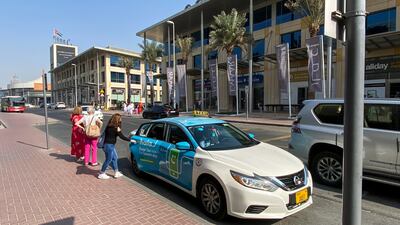
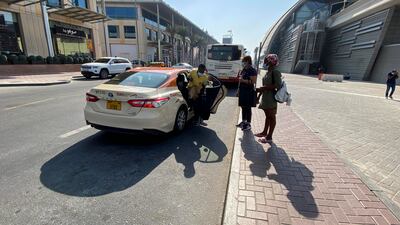
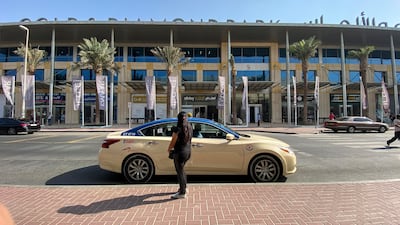
The days of flagging a taxi on the street could be coming to an end in Dubai as transport authorities look to switch to online booking.
Dubai's Roads and Transport Authority’s Hala e-hailing service accounted for almost a third of all taxi trips in the emirate in 2022.
An expanded Hala service accessed using the Careem mobile app could switch 80 per cent of all rides to online hailing in the years ahead as the most efficient way to provide taxi services on the roads.
This step aligns with the worldwide shift in urban transportation planning
Mattar Al Tayer,
the RTA’s Director-General
A transition towards an online booking taxi service should cut waiting times to less than three and a half minutes, and reduce wasted mileage, while cutting fuel consumption and carbon emissions, the RTA said in a press release.
“The expansion of taxi e-hail services, as opposed to street hailing, reinforces the government’s goal of transforming Dubai into the world's smartest city,” said Mattar Al Tayer, the RTA’s Director-General.
“E-hailing has emerged as the most efficient means of matching taxi supply with demand and providing customers with hassle-free, efficient taxi services.
“The service boosts the efficiency of taxi operations in Dubai by streamlining the process of locating and booking rides electronically.”
Launched in 2019, Hala provided 11 per cent of total taxi trips in 2020.
A year later and that number increased to 18 per cent and then to 30 per cent in 2022.
Of the 11,662 taxis operating in Dubai in 2022, 105 million trips were completed in total.
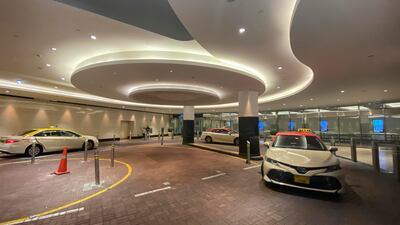
Under the expansion, designated zones reserved for e-hail services will be created alongside extra parking spaces for both street-hail taxis and e-hail vehicles, as well as more parking for taxis in high-demand areas.
In Singapore, 80 per cent of taxi services operate through e-hailing.
Customers there said it had become increasingly difficult to flag down a cab on the street, although that was also due to a shortage of drivers, as well as a migration to online bookings.
In Dubai, as the RTA allocates a dedicated fleet to e-hail services, Hala will be responsible for promoting the service, building a customer base and implementing driver incentives.
“This step aligns with the worldwide shift in urban transportation planning,” said Mr Al Tayer.
“By focusing on improving individual mobility, we can decrease dependence on private cars, foster happiness among residents, deliver outstanding services to visitors and boost customer satisfaction.”
Dubai taxis record surge in passenger numbers — in pictures
UAE currency: the story behind the money in your pockets
Mercer, the investment consulting arm of US services company Marsh & McLennan, expects its wealth division to at least double its assets under management (AUM) in the Middle East as wealth in the region continues to grow despite economic headwinds, a company official said.
Mercer Wealth, which globally has $160 billion in AUM, plans to boost its AUM in the region to $2-$3bn in the next 2-3 years from the present $1bn, said Yasir AbuShaban, a Dubai-based principal with Mercer Wealth.
“Within the next two to three years, we are looking at reaching $2 to $3 billion as a conservative estimate and we do see an opportunity to do so,” said Mr AbuShaban.
Mercer does not directly make investments, but allocates clients’ money they have discretion to, to professional asset managers. They also provide advice to clients.
“We have buying power. We can negotiate on their (client’s) behalf with asset managers to provide them lower fees than they otherwise would have to get on their own,” he added.
Mercer Wealth’s clients include sovereign wealth funds, family offices, and insurance companies among others.
From its office in Dubai, Mercer also looks after Africa, India and Turkey, where they also see opportunity for growth.
Wealth creation in Middle East and Africa (MEA) grew 8.5 per cent to $8.1 trillion last year from $7.5tn in 2015, higher than last year’s global average of 6 per cent and the second-highest growth in a region after Asia-Pacific which grew 9.9 per cent, according to consultancy Boston Consulting Group (BCG). In the region, where wealth grew just 1.9 per cent in 2015 compared with 2014, a pickup in oil prices has helped in wealth generation.
BCG is forecasting MEA wealth will rise to $12tn by 2021, growing at an annual average of 8 per cent.
Drivers of wealth generation in the region will be split evenly between new wealth creation and growth of performance of existing assets, according to BCG.
Another general trend in the region is clients’ looking for a comprehensive approach to investing, according to Mr AbuShaban.
“Institutional investors or some of the families are seeing a slowdown in the available capital they have to invest and in that sense they are looking at optimizing the way they manage their portfolios and making sure they are not investing haphazardly and different parts of their investment are working together,” said Mr AbuShaban.
Some clients also have a higher appetite for risk, given the low interest-rate environment that does not provide enough yield for some institutional investors. These clients are keen to invest in illiquid assets, such as private equity and infrastructure.
“What we have seen is a desire for higher returns in what has been a low-return environment specifically in various fixed income or bonds,” he said.
“In this environment, we have seen a de facto increase in the risk that clients are taking in things like illiquid investments, private equity investments, infrastructure and private debt, those kind of investments were higher illiquidity results in incrementally higher returns.”
The Abu Dhabi Investment Authority, one of the largest sovereign wealth funds, said in its 2016 report that has gradually increased its exposure in direct private equity and private credit transactions, mainly in Asian markets and especially in China and India. The authority’s private equity department focused on structured equities owing to “their defensive characteristics.”
Defence review at a glance
• Increase defence spending to 2.5% of GDP by 2027 but given “turbulent times it may be necessary to go faster”
• Prioritise a shift towards working with AI and autonomous systems
• Invest in the resilience of military space systems.
• Number of active reserves should be increased by 20%
• More F-35 fighter jets required in the next decade
• New “hybrid Navy” with AUKUS submarines and autonomous vessels