


Funding for the education of refugees in the Mena region has suffered as a result of the Russian invasion of Ukraine and subsequent global energy crisis, experts said on Tuesday.
That was the bleak picture painted at a humanitarian conference being held this week at Dubai's World Trade Centre.
“There was limited funding already and it has definitely diverted some funds away from the crisis in the Middle East and left some gaps in the system,” said Dr Sonia Ben Jaafar, chief executive of the Al Ghurair Foundation, a philanthropic education project in the region.
Dr Ben Jaafar explained that in times of emergency, such as the Lebanon blast or the pandemic, donated money is diverted from refugee education.
“I appreciate their [donors'] decision from a strategic point of view but the vulnerable people who are still there don’t have that choice,” she said.
She was speaking to The National on the sidelines of the Dubai International Humanitarian Aid and Development (Dihad) conference.
Abdulaziz Al Ghurair created a fund in 2018, worth Dh120 million ($32.67 million), to provide education programmes in Jordan and Lebanon for refugees. The fund is administered by the Al Ghurair Foundation.
The pot also helps Arab children of families who are living temporarily in the UAE having fled wars and disasters.

Ongoing battle for funding
The challenge to provide education for refugees has been constant throughout the past decade, however, recent events have only exacerbated that task, said Dr Ben Jaafar.
More than 13.7 million children in the world are classed as refugees or said to be seeking asylum, according to the latest figures from Unicef.
Almost 23 million more were internally displaced due to conflict and violence, said the same report.
These were the highest recorded numbers since the Second World War.
Another speaker at the conference said the gaps in education opportunities for refugees, compared to the rest of the global community, were alarming.
“The global population can access secondary education at a rate of around 86 per cent compared to 36 per cent of refugees,” said Aya Shashaa, global vice president of societal impact for Udacity, which provides online learning courses.
“The gap isn’t just relevant to the refugee community. It is relevant to rural and disadvantaged communities within urban areas as well.
“There is a drastic gap in the provision of the right quality of education to different communities in different countries.”
There were 16 million people said to be forcibly displaced or living statelessly in the Mena region, according to the latest report from the UNHCR.
The pandemic also created a seismic challenge for those trying to help educate the most vulnerable sectors of the global community.
Learning poverty was said to have risen by a third in low and middle-income nations during the crisis, according to a report released last year by the World Bank.
This meant an estimated 70 per cent of children aged 10 or under could not understand simple written text.
‘If you look at that global number of 70 per cent of children in learning poverty, you can see that it is a root problem,” said Dr Ben Jaafar.
“If we don’t address it and it continues to grow, we will have a critical mass of young adults who are uneducated and unable to sustain a livelihood.
“If we rob them of those opportunities over the next decade, then I’m not sure how we, as a global community, can look ourselves in the face.”
Syrian refugee children find hope at centre in Jordan's capital - in pictures
-
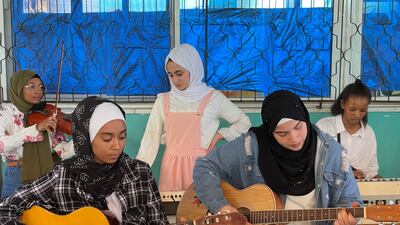
Members of the music band at Makani, an internationally funded learning centre in a low-income district of Amman. All photos: Khaled Yacoub Oweis / The National -
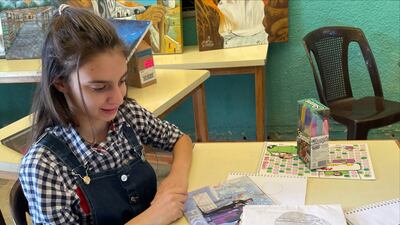
Judi, a Syrian refugee, displays her drawings. -
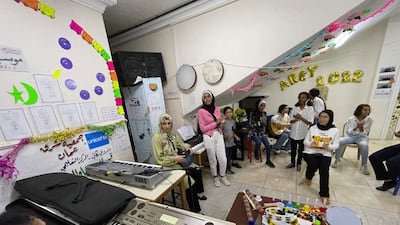
Music students and instructors at Makani. -
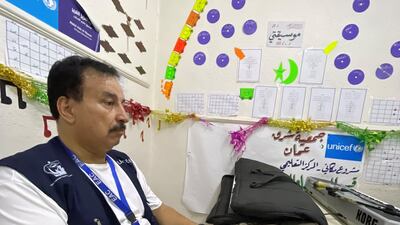
Music teacher Mohammad Brayk, who worked in Saudi Arabia. -

A drawing by one of the Syrian refugees entitled 'I love you, mama'. -
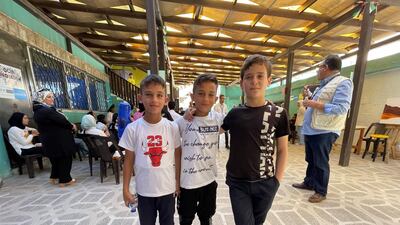
Bilal, a winger from the Syrian city of Homs, and the Jordanian Bakkar twins, who play midfield, often play together at Makani. -
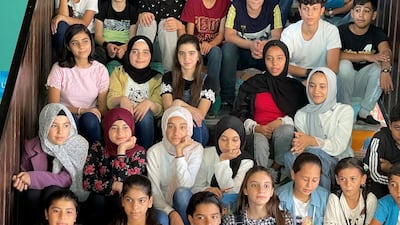
Some of the children served by the centre. -
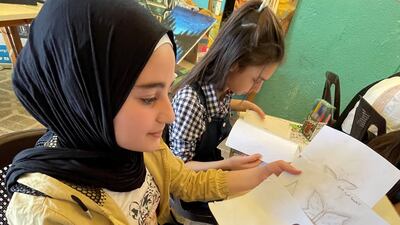
Refugees draw pictures at Makani. -

The entrance to the learning centre.



