

The rare sight of a dying star 15,000 light years away has been captured by Nasa’s James Webb Space Telescope to provide astronomers with valuable scientific insight.
The shimmering purple bloom of a Wolf-Rayet star — one of the biggest and brightest — was one of the first observations made by the space telescope in June last year.
New images have been released at the South by Southwest Conference in Austin, Texas.
“We’ve never seen it like that before. It’s really exciting,” said Macarena Garcia Marin, a European Space Agency scientist who is part of the project.
The huge star is 30 times the size of our Sun and sits in the Sagittarius constellation. Officially known as WR 124, it has already shed enough material to account for 10 suns, according to Nasa.
The telescope’s infrared eyes observed gas and dust flung into space from the hot star as it passes through a brief Wolf-Rayet phase before going supernova and exploding.
The glow from the cosmic dust was picked up by Webb, 15,000 light years in the distance. One light year is around 5.8 trillion miles.
It is not the first time that WR 124 has been spotted from Earth.
The same star was picked up by the Hubble Space Telescope a few decades ago, but appeared more as a fireball without the detail framed by Webb.
Images of WR 124 will help astronomers understand a crucial period in the early history of the universe.
Similar dying stars first seeded the young universe with heavy elements forged in their cores — elements that are now common in the current era, including on Earth.
What is the James Webb Space Telescope?
-
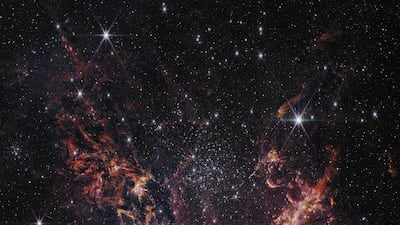
A cluster of stars in the Small Magellanic Cloud in an image taken by the James Webb Space Telescope. PA -
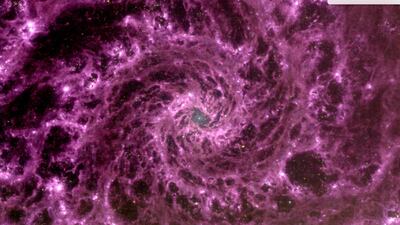
A colour composite image of the Messier 74 galaxy. Photo: Gabriel Brammer (Cosmic Dawn Center, Niels Bohr Institute, University of Copenhagen) / James Webb Space Telescope -
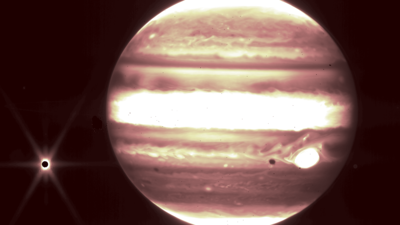
Jupiter and its moon Europa, left, are seen through the James Webb Space Telescope. Photo: Nasa -
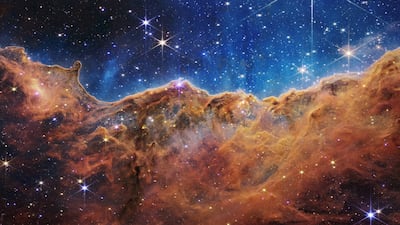
Captured in infrared light by Nasa's new James Webb Space Telescope, this image reveals areas of star birth in Carina Nebula. All photos: James Webb Space Telescope -
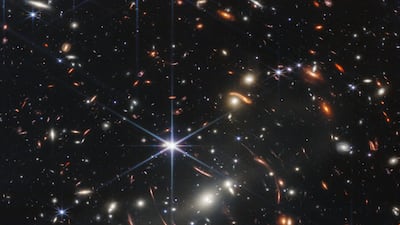
Known as Webb's First Deep Field, the picture showcases a galaxy cluster called SMACS 0723 as it appeared 4.6 billion years ago. The image was revealed by US President Joe Biden on July 11 during an event at the White House. -
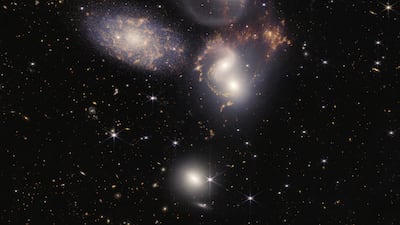
An image of Stephan's Quintet, an area in space with a group of five galaxies. -
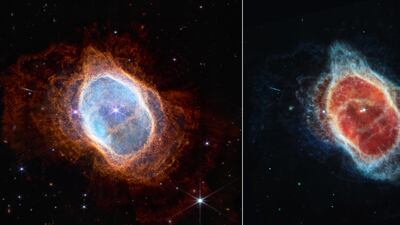
Side-by-side comparison shows observations of the Southern Ring Nebula in near-infrared light (left) and mid-infrared light. -
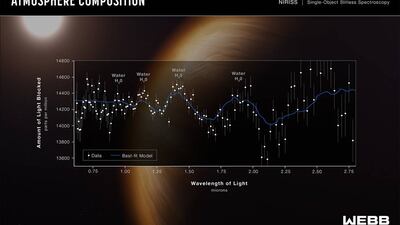
The telescope has captured the distinct signature of water, along with evidence for clouds and haze, in the atmosphere surrounding a hot, puffy gas giant planet orbiting a distant Sun-like star, called WASP-96 b. Photo: James Webb Space Telescope


The James Webb Space Telescope is the largest optical telescope in space, equipped with high-resolution and high-sensitivity instruments to conduct infrared astronomy, allowing objects that were previously too old or far away to be seen.
Among its discoveries, an image beamed back to Earth from the telescope in January last year offered clues about how the first stars were born.
Astronomers believe the image shows a young cluster of stars more than 200,000 light years from Earth, in a dwarf galaxy called the Small Magellanic Cloud, could help shed light on how the first stars formed during the “cosmic noon” period, about two or three billion years after the Big Bang.
That same month, it found an Earthlike exoplanet outside the solar system. The planet, called LHS 475 b, is almost exactly the same size as the Earth.

