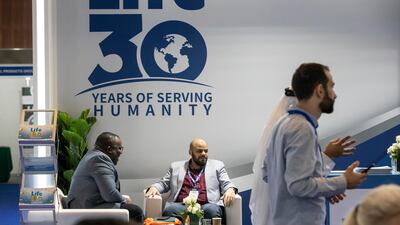
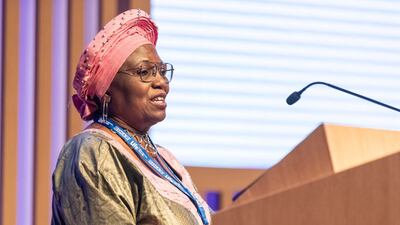
Professor Mukesh Kapila, Global Health and Humanitarian Affairs, University of Manchester and former under-secretary general with the International Federation of Red Cross and Red Crescent Societies (IFRC). Antonie Robertson/The National
Professor Mukesh Kapila, Global Health and Humanitarian Affairs, University of Manchester and former under-secretary general with the International Federation of Red Cross and Red Crescent Societies (

Global energy crisis compounds misery for refugees, Dubai conference hears


Patrick Ryan
  • English
  • Arabic

The global energy crisis has exacerbated the challenges facing humanitarian organisations, a Dubai conference heard on Monday afternoon.

Rising fuel and energy costs have created an environment where the risks to the most vulnerable were amplified, meaning access to basic human needs such as heating, lighting, cooking and sanitation for refugees are being compromised.

“The life support for populations of humanitarian concern is extremely energy intensive,” said Prof Mukesh Kapila, from the University of Manchester and former undersecretary general with the International Federation of Red Cross and Red Crescent Societies (IFRC).

They will often make a fire with whatever rubbish they can find
Prof Mukesh Kapila

Speaking at the Dubai International Humanitarian Aid and Development (Dihad) conference, Prof Kapila said energy was crucial when it came to basic survival.

“There is a danger that the energy crunch caused by the situation between Russia and Ukraine is going to leave people behind.

“Access to basic needs like food, shelter and sanitation is impossible without having consistent and safe energy,” he said.

With the latest UN figures suggesting there are more than 100 million refugees in the world, the crisis could not have come at a worse time, he said at Dubai World Trade Centre on the first day of the conference.

Effect of war on oil prices

Russia’s invasion of Ukraine and sanctions from western countries have led to pressure on oil and petrol supplies.

Petrol prices soared to their highest rate in years during 2022, while the cost of oil surpassed $120 a barrel.

Household energy costs have almost doubled since the invasion began in February last year, according to a study from the World Economic Forum released last month.

The situation is even more dire in sub-Saharan Africa where the costs have almost tripled, according to the same report.

“There is a minimum of 100 million people who are classified as refugees and displaced right now but I believe that’s an underestimation,” said Prof Kapila.

“It’s up to humanitarian agencies to provide relief but the packages being provided are not catching up with what people need.

“It’s estimated that only up to 30 per cent of the energy needed is being provided by humanitarian agencies.”

He warned this has led to a situation where many refugees and displaced people have had to forage for themselves, leading to some desperate decisions.

“One consequence is that a large proportion are missing their meals,” he said.

“In other instances they are eating uncooked or poorly prepared rations and are unable to get the full nutritional value.

“A quarter of the average income of a refugee goes towards sourcing energy requirements.”

Burning toxic materials

Prof Kapila warned that it was not only what was being consumed that was causing problems to the health of refugees.

“Many refugees do not have access to electricity and will make do with whatever they can,” he said.

“They will often make a fire with whatever rubbish they can find, including plastic and rubber which create toxic fumes.”

The World Health Organisation has estimated that 20,000 displaced people die each year from indoor pollution.

The issue with sub-Saharan Africa is compounded by the fact that almost four out of five people there do not have access to electricity, said another expert at Dihad.

“There is an urgent need for greater investment in developing renewable energy resources,” said Yvette Stevens, former director of the UN Office for the Co-ordination of Humanitarian Affairs.

“It is estimated that in Africa alone, some $120 billion a year is required through to 2040 to ensure that all electricity requirements are met.

“Public and private partnerships and investment are crucial in this regard.”

Farasan Boat: 128km Away from Anchorage

Director: Mowaffaq Alobaid 

Stars: Abdulaziz Almadhi, Mohammed Al Akkasi, Ali Al Suhaibani

Rating: 4/5

The specs

Engine: Four electric motors, one at each wheel

Power: 579hp

Torque: 859Nm

Transmission: Single-speed automatic

Price: From Dh825,900

On sale: Now

Tips%20for%20holiday%20homeowners
%3Cp%3EThere%20are%20several%20factors%20for%20landlords%20to%20consider%20when%20preparing%20to%20establish%20a%20holiday%20home%3A%3C%2Fp%3E%0A%3Cul%3E%0A%3Cli%3E%3Cstrong%3ERevenue%20potential%20of%20the%20unit%3A%3C%2Fstrong%3E%20location%2C%20view%20and%20size%3C%2Fli%3E%0A%3Cli%3E%3Cstrong%3EDesign%3A%20furnished%20or%20unfurnished.%3C%2Fstrong%3E%20Is%20the%20design%20up%20to%20standard%2C%20while%20being%20catchy%20at%20the%20same%20time%3F%3C%2Fli%3E%0A%3Cli%3E%3Cstrong%3EBusiness%20model%3A%3C%2Fstrong%3E%20will%20it%20be%20managed%20by%20a%20professional%20operator%20or%20directly%20by%20the%20owner%2C%20how%20often%20does%20the%20owner%20wants%20to%20use%20it%20for%20personal%20reasons%3F%3C%2Fli%3E%0A%3Cli%3E%3Cstrong%3EQuality%20of%20the%20operator%3A%3C%2Fstrong%3E%20guest%20reviews%2C%20customer%20experience%20management%2C%20application%20of%20technology%2C%20average%20utilisation%2C%20scope%20of%20services%20rendered%3C%2Fli%3E%0A%3C%2Ful%3E%0A%3Cp%3E%3Cem%3ESource%3A%20Adam%20Nowak%2C%20managing%20director%20of%20Ultimate%20Stay%20Vacation%20Homes%20Rental%3C%2Fem%3E%3C%2Fp%3E%0A
Sole survivors
  • Cecelia Crocker was on board Northwest Airlines Flight 255 in 1987 when it crashed in Detroit, killing 154 people, including her parents and brother. The plane had hit a light pole on take off
  • George Lamson Jr, from Minnesota, was on a Galaxy Airlines flight that crashed in Reno in 1985, killing 68 people. His entire seat was launched out of the plane
  • Bahia Bakari, then 12, survived when a Yemenia Airways flight crashed near the Comoros in 2009, killing 152. She was found clinging to wreckage after floating in the ocean for 13 hours.
  • Jim Polehinke was the co-pilot and sole survivor of a 2006 Comair flight that crashed in Lexington, Kentucky, killing 49.
While you're here
Terror attacks in Paris, November 13, 2015

- At 9.16pm, three suicide attackers killed one person outside the Atade de France during a foootball match between France and Germany- At 9.25pm, three attackers opened fire on restaurants and cafes over 20 minutes, killing 39 people- Shortly after 9.40pm, three other attackers launched a three-hour raid on the Bataclan, in which 1,500 people had gathered to watch a rock concert. In total, 90 people were killed- Salah Abdeslam, the only survivor of the terrorists, did not directly participate in the attacks, thought to be due to a technical glitch in his suicide vest- He fled to Belgium and was involved in attacks on Brussels in March 2016. He is serving a life sentence in France

What are the main cyber security threats?

Cyber crime - This includes fraud, impersonation, scams and deepfake technology, tactics that are increasingly targeting infrastructure and exploiting human vulnerabilities.
Cyber terrorism - Social media platforms are used to spread radical ideologies, misinformation and disinformation, often with the aim of disrupting critical infrastructure such as power grids.
Cyber warfare - Shaped by geopolitical tension, hostile actors seek to infiltrate and compromise national infrastructure, using one country’s systems as a springboard to launch attacks on others.

Muslim Council of Elders condemns terrorism on religious sites

The Muslim Council of Elders has strongly condemned the criminal attacks on religious sites in Britain.

It firmly rejected “acts of terrorism, which constitute a flagrant violation of the sanctity of houses of worship”.

“Attacking places of worship is a form of terrorism and extremism that threatens peace and stability within societies,” it said.

The council also warned against the rise of hate speech, racism, extremism and Islamophobia. It urged the international community to join efforts to promote tolerance and peaceful coexistence.

Updated: March 14, 2023, 5:48 AM