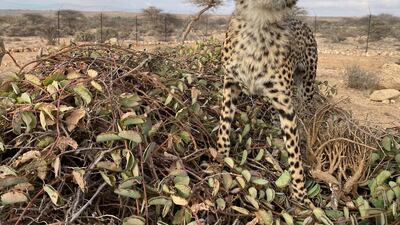
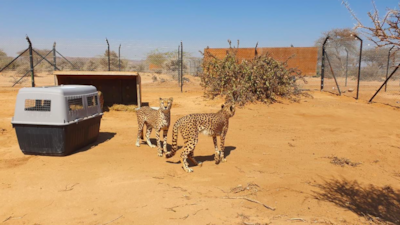
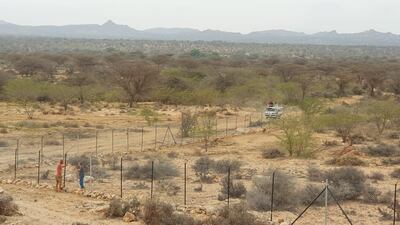
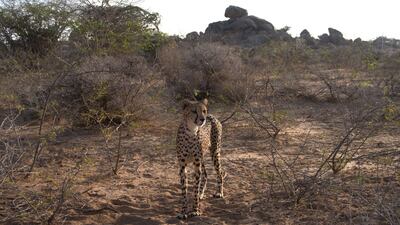
Cheetahs are mostly removed from the wild in the Horn of Africa to supply the illegal pet trade. Photo: Cheetah Conservation Fund

More than 50 cheetahs rescued from illegal trade find new home


Nick Webster
  • English
  • Arabic

More than 50 cheetahs rescued from the illegal wildlife trade have been relocated to a compound in Somaliland, East Africa, amid a report that reveals global demand for exotic pets remains high.

Two siblings — Cizi and Bagheer — brought into the Cheetah Conservation Fund as cubs were rescued by the Somaliland government in 2020 and are among the first to bed down in the Somaliland Cheetah Rescue and Conservation Centre at Geed-Deeble.

The government project, the result of a long-standing partnership with the Cheetah Conservation Fund, is one of the first in East Africa.

The siblings have been joined by 50 other cubs at the 800-hectare site, all rescued from the illegal pet trade in recent months.

A further 37 cheetahs — rescued from traffickers and that are currently in safe houses — will join the compound, that will double as a research and training centre, an hour or so outside of Hargeisa.

  • Fifty-two cheetahs rescued from illegal wildlife trade given new home by Cheetah Conservation Fund and Republic of Somaliland as international report finds demand for illegally sourced wildlife products remains high across the Middle East and wider region.
    Fifty-two cheetahs rescued from illegal wildlife trade given new home by Cheetah Conservation Fund and Republic of Somaliland as international report finds demand for illegally sourced wildlife products remains high across the Middle East and wider region.
  • Two siblings brought into the Cheetah Conservation Fund as cubs were rescued by the Somaliland government in 2020 and among the first to bed down in the Somaliland Cheetah Rescue and Conservation Centre (CRCC) at Geed-Deeble.
    Two siblings brought into the Cheetah Conservation Fund as cubs were rescued by the Somaliland government in 2020 and among the first to bed down in the Somaliland Cheetah Rescue and Conservation Centre (CRCC) at Geed-Deeble.
  • The Somaliland Cheetah Rescue and Conservation Centre (CRCC) at Geed-Deeble is one of the first projects of its kind in East Africa.
    The Somaliland Cheetah Rescue and Conservation Centre (CRCC) at Geed-Deeble is one of the first projects of its kind in East Africa.
  • A further 37 cheetahs rescued from traffickers currently in safe houses will join the compound, that will double as a research and training centre, an hour or so outside of Hargeisa.
    A further 37 cheetahs rescued from traffickers currently in safe houses will join the compound, that will double as a research and training centre, an hour or so outside of Hargeisa.
  • Since 2011, CCF has been assisting the government of Somaliland in caring for cheetahs intercepted from traffickers.
    Since 2011, CCF has been assisting the government of Somaliland in caring for cheetahs intercepted from traffickers.

“We are exceptionally pleased with the results of the move,” said Dr Laurie Marker, founder and executive director of the Cheetah Conservation Fund.

“The cubs we moved stayed in their large management enclosures for a day or two to acclimatise them to their new area.

“Then their keepers watched happily as they were released into their spacious enclosures and [they] have since settled in very well.”

Cheetahs, listed as an Appendix 1 species under the Convention for International Trade in Endangered Species, are mostly removed from the wild in the Horn of Africa to supply the illegal pet trade.

Since 2011, the Cheetah Conservation Fund has been assisting the government of Somaliland in caring for cheetahs intercepted from traffickers.

A recent report from the Counter Extremism Project (CEP), a non-profit NGO that monitors revenue streams for terrorism and extremism, found illegal wildlife trafficking was experiencing a post-pandemic resurgence.

The illegal trade in animals and their body parts has grown to an estimated annual value of up to $23 billion, devastating animal populations and driving species such as the elephant, rhinoceros and cheetah towards extinction.

The CEP’s Extinction Inc report showed how poachers and smugglers rapidly adapted during the pandemic, exploiting tourist-free national parks while moving marketing and sales online.

The onset of Covid-19 crippled national park budgets, limiting the number of bush rangers in place to protect wildlife.

In Garamba National Park, a 5,000-square-kilometre plot in the Democratic Republic of Congo, 25 per cent of rangers had at one point lost their jobs, a familiar pattern seen across Africa.

“Gangs of ivory poachers and porters cross the border with Cameroon, working directly for larger scale traffickers,” Lee White, Gabon's Minister of Water, Forests, the Sea and Environment, told the report’s authors.

“A small number of individuals control the large trafficking networks. Some of these feed money to extremist groups.”

Globalisation fuels smuggling

Anti-smuggling efforts are being completely overwhelmed by the huge growth of international trade and passenger traffic.

In 2019, one million wildlife products were seized at airports around the world, with half plucked from hand luggage.

Ivory trafficking routes from Zimbabwe include couriers flying from Harare to Hong Kong, with ivory hidden inside purpose-made vests and luggage, the report said.

Smuggled goods from the illegal trade are becoming increasingly difficult to monitor.

Global maritime trade has almost tripled since 1990, from four billion tonnes to more than 11 billion in 2021, with similar growth expected over the next 25 years.

Fifty-two cheetahs rescued from illegal wildlife trade given new home by Cheetah Conservation Fund.

Analysis in the CEP report found that only 10 per cent of shipping containers were inspected by operators, while about 2 per cent of all freight was checked by global port authorities.

Despite the challenges, gains are being made.

A month-long Interpol operation in October 2022 resulted in 2,200 separate seizures and the identification of 934 suspects and 141 companies involved in illegal wildlife trafficking.

Aside from financing extremism, the illicit transfer of animal products represents a major entry point for zoonotic diseases that can pass from animals to humans.

According to the US Centres for Disease Control, three in four new or emerging infectious diseases are zoonotic.

“The effect of the Covid-19 pandemic has been difficult to analyse,” said Trang Nguyen, executive director at WildAct, in the CEP report.

“There has been a reduction in cross-border trade. But domestically, wildlife crime has not decreased at all — and may have even increased.”


21 Lessons for the 21st Century

Yuval Noah Harari, Jonathan Cape
 

Company Profile

Name: Thndr
Started: 2019
Co-founders: Ahmad Hammouda and Seif Amr
Sector: FinTech
Headquarters: Egypt
UAE base: Hub71, Abu Dhabi
Current number of staff: More than 150
Funds raised: $22 million

Real estate tokenisation project

Dubai launched the pilot phase of its real estate tokenisation project last month.

The initiative focuses on converting real estate assets into digital tokens recorded on blockchain technology and helps in streamlining the process of buying, selling and investing, the Dubai Land Department said.

Dubai’s real estate tokenisation market is projected to reach Dh60 billion ($16.33 billion) by 2033, representing 7 per cent of the emirate’s total property transactions, according to the DLD.

Mercer, the investment consulting arm of US services company Marsh & McLennan, expects its wealth division to at least double its assets under management (AUM) in the Middle East as wealth in the region continues to grow despite economic headwinds, a company official said.

Mercer Wealth, which globally has $160 billion in AUM, plans to boost its AUM in the region to $2-$3bn in the next 2-3 years from the present $1bn, said Yasir AbuShaban, a Dubai-based principal with Mercer Wealth.

Within the next two to three years, we are looking at reaching $2 to $3 billion as a conservative estimate and we do see an opportunity to do so,” said Mr AbuShaban.

Mercer does not directly make investments, but allocates clients’ money they have discretion to, to professional asset managers. They also provide advice to clients.

“We have buying power. We can negotiate on their (client’s) behalf with asset managers to provide them lower fees than they otherwise would have to get on their own,” he added.

Mercer Wealth’s clients include sovereign wealth funds, family offices, and insurance companies among others.

From its office in Dubai, Mercer also looks after Africa, India and Turkey, where they also see opportunity for growth.

Wealth creation in Middle East and Africa (MEA) grew 8.5 per cent to $8.1 trillion last year from $7.5tn in 2015, higher than last year’s global average of 6 per cent and the second-highest growth in a region after Asia-Pacific which grew 9.9 per cent, according to consultancy Boston Consulting Group (BCG). In the region, where wealth grew just 1.9 per cent in 2015 compared with 2014, a pickup in oil prices has helped in wealth generation.

BCG is forecasting MEA wealth will rise to $12tn by 2021, growing at an annual average of 8 per cent.

Drivers of wealth generation in the region will be split evenly between new wealth creation and growth of performance of existing assets, according to BCG.

Another general trend in the region is clients’ looking for a comprehensive approach to investing, according to Mr AbuShaban.

“Institutional investors or some of the families are seeing a slowdown in the available capital they have to invest and in that sense they are looking at optimizing the way they manage their portfolios and making sure they are not investing haphazardly and different parts of their investment are working together,” said Mr AbuShaban.

Some clients also have a higher appetite for risk, given the low interest-rate environment that does not provide enough yield for some institutional investors. These clients are keen to invest in illiquid assets, such as private equity and infrastructure.

“What we have seen is a desire for higher returns in what has been a low-return environment specifically in various fixed income or bonds,” he said.

“In this environment, we have seen a de facto increase in the risk that clients are taking in things like illiquid investments, private equity investments, infrastructure and private debt, those kind of investments were higher illiquidity results in incrementally higher returns.”

The Abu Dhabi Investment Authority, one of the largest sovereign wealth funds, said in its 2016 report that has gradually increased its exposure in direct private equity and private credit transactions, mainly in Asian markets and especially in China and India. The authority’s private equity department focused on structured equities owing to “their defensive characteristics.”

WRESTLING HIGHLIGHTS
THE SPECS

Engine: 1.5-litre turbocharged four-cylinder

Transmission: Constant Variable (CVT)

Power: 141bhp 

Torque: 250Nm 

Price: Dh64,500

On sale: Now

Updated: March 12, 2023, 8:45 AM