• Spending time in space for an extended period of time can lead to stresses and strains on body and mind beyond those faced on Earth. All photos: Nasa
    Spending time in space for an extended period of time can lead to stresses and strains on body and mind beyond those faced on Earth. All photos: Nasa
  • Astronauts lose muscle mass in space because the lack of gravity makes tasks less physically demanding
    Astronauts lose muscle mass in space because the lack of gravity makes tasks less physically demanding
  • Normal exercise equipment relies on gravity, but on the ISS, the astronauts push against what are, in effect, large springs
    Normal exercise equipment relies on gravity, but on the ISS, the astronauts push against what are, in effect, large springs
  • Expedition 36 flight engineer Karen Nyberg washes her hair in space in 2013
    Expedition 36 flight engineer Karen Nyberg washes her hair in space in 2013
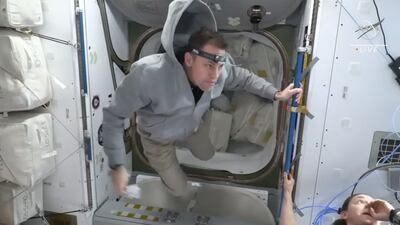
  • Mark Vande Hei swaps over components on an advanced new toilet installed inside the ISS Tranquility module, believed to be the most expensive toilet ever assembled
    Mark Vande Hei swaps over components on an advanced new toilet installed inside the ISS Tranquility module, believed to be the most expensive toilet ever assembled
  • Expedition 50 crew members celebrate Thanksgiving in space in November 2016, with rehydrated food
    Expedition 50 crew members celebrate Thanksgiving in space in November 2016, with rehydrated food
  • Nasa astronaut Kjell Lindgren poses for a portrait inside a crew sleeping bag on the ISS
    Nasa astronaut Kjell Lindgren poses for a portrait inside a crew sleeping bag on the ISS
  • Expedition 66 crew members gather for a Thanksgiving meal inside the ISS Unity module
    Expedition 66 crew members gather for a Thanksgiving meal inside the ISS Unity module
  • Science conducted on the ISS offers researchers an unparalleled opportunity to test physical processes in the absence of gravity
    Science conducted on the ISS offers researchers an unparalleled opportunity to test physical processes in the absence of gravity

How spending time in space poses challenges for body and mind


Daniel Bardsley
  • English
  • Arabic

When Emirati astronaut Sultan Al Neyadi took off on Thursday for the International Space Station, he began an adventure of the kind only a select few ever experience.

But while his time in space will no doubt be exciting, it will pose stresses and strains on body and mind beyond those faced on planet Earth.

For example, astronauts have been shown to lose muscle mass during space flight because the lack of gravity makes tasks less physically demanding.

When you come back to Earth, your body has to readjust how it maintains blood pressure
Nathaniel Szewczyk,
Ohio University

“The new astronaut will expect to lose a very substantial proportion of the mass of muscles,” said Malcolm Jackson, of the University of Liverpool in the UK, who has studied cultured muscle cells sent up to the International Space Station.

“It will start within a few days. That happens despite the fact that the astronauts all have to undertake two hours [of exercise] on the space station each day.

“When they went to the Moon, it was about a two-week trip and when they came back, they had to be lifted from their capsule and were very wobbly.”

Dr Jackson’s work has shown that microgravity on the ISS causes muscle cells to undergo a process akin to accelerated ageing.

Maintain conditioning

Much like professional sportspeople, astronauts have nutritionists and exercise coaches to advise them on how to maintain conditioning.

Normal exercise equipment relies on gravity, but on the ISS, the astronauts push against what are, in effect, large springs, Dr Jackson said.

Tim Peake, the British astronaut who spent six months on the ISS, reported that the soles of his feet become “very smooth and soft” because they are hardly used, while the skin on the tops of the toes hardens because it is often employed by astronauts to hold them down or grab handrails.

British astronaut Tim Peake described how his muscles returned to normal over a matter of weeks. Photo: Picasa

Exercise equipment can be bulky, so while it can be accommodated on the ISS, there may be issues with other missions, said Nathaniel Szewczyk of Ohio University in the US, who is also an emeritus professor of space biology at the University of Nottingham in the UK.

“The challenges of proper nutrition and proper activity will become emergent problems as we talk about the Moon and Mars,” he said

On their return to Earth, Dr Szewczyk said astronauts often experienced problems with the vestibular system, which controls balance and spatial orientation. This can cause dizziness and difficulty in standing up, walking and turning corners. Blood pressure may also be affected by the lack of gravity.

“In space, it tends to not have that gravity pull; it tends to accumulate a bit in the head. When you come back to Earth, your body has to readjust how it maintains blood pressure,” Dr Szewczyk said.

Balance and blood pressure issues may only last a couple of days after returning to Earth, but hand-eye co-ordination may take longer to return to normal. Tim Peake said his muscles returned to normal over a matter of weeks.

Professor Nathaniel Szewczyk of Ohio University

Vision may be affected by being in space because of “quite significant fluid shifts around the eye”, Dr Jackson said.

Microgravity also causes bone mineral density to fall by between 1 per cent and 2 per cent per month, which could pose particular difficulties for longer missions, with astronauts potentially at greater risk of breakages on returning.

Many of the ways in which being in space affects the body happen because of changes to mitochondria, the tiny, energy-producing structures in the cell.

Dr Jackson described the mitochondria as almost like gravity sensors, and it could be their interactions with the cytoskeleton of cells — the network of protein tubules and filaments that give cells their structure — that causes the larger body to be affected by microgravity.

“That’s one of the things we’re trying to [analyse] in another study — the maintaining of tension. It may lead to ways of thinking about how we could prevent these changes and it may have relevance to ageing on Earth,” he said.

Four phases

Space travel does not affect only the body — there are impacts on the mind too, even though astronauts undergo a rigorous psychological assessment before selection.

Astronauts typically experience four phases during a mission, said Patrick Stacey, a senior lecturer in information management at Loughborough University in the UK, who researches mental and emotional health in space.

The arrival phase may involve difficulties sleeping, irritability and nausea, but this is succeeded by the performing phase, when astronauts begin to operate at a high level as they carry out the various experiments they are responsible for.

However, eventually, perhaps after months, the enduring phase begins, in which morale falls and astronauts may wonder when they are going to see their families again, Dr Stacey said.

“It’s well documented — the third phase is [associated with] low morale, which could affect productivity, but it’s not documented the extent to which it does,” he said.

Fortunately, mood tends to pick up in the leaving phase, when astronauts look forward to seeing their relatives again and being back on Earth.

Efforts are made to promote mental well-being during missions, with astronauts typically having a discussion with a psychologist every two or three weeks, Dr Stacey said.

“They can call their family every few weeks or so, but the family cannot call them,” he added.

In previous missions, there has been tension when astronauts have voiced complaints to one another about their life in space, so now they are strongly encouraged to write down concerns in journals instead of saying them aloud.

Sometimes astronauts have struggled on returning to Earth, among them Buzz Aldrin, who became depressed and experienced alcoholism, and Lisa Nowak, who attacked a woman her ex-boyfriend had become involved with.

Dr Stacey said stress could build up during missions and come out later in these ways, highlighting the importance of using journals to “vent”.

SpaceX Falcon 9 rocket launches into space — in pictures

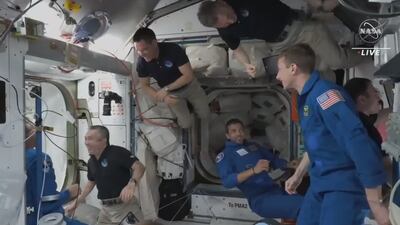
  • UAE astronaut Sultan Al Neyadi enters the International Space Station for the first time, on Friday. Photo: Nasa
    UAE astronaut Sultan Al Neyadi enters the International Space Station for the first time, on Friday. Photo: Nasa
  • Dr Al Neyadi helps his fellow astronauts as they prepare to enter the space station. Photo: Nasa
    Dr Al Neyadi helps his fellow astronauts as they prepare to enter the space station. Photo: Nasa
  • Astronauts already on board the ISS prepare to receive the SpaceX Crew-6 astronauts. Photo: Nasa
    Astronauts already on board the ISS prepare to receive the SpaceX Crew-6 astronauts. Photo: Nasa
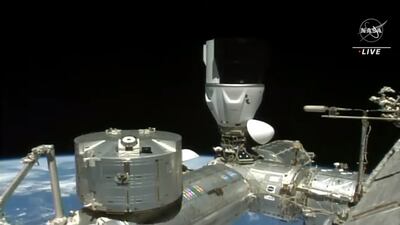
  • The Dragon capsule docks on the ISS. Photo: Nasa
    The Dragon capsule docks on the ISS. Photo: Nasa
  • The capsule approaches the space station for docking. Photo: Nasa
    The capsule approaches the space station for docking. Photo: Nasa
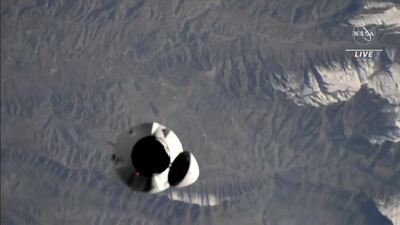
  • The capsule as seen from the ISS. Photo: Nasa
    The capsule as seen from the ISS. Photo: Nasa
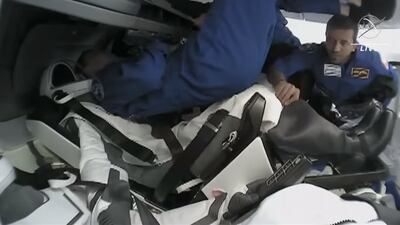
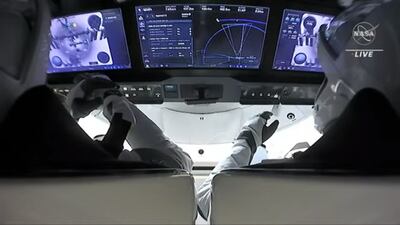
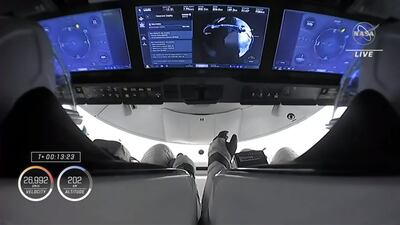
  • The astronauts watch the docking process on their screens inside the Dragon capsule. Photo: Nasa
    The astronauts watch the docking process on their screens inside the Dragon capsule. Photo: Nasa
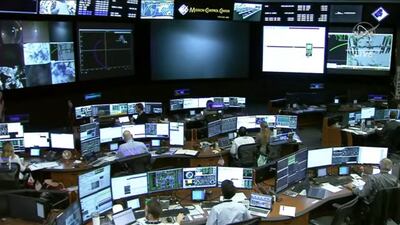
  • The SpaceX mission control room. Photo: Nasa
    The SpaceX mission control room. Photo: Nasa
  • The Dragon capsule during 'Waypoint 1' of its approach to the space station. Photo: Nasa
    The Dragon capsule during 'Waypoint 1' of its approach to the space station. Photo: Nasa
  • A photo taken from the space station shows the capsule above Earth. Photo: Nasa
    A photo taken from the space station shows the capsule above Earth. Photo: Nasa
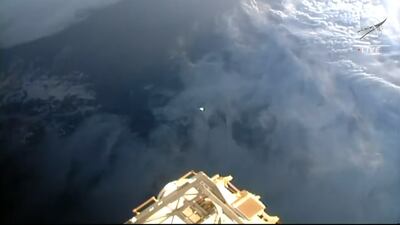
  • The ISS as seen from the capsule. Photo: Nasa
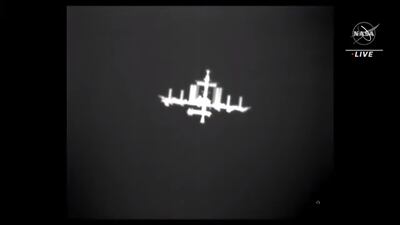
    The ISS as seen from the capsule. Photo: Nasa
  • The SpaceX Falcon 9 rocket lifts off from Nasa's Kennedy Space Centre in Cape Canaveral, Florida. AFP
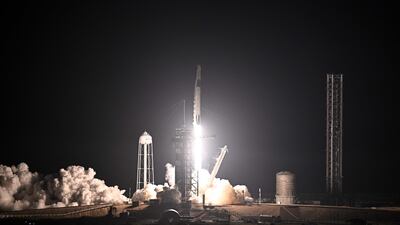
    The SpaceX Falcon 9 rocket lifts off from Nasa's Kennedy Space Centre in Cape Canaveral, Florida. AFP
  • Skies above the Kennedy Space Centre lit up after the rocket lifted off. Photo: nasa
    Skies above the Kennedy Space Centre lit up after the rocket lifted off. Photo: nasa
  • A long exposure shot of the rocket hurtling towards space. AFP
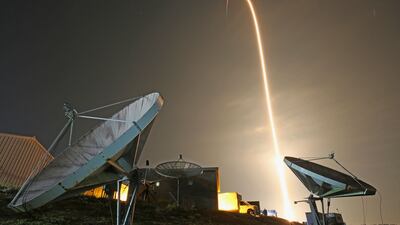
    A long exposure shot of the rocket hurtling towards space. AFP
  • The Crew-6 astronauts in zero gravity after launch. Photo: NASA
    The Crew-6 astronauts in zero gravity after launch. Photo: NASA
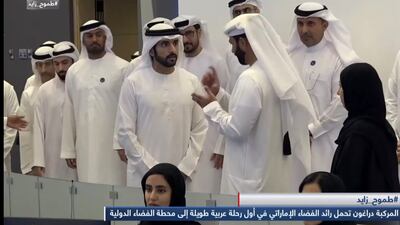
  • Sheikh Hamdan bin Mohammed, Crown Prince of Dubai, watches from the Mohammed bin Rashid Space Centre as the Falcon 9 rocket lifts off . Photo: Dubai Media Office
    Sheikh Hamdan bin Mohammed, Crown Prince of Dubai, watches from the Mohammed bin Rashid Space Centre as the Falcon 9 rocket lifts off . Photo: Dubai Media Office
  • Sheikh Hamdan watches as the rocket carrying Dr Al Neyadi makes its way. Photo: Dubai Media Office
    Sheikh Hamdan watches as the rocket carrying Dr Al Neyadi makes its way. Photo: Dubai Media Office
  • The crew monitoring their operation screens. Photo: NASA
    The crew monitoring their operation screens. Photo: NASA
  • The rear capsule. Photo: NASA
    The rear capsule. Photo: NASA
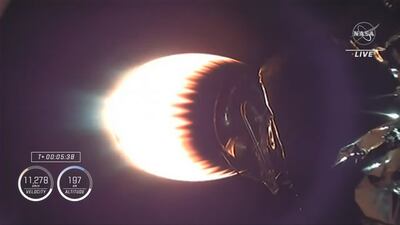
  • The rocket firing. Photo: NASA
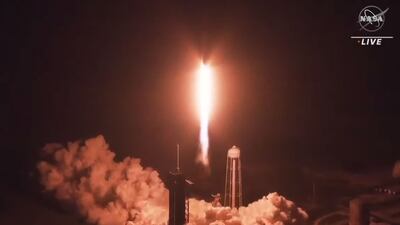
    The rocket firing. Photo: NASA
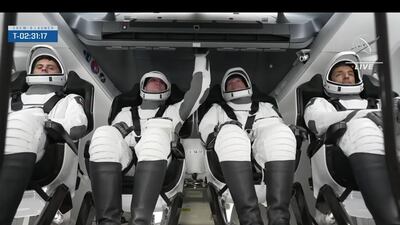
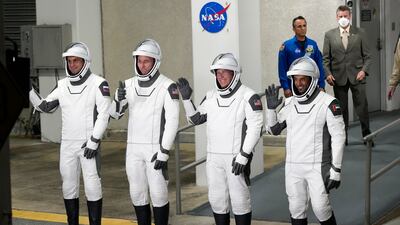
  • Russian cosmonaut Andrey Fedyaev, Nasa astronauts Warren Hoburg and Stephen Bowen, and the UAE's Dr Al Neyadi moments before blast-off. Photo: Nasa
    Russian cosmonaut Andrey Fedyaev, Nasa astronauts Warren Hoburg and Stephen Bowen, and the UAE's Dr Al Neyadi moments before blast-off. Photo: Nasa
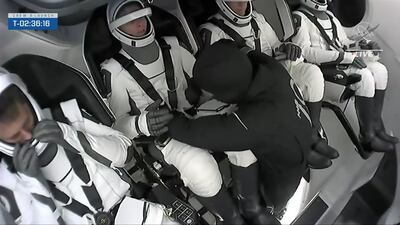
  • Ground teams prepare the astronauts for launch. Photo: Nasa
    Ground teams prepare the astronauts for launch. Photo: Nasa
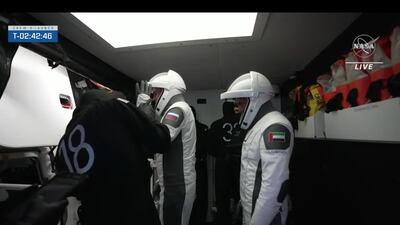
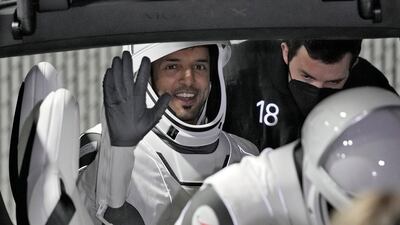
  • Dr Al Neyadi prepares to board the spacecraft. Photo: Nasa
    Dr Al Neyadi prepares to board the spacecraft. Photo: Nasa
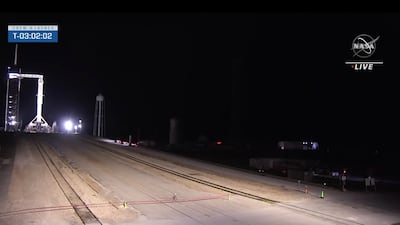
  • The cars carrying the astronauts approach the launchpad at the Kennedy Space Centre in Cape Canaveral, Florida. Photo: Nasa
    The cars carrying the astronauts approach the launchpad at the Kennedy Space Centre in Cape Canaveral, Florida. Photo: Nasa
  • Maj Fedyaev, Dr Hoburg and Capt Bowen, and Dr Al Neyadi head to the launch pad. AP
    Maj Fedyaev, Dr Hoburg and Capt Bowen, and Dr Al Neyadi head to the launch pad. AP
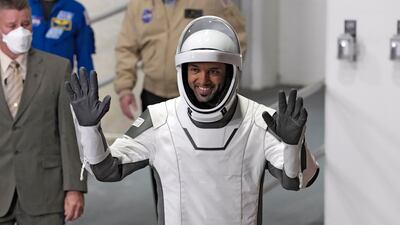
  • Dr Al Neyadi waves to family members. AP
    Dr Al Neyadi waves to family members. AP
  • Dr Al Neyadi said he was ready to see space this morning as the Crew-6 astronauts prepared to board. AP
    Dr Al Neyadi said he was ready to see space this morning as the Crew-6 astronauts prepared to board. AP
  • UAE astronaut Hazza Al Mansouri arrives at the space centre to watch the launch. Sarwat Nasir / The National
    UAE astronaut Hazza Al Mansouri arrives at the space centre to watch the launch. Sarwat Nasir / The National
  • Adnan Al Rais, manager of the UAE's second mission to the International Space Station, at the space centre. Sarwat Nasir / The National
    Adnan Al Rais, manager of the UAE's second mission to the International Space Station, at the space centre. Sarwat Nasir / The National
Abu Dhabi GP schedule

Friday: First practice - 1pm; Second practice - 5pm

Saturday: Final practice - 2pm; Qualifying - 5pm

Sunday: Etihad Airways Abu Dhabi Grand Prix (55 laps) - 5.10pm

What%20is%20cystic%20fibrosis%3F
%3Cul%3E%0A%3Cli%3ECystic%20fibrosis%20is%20a%20genetic%20disorder%20that%20affects%20the%20lungs%2C%20pancreas%20and%20other%20organs.%3C%2Fli%3E%0A%3Cli%3EIt%20causes%20the%20production%20of%20thick%2C%20sticky%20mucus%20that%20can%20clog%20the%20airways%20and%20lead%20to%20severe%20respiratory%20and%20digestive%20problems.%3C%2Fli%3E%0A%3Cli%3EPatients%20with%20the%20condition%20are%20prone%20to%20lung%20infections%20and%20often%20suffer%20from%20chronic%20coughing%2C%20wheezing%20and%20shortness%20of%20breath.%3C%2Fli%3E%0A%3Cli%3ELife%20expectancy%20for%20sufferers%20of%20cystic%20fibrosis%20is%20now%20around%2050%20years.%3C%2Fli%3E%0A%3C%2Ful%3E%0A
TEAMS

EUROPE:
Justin Rose, Francesco Molinari, Tyrrell Hatton, Tommy Fleetwood, Jon Rahm, Rory McIlroy, Alex Noren, Thorbjorn Olesen, Paul Casey, Sergio Garcia, Ian Poulter, Henrik Stenson

USA:
Brooks Koepka, Justin Thomas, Dustin Johnson, Patrick Reed, Bubba Watson, Jordan Spieth,​​​​​​​ Rickie Fowler, Webb Simpson, Tiger Woods, Phil Mickelson, Bryson DeChambeau ( 1 TBC)

STAGE 4 RESULTS

1 Sam Bennett (IRL) Deceuninck-QuickStep - 4:51:51

2 David Dekker (NED) Team Jumbo-Visma

3 Caleb Ewan (AUS) Lotto Soudal 

4 Elia Viviani (ITA) Cofidis

5 Matteo Moschetti (ITA) Trek-Segafredo

General Classification

1 Tadej Pogacar (SLO) UAE Team Emirates - 12:50:21

2 Adam Yates (GBR) Teamn Ineos Grenadiers - 0:00:43

3 Joao Almeida (POR) Deceuninck-QuickStep - 0:01:03

4 Chris Harper (AUS) Jumbo-Visma - 0:01:43

5 Neilson Powless (USA) EF Education-Nippo - 0:01:45

THE BIO

Ms Al Ameri likes the variety of her job, and the daily environmental challenges she is presented with.

Regular contact with wildlife is the most appealing part of her role at the Environment Agency Abu Dhabi.

She loves to explore new destinations and lives by her motto of being a voice in the world, and not an echo.

She is the youngest of three children, and has a brother and sister.

Her favourite book, Moby Dick by Herman Melville helped inspire her towards a career exploring  the natural world.

Mercer, the investment consulting arm of US services company Marsh & McLennan, expects its wealth division to at least double its assets under management (AUM) in the Middle East as wealth in the region continues to grow despite economic headwinds, a company official said.

Mercer Wealth, which globally has $160 billion in AUM, plans to boost its AUM in the region to $2-$3bn in the next 2-3 years from the present $1bn, said Yasir AbuShaban, a Dubai-based principal with Mercer Wealth.

Within the next two to three years, we are looking at reaching $2 to $3 billion as a conservative estimate and we do see an opportunity to do so,” said Mr AbuShaban.

Mercer does not directly make investments, but allocates clients’ money they have discretion to, to professional asset managers. They also provide advice to clients.

“We have buying power. We can negotiate on their (client’s) behalf with asset managers to provide them lower fees than they otherwise would have to get on their own,” he added.

Mercer Wealth’s clients include sovereign wealth funds, family offices, and insurance companies among others.

From its office in Dubai, Mercer also looks after Africa, India and Turkey, where they also see opportunity for growth.

Wealth creation in Middle East and Africa (MEA) grew 8.5 per cent to $8.1 trillion last year from $7.5tn in 2015, higher than last year’s global average of 6 per cent and the second-highest growth in a region after Asia-Pacific which grew 9.9 per cent, according to consultancy Boston Consulting Group (BCG). In the region, where wealth grew just 1.9 per cent in 2015 compared with 2014, a pickup in oil prices has helped in wealth generation.

BCG is forecasting MEA wealth will rise to $12tn by 2021, growing at an annual average of 8 per cent.

Drivers of wealth generation in the region will be split evenly between new wealth creation and growth of performance of existing assets, according to BCG.

Another general trend in the region is clients’ looking for a comprehensive approach to investing, according to Mr AbuShaban.

“Institutional investors or some of the families are seeing a slowdown in the available capital they have to invest and in that sense they are looking at optimizing the way they manage their portfolios and making sure they are not investing haphazardly and different parts of their investment are working together,” said Mr AbuShaban.

Some clients also have a higher appetite for risk, given the low interest-rate environment that does not provide enough yield for some institutional investors. These clients are keen to invest in illiquid assets, such as private equity and infrastructure.

“What we have seen is a desire for higher returns in what has been a low-return environment specifically in various fixed income or bonds,” he said.

“In this environment, we have seen a de facto increase in the risk that clients are taking in things like illiquid investments, private equity investments, infrastructure and private debt, those kind of investments were higher illiquidity results in incrementally higher returns.”

The Abu Dhabi Investment Authority, one of the largest sovereign wealth funds, said in its 2016 report that has gradually increased its exposure in direct private equity and private credit transactions, mainly in Asian markets and especially in China and India. The authority’s private equity department focused on structured equities owing to “their defensive characteristics.”

HOW TO WATCH

Facebook: TheNationalNews 

Twitter: @thenationalnews 

Instagram: @thenationalnews.com 

TikTok: @thenationalnews   

INFO

Everton 0

Arsenal 0

Man of the Match: Djibril Sidibe (Everton)

FIXTURES

Thursday
Dibba v Al Dhafra, Fujairah Stadium (5pm)
Al Wahda v Hatta, Al Nahyan Stadium (8pm)

Friday
Al Nasr v Ajman, Zabeel Stadium (5pm)
Al Jazria v Al Wasl, Mohammed Bin Zayed Stadium (8pm)

Saturday
Emirates v Al Ain, Emirates Club Stadium (5pm)
Sharjah v Shabab Al Ahli Dubai, Sharjah Stadium (8pm)

COMPANY%20PROFILE
%3Cp%3E%3Cstrong%3EName%3A%20%3C%2Fstrong%3EKinetic%207%3Cbr%3E%3Cstrong%3EStarted%3A%3C%2Fstrong%3E%202018%3Cbr%3E%3Cstrong%3EFounder%3A%3C%2Fstrong%3E%20Rick%20Parish%3Cbr%3E%3Cstrong%3EBased%3A%3C%2Fstrong%3E%20Abu%20Dhabi%2C%20UAE%3Cbr%3E%3Cstrong%3EIndustry%3A%3C%2Fstrong%3E%20Clean%20cooking%3Cbr%3E%3Cstrong%3EFunding%3A%3C%2Fstrong%3E%20%2410%20million%3Cbr%3E%3Cstrong%3EInvestors%3A%3C%2Fstrong%3E%20Self-funded%3C%2Fp%3E%0A
if you go

The flights
Emirates flies to Delhi with fares starting from around Dh760 return, while Etihad fares cost about Dh783 return. From Delhi, there are connecting flights to Lucknow. 
Where to stay
It is advisable to stay in Lucknow and make a day trip to Kannauj. A stay at the Lebua Lucknow hotel, a traditional Lucknowi mansion, is recommended. Prices start from Dh300 per night (excluding taxes). 

Crops that could be introduced to the UAE

1: Quinoa 

2. Bathua 

3. Amaranth 

4. Pearl and finger millet 

5. Sorghum

Updated: March 05, 2023, 8:17 AM