



After a week of gruelling tasks, the UAE Swat Challenge 2023 has shown it takes a special kind of grit to become a member of such an elite team.
Held at Dubai Police training centre at Al Ruwayyah, the competition required more than just the strength to fight an armed criminal or abseil from the top of tall buildings. Participants needed to show they had the special skills that would help save lives.
In the competition, where Dubai Police's team came second to participants from Russia, groups of specially trained police officers had to show they are equipped to deal with dangerous or violent situations, while also display an exceptional level of physical fitness.
The National spoke to members of special weapons and tactics units to find out what it takes to become part of the team.
Physical abilities a must
Fernando Camargos, 44, said the Brazilian federal swat unit trains six days a week for a minimum of four hours a day.
The physical training usually includes swimming, running and weight lifting.
“Normally on Sundays, if not resting, we take it a little easier by doing some recovery training,” he told The National.
“Physical training is a must. Part of our working hours is dedicated to physical training and tactical training.
“There is some guided training, like cross-fit workouts, but each operator has the flexibility to include training they believe they need.”
They also do two hours of tactical training every day to sharpen their skills in shooting, close-quarter combat, urban patrol and vertical techniques.
Officers are encouraged to eat healthily but are not forced to go on diets.
“Myself, as an example, I don't drink. I am 44 so I believe that's better for my body, but the younger guys may do differently,” he said.
While the exact requirements differ from one team to another, having supreme physical ability is a must.
“Muscles are not important ― it's the overall physical shape, flexibility and endurance that matter,” said Lt Jasim Mohammed from Sharjah Police.
Officers in Sharjah train for four hours a day, which includes a five-kilometre run.
“Beginners must go on strict diets that are different for each based on their bodies' needs,” Lt Mohammed said.
For officers in Abu Dhabi, as well as adhering to a strict diet, they must carry heavy gear and run 3.2km every morning.
“They can’t have soft drinks or sugary food for example,” said First Asst Ahmad Al Kaabi from Abu Dhabi Police’s swat unit.
_____________________________________
UAE Swat Challenge — in pictures
-

Brazilian commando Matias shows the scars of battle after a career fighting crime. All photos: Antonie Robertson / The National -

The South African task force take part in the second day of the UAE Swat Challenge -
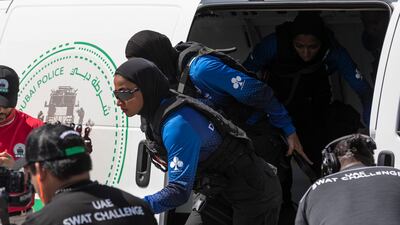
Dubai Police's all-women team are put to the test -

Fernando Camargos, part of Brazil's federal Swat unit -
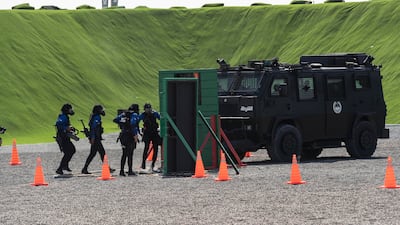
Dubai Police's female squad at the UAE Swat Challenge, which is being held at the force's training centre in Al Rowaiyah until Friday -
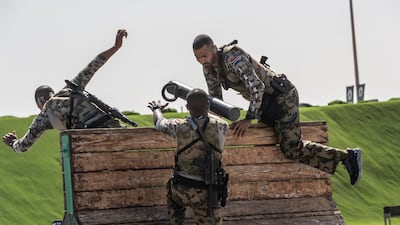
The South African team on day two of the competition -

Saudia Arabia's representatives challenge the world's best -
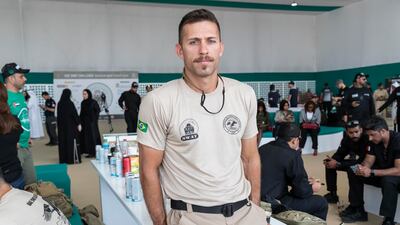
Brazilian commando Vitor Merjak


_____________________________________
Exercises include mock hostage rescues, raids, shootouts and helicopter fast rope insertion.
“But when officers are specialising, for example, to become snipers, they will have two hours of general fitness training and two hours of shooting training,” Al Kaabi said.
Officers' combat and tactical skills and physical ability are tested six times a year, he said.
Commandos from the South African Special Taskforce sometimes have to go on special diets to stay in shape, said Victor September, 34.
He said they train for long hours between Monday and Saturday, from 4am until about 6pm and sometimes beyond, to 8pm.
“This includes a lot of running, cross-fit, weight lifting, tactical, shooting and obstacle course training,” he said.
Special skills
New York swat officer Daniel Messia, 34, and his fellow officers undergo training that helps them better approach and engage with people in critical situations.
“Doing this job requires an officer to have a set of skills that help them do what the job is about, which is saving lives,” he said.
“We train on how to properly communicate with people in order to carry out a successful mission.”
He said they also learn how to recognise and deal with signs or symptoms of stress they may develop on the job.
Jameelah Al Hammadi’s life turned upside down after she joined the UAE’s first all-women swat team in September last year.
She said her eating habits changed drastically.
“Soft drinks, starch and fatty foods were cut out and we focused on building muscle,” she said.
She said they train for nearly three hours a day.
“We start with stretching, then a lot of running, weight lifting, and cross-fit, because its best for increasing flexibility,” she said.
They also have to do a daily run of at least 3.4 kilometres.
“This is the first part of our training. The second is tactics and shooting skills, each apart, and then tactical shooting, requires us to move fast from one location to another," she said.
She said that proficiency in tactical shooting, which includes running, is essential when there are moving targets during missions.

