



Ten Syrian earthquake survivors arrived in Abu Dhabi on Friday to receive crucial medical treatment.
The patients were transported on a special evacuation flight which included doctors, anaesthesiologists, technicians and paramedics along with the latest medical equipment.
The mission was carried out by Emirates Crescent, the humanitarian arm of the UAE government, in partnership with the Syrian Ministry of Health, under the directive of Sheikha Fatima, Mother of the Nation.
Five adult patients were taken to Sheikh Shakhbout Medical City, with children aged nine, 10, 12, 14 and 16 transferred to Sheikh Khalifa Medical City.
All of the children have suffered fractures to limbs, with two in a critical condition.
Sheikha Fatima had earlier called on authorities to arrange treatment for some of those injured in the deadly Turkey-Syria quake.
She has taken care of the costs of their treatment and all the resulting commitments, state news agency Wam reported.
'My mother died so I can live'

The National spoke to the young Syrian survivors at Sheikh Khalifa Medical City, who recounted their harrowing experiences as the earthquake struck.
Eissa Shaheen, 10, was trapped under the rubble of a building for four hours before being pulled to safety.
He was found by rescuers in the arms of his mother, who sadly did not survive.
Lying in hospital with metal rods in his leg as he embarks on his physical recovery, his eyes filled with tears as he described the “nightmare” he endured.
“My mother died so I can live,” he said.
Eissa is one three siblings from the Latakia area of Syria. His father, Fedda Shaheen, is a doctor.
“I am still in shock,” said Dr Shaheen, 50.
“I am grateful to the UAE and Sheikha Fatima for bringing us here. But you must understand the shock we are all in.
“This was nothing short of a nightmare.
“The building was a pile of stones and I kept praying they [his family] would be alive.
“The generosity of the UAE and the hospitality is like nothing we have ever witnessed.”
“I thought I was dead'

Mohammed Al Qablawi, 14, was stuck under rubble for 12 hours along with his younger brother before being rescued.
He has fractures to his skull and arm and a dislocated shoulder.
His brother was not as severely injured and remains in Syria with their mother.
“When I opened my eyes, there was a corpse on top of my arm and rubble from the building. My other arm was twisted and was behind my body. I thought I was dead.”

Zialyazan Sabbagh, chairman of the trauma committee at Sheikh Khalifa Medical City, said one of the young patients had been diagnosed with compartment syndrome due to being under rubble for a sustained period.
Another arrived unconscious with an amputated arm.
He said all five patients had arrived at the hospital at about 2am on Friday after spending 15 days in Syrian hospitals.
The doctor said all the patients were making gradual improvements, with surgery scheduled for all of them.
Heartbreak for father
Mohammed Al Kani lost all four of his children in the earthquake.
He is now by his wife Yusra Khalifa’s side as she lies in a hospital bed at Shakhbout Medical City
Her spine and neck muscles were fractured.
“My four kids have died under the rubble,” he said. “But in all this agony, the UAE’s support was a ray of light.”
Ms Khalifa does not know that all her children died in the earthquake. Her husband is waiting for her to get better before they break the news to her.
Manhal Taraaf lost his only daughter in the earthquake. His wife, Rawan Eissa, remained under the rubble for 10 hours before rescuers managed to pull her out.
His wife has compartment syndrome and internal bleeding, kidney failure and a fractured pelvis.
“The UAE stood by our side in this crises. The care we receive is unimaginable,” he said.
Maram Ayash's brother, Khaldoun, 30, is in a coma after rubble fell on his head.
“I’m grateful for Sheikha Fatima sending us a medically equipped to bring us over to the UAE for treatment. I hope my brother and everyone recovers,” he said.
Death toll rises still
The death toll resulting from the devastating disaster earlier this month has climbed above 47,000, with more than 4,500 of the deceased in Syria.
Millions more were affected in both countries when the 7.8-magnitude quake flattened thousands of buildings.
Hamdan Al Mazrouei, chairman of the board of directors of ERC, said the authority had finalised arrangements to receive the first batch of earthquake survivors and their families, and would provide hospital beds and accommodation for the duration of their stay in the UAE.
Dr Al Mazrouei said the patients included injured children who required special care as their condition was considered critical.
On Wednesday, the Joint Operations Command of the Ministry of Defence's Operation Gallant Knight/2 entered the recovery and rehabilitation stage to support those affected by the earthquake.
The Joint Operations Command ― through a maritime aid corridor ― will mobilise humanitarian aid, including food and medical assistance, while continuing the operations through the existing humanitarian air bridge.
A health delegation from various medical authorities in the Emirates has started visiting Syria to rehabilitate its hospitals. The UAE will also build camps for refugees in Syria and Turkey.
While the UAE's search and rescue team's mission in Turkey ended on Monday, the Emirati teams are still in Syria, training local teams on the advanced equipment donated to them.
Operation Gallant Knight/2 in Syria and Turkey involved 134 rescuers, a humanitarian air bridge, 136 flights and 3,772 tonnes of food and medical supplies. Two field hospitals were also opened in Turkey.
Turkey-Syria earthquake — in pictures
-
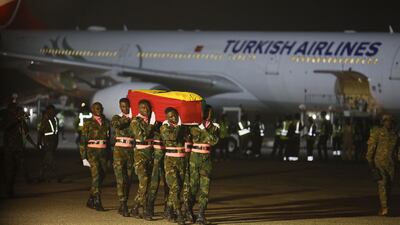
The coffin of former Ghana international football player Christian Atsu, who died in the earthquake in Turkey, arrives at the Kotoka International Airport in Accra in Ghana. AFP -
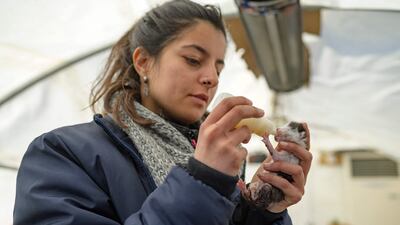
Petek Nur Sezer, a volunteer for the local NGO Haytap, feeds a kitten in Antakya, Turkey, where many animals are trapped in the rubble. AFP -

Mustafa Ozdimir helps his family as they collect goods from their collapsed shop in Antakya. AFP -
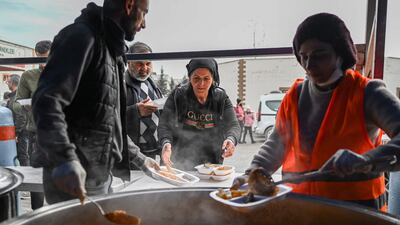
A woman collects a ration of cooked food distributed in Adiyaman, a Kurdish Alevi region in Turkey where 108 people died and 170 houses collapsed. AFP -
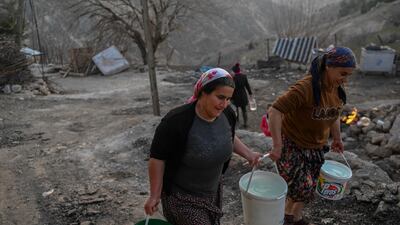
Women carry buckets of water in Yaylakonak village in Adiyaman, in Turkey. AFP -
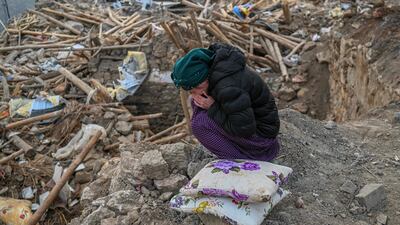
A woman cries as she sits atop the rubble of her collapsed house in Yaylakonak village in Adiyaman, in Turkey. AFP -
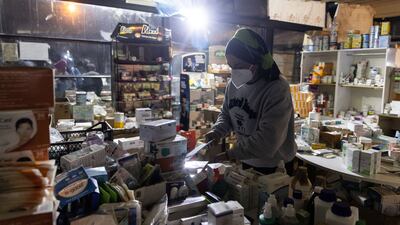
A woman arranges medicine at a hospital in a camp in Antakya, in Turkey. Reuters -
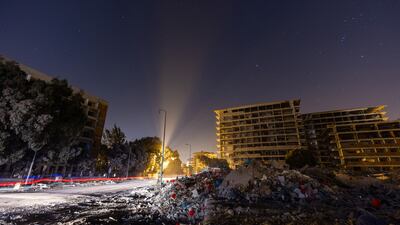
Balloons attached to rubble in memory of children who died in the earthquake are seen at night in Hatay, in Turkey. Reuters -
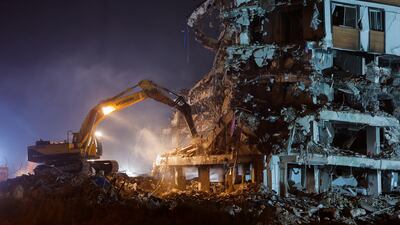
A damaged building being demolished in Hatay, in Turkey. Reuters -
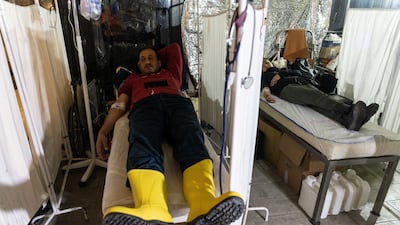
Injured at a hospital set up in a camp in Antakya. Reuters -
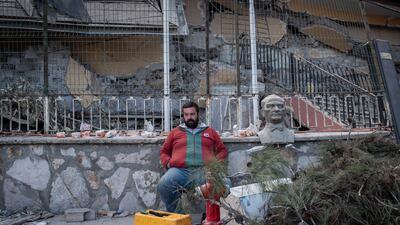
A man sits next to a bust of Turkey's founding father, Mustafa Kemal Ataturk, in front of collapsed buildings in Hatay, in Turkey. Getty -
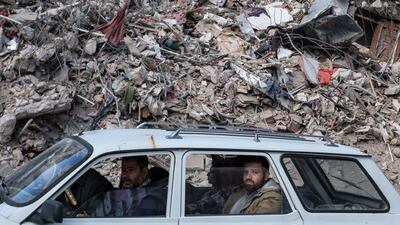
People drive past a collapsed buildings in Hatay, in Turkey. Getty -

A tilted building in Antakya. Reuters



