


Built with more than 4,000 tonnes of steel, about 18,300 cubic metres of reinforced concrete and 100 specialised beams that support the track — welcome to one of Etihad Rail’s most complex projects.
The UAE-wide network's first marine bridge stretches a kilometre across the Arabian Gulf and connects Abu Dhabi’s sprawling Khalifa Port to the emirate's mainland.
Freight trains will run on the line, allowing goods shipped to Khalifa Port to be carried swiftly and efficiently across the country.
Once operational, Etihad Rail say a fully loaded freight train that passes over the bridge can take up to 300 lorries off the UAE’s roads.
The National visited the bridge inside Khalifa Port on Thursday to take a closer look.
“It is of the most complex and difficult bridges we have had on the project without a doubt,” says Adriaan Wolhuter, director of engineering at Etihad Rail.
“It is the only marine bridge in the UAE and took a lot of planning and detailed design."
The bridge is a feat of engineering with harsh marine conditions, high temperatures, humidity and environmental concerns all posing their own challenges. Engineers conducted complex surveys to find out what was under the seabed before work began.
Then steel-encased reinforced 27.5 metre concrete piles, or foundations, were driven into the seabed to support the bridge.
Specialised tools such as “silt curtains” prevented mud from slipping into the sea during this phase, while nets stopped debris from falling into the water. Then 100 concrete beams to support trains were installed.
director of engineering at Etihad Rail
About 320 people toiled for more than a million working hours to make the project happen. Engineers also had to take into account strong currents and tides. They ensured it was built in harmony with the adjacent road bridge to ensure an easy flow of water between the two.
The line that spans the bridge also has guard rails running inside the track to protect the train in case of an accident.
“If there is a derailment it keeps the train upright and stops it falling into the sea,” says Mr Wolhuter, who is from South Africa. “It is a safety mechanism and standard practice in bridges.”
Construction of the 1,200km Etihad Rail network is well advanced, with about 75 per cent of the works completed.
It is being built in two stages and the first stage, a service in Abu Dhabi’s Al Dhafra region that carries sulphur from two gasfields to Ruwais, opened in 2016.
Construction of stage two, a freight and passenger service that will run across the country from the UAE border with Saudi Arabia to the frontier with Oman, began in 2020.

No date has been given for the launch of this service but the marine bridge is part of this phase. Construction of the bridge began in 2021 and by October last year, the Khalifa Port freight facility was connected to the main Abu Dhabi line.
"The teams have constructed the bridge to the best international standards and this bridge will last for 120 years,” Mr Wolhuter says.
The scenery the trains will travel through from the Khalifa Port freight terminal is striking and reveals Abu Dhabi’s increasing industrial and logistical depth.
From the sprawling offshore port with its scores of huge shipping cranes, locomotives will chug across the bridge and on to the Abu Dhabi mainland before passing warehouses, factories and logistics companies, and then joining the mainline.
Walking across the bridge in January afternoon sun with the waters of the Arabian Gulf glistening on other side, it is clear to see Mr Wolhuter's pride in his job.
His original university choice was dentistry but a switch to engineering ignited an interest in the railway. The first project he worked on was the refurbishment of the historic St John’s Wood Tube station in London.

“My great-grandfather worked on railways,” he says, with a smile. “It might have been something to do with that. But overall, it is an industry which I find rewarding and interesting.”
People can expect to see trains as long as 1.2km travelling down the track with a fleet of 69 wagons. They will chiefly carry distinctive shipping containers that are known in the industry as TEUs, or twenty-foot equivalent (6m) units.
A train can potentially transport about 276 of these, taking about 300 lorries off the road in the process, reducing transport costs and cutting emissions.
“The trains take an enormous amount of trucks off the road,” says Mr Wolhuter. “It is a much greener form of transport, links the key ports around the country and the key manufacturing hubs. It is also much more cost-efficient.”
He also worked on the Doha Metro in Qatar before taking up a role with Etihad Rail a few years ago. The scope of what the UAE was doing surprised him.
“The scale of the project is something else and is one of the biggest, if not the biggest, rail project in the world,” he says.
“It is incredible. I took my son the other day who is six and went to show him some of the sections. It is something to be proud about. It is incredibly rewarding — difficult but rewarding.”
Etihad Rail unveils first batch of its new trains - in pictures
-

Etihad Rail's new locomotive fleet is delivered. Photo: Etihad Rail -
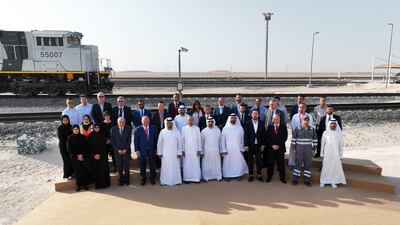
The advanced rolling stock will be at the heart of the national rail network. Photo: Etihad Rail -
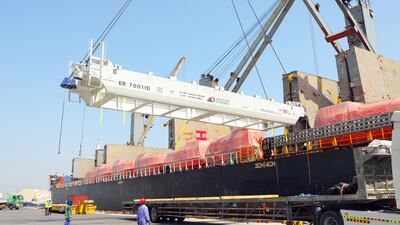
New wagons are delivered to support Etihad Rail services. Photo: Etihad Rail -
Construction of the Etihad Rail railway in Fujairah. Photo: Etihad Rail -
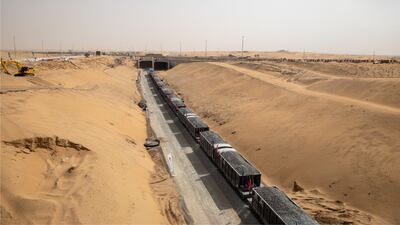
The first stage of the Etihad Rail network links gasfields in Shah and Habshan with Ruwais in Abu Dhabi. Photo: Abu Dhabi Media Office -
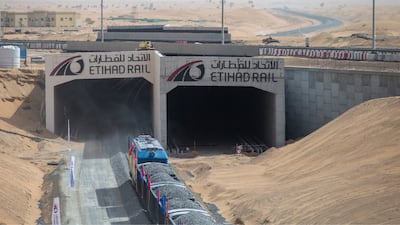
Sheikh Theyab bin Mohamed visited Etihad Rail project sites in Sharjah and Fujairah, inspecting the latest developments of the final part of the second phase of track construction, which spans 145km. Photo: Abu Dhabi Media office



