


Intensifying "rivers" of water vapour in the atmosphere over Africa caused by climate change are creating more dust storms for the UAE and the Middle East region, research has revealed.
The study by an international team that includes scientists at Khalifa University in Abu Dhabi demonstrates how complex the effects of human-induced climatic changes are.
Warning of potentially "disastrous" effects on human health, the researchers came to their conclusions after looking at dust storms that hit the Middle East, including the UAE, in May.
By analysing satellite data and other meteorological measurements, they found that the dust storms resulted from air currents in Turkey. These were caused by low-pressure systems fed by what meteorologists call African atmospheric rivers.
"Atmospheric rivers are rivers of water vapour in the sky. We can imagine them as the rivers we see on land but instead of liquid water, atmospheric rivers are made of water vapour and clouds," said Dr Diana Francis, head of the Environmental and Geophysical Sciences Laboratory at Khalifa University and the study’s first author.
"By virtue of their ability to transport large amounts of water vapour over long distances and in a relatively short time, African atmospheric rivers fuel the development of clouds [convective cloud] over the Middle East which in turn generates dust storms due to cold outflows [or density currents] that fall towards the ground during the natural process of cloud formation."
When occurring over desert regions, the high winds in these downdrafts generate what Dr Francis described as "massive dust storms".
-
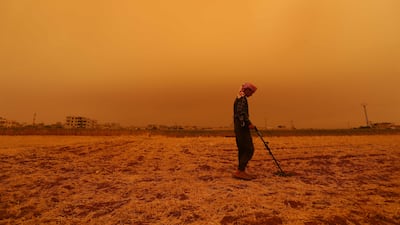
A young man uses a metal detector in Zardana, northwestern Syria, during a dust storm. AFP -
A man walks past the Kuwait Towers shrouded in heavy dust in Kuwait City. EPA -
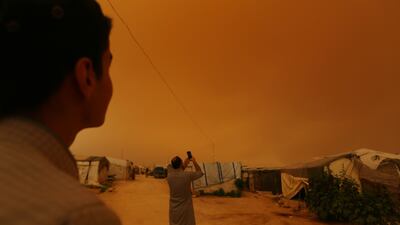
A displaced Syrian takes a picture of the sky during a dust storm in Dana. AFP -

Displaced children walk past tents in Dana as dust blows. AFP -
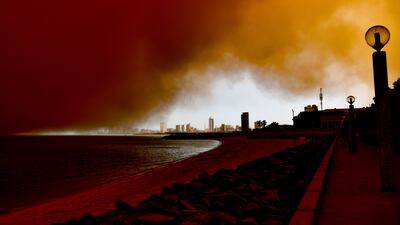
A heavy dust storm advances towards the shore in Kuwait City. EPA -

Birds sit amid heavy dust in Kuwait City. EPA -
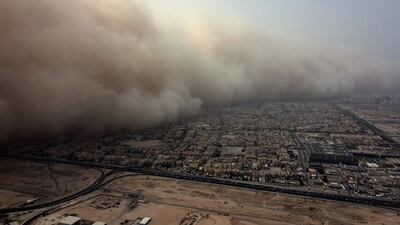
A massive dust storm heads towards Kuwait City. AFP -
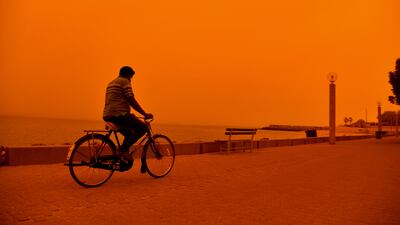
A man rides a bicycle during a heavy dust storm in Kuwait City. EPA -
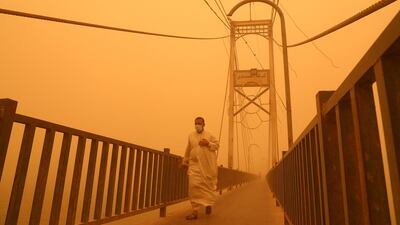
A man walks along a pedestrian bridge across the Euphrates river during a heavy dust storm in Nasiriyah. AFP -

Pedestrians cross a road amid a severe dust storm in Kuwait City. AFP -
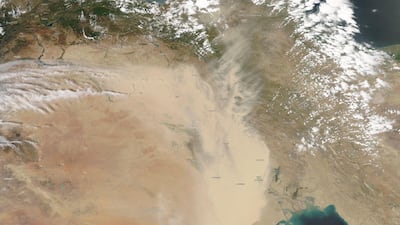
A dust storm engulfs parts of Iraq and neighbouring countries. AFP -
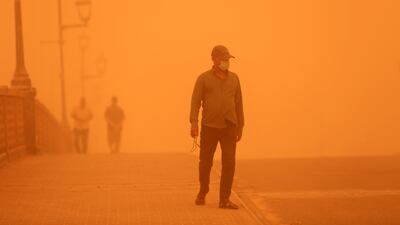
A man walks among dust in central Baghdad, Iraq. EPA -
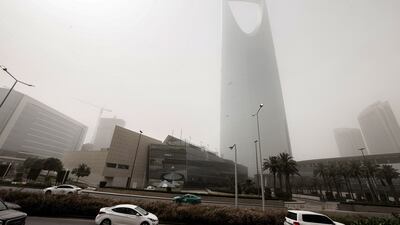
Riyadh's Kingdom Centre skyscraper during a heavy dust storm. AFP -
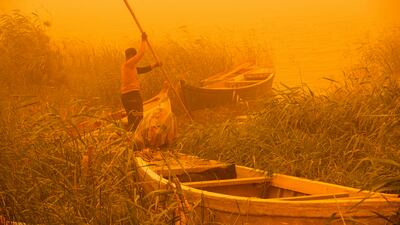
A fisherman sails his boat on the Shatt Al Arab during a sandstorm in Basra, Iraq. AP Photo -
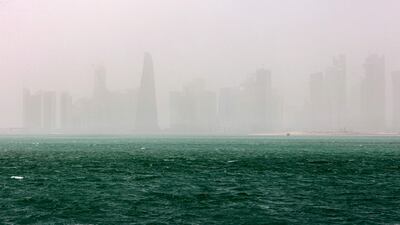
Haze obscures Doha's skyline in Qatar. AFP -
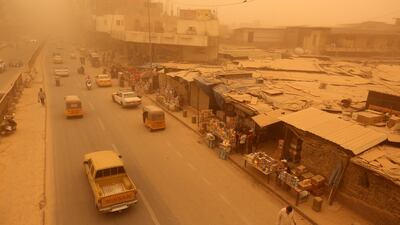
Cars drive along a street at the Shorja market shrouded in heavy dust in Baghdad. EPA -
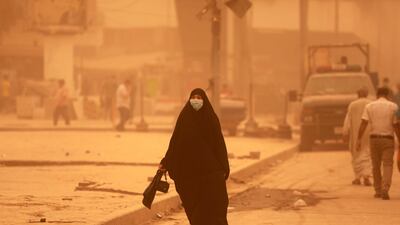
An Iraqi woman wears a face mask and walks along a street shrouded in heavy dust in central Baghdad. EPA -

A traffic policeman directs traffic flow in the city of Nasiriyah in Iraq's southern Dhi Qar province. AFP -
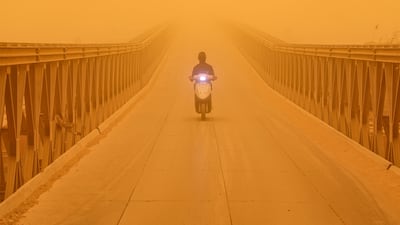
A motorist drives a scooter along a bridge in the city of Nasiriyah in Iraq's southern Dhi Qar province during a heavy dust storm. AFP -
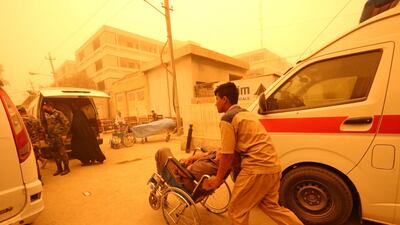
A patient suffering from breathing problems and suffocation arrives at Sheikh Zayed Hospital in Baghdad. AFP


These African atmospheric rivers are becoming more frequent and intense because of climate change, Dr Francis said. This is the result of increased evaporation over oceans and the capacity of a warmer atmosphere to hold more water vapour.
Droughts, too, are creating new sources of dust, the researchers wrote in their paper published in the Atmospheric Environment journal.
"Recent studies suggest dust storms are becoming more frequent in the Middle East, with the recent droughts leading to new emission sources, and this trend can be amplified in a warmer world, with potentially disastrous consequences for human health," they said.
The drying of Lake Sawa in southern Iraq, caused by drought and too much water being used by local industry and agriculture, represents the type of change that could be making dust storms more likely.
"Dried lakes are a very important source of atmospheric dust because the particles at the surface are not compacted and can easily be eroded," Dr Francis said.
The study, titled On the Middle East’s Severe Dust Storms in Spring 2022: Triggers and Impacts, is co-written by researchers from Khalifa University and from the Federal Authority for Nuclear Regulation in Abu Dhabi, the University of Valparaiso in Chile, Paris-East Creteil University and Paris Cité University.
As The National reported when the dust storms hit in May, UAE residents were advised to be "extremely vigilant", with visibility affected.
Late in the month, the National Centre of Meteorology forecast "hazardous weather events of exceptional severity".
Air quality in Dubai and Abu Dhabi became "very poor", according to the Plume app, which provides updates on pollution levels in cities across the globe.
Abu Dhabi Police warned motorists to be careful and told them not to take photographs of the dusty conditions when behind the wheel.
Neighbouring countries, including Syria, Iraq, Saudi Arabia and Kuwait, were affected, causing some flights to be suspended.

The latest study may help to forecast dust storms, because identifying the processes that cause the events "is a key milestone" in predicting when they might occur, Dr Francis said. This, in turn, allows authorities to issue warnings so the public can protect themselves.
"The first measure once a warning is issued is to advise the public to stay indoors when possible," Dr Francis said.
"Air and road traffic can be prepared in advance as well to avoid accidents."
Another pre-emptive measure is for solar power plants, of which there are many in the UAE, to prepare cleaning operations to limit the impact of dust storms on power generation, according to Dr Francis.
The Middle East is not the only region experiencing more dust storms as a result of climate change, with areas including northern China having suffered severe effects blamed in part on higher temperatures and reduced rainfall in neighbouring Mongolia.
In another demonstration of how complex the reasons behind dust storms are, two years ago The National reported on other work by Dr Francis and colleagues that showed how a major dust storm, named "Godzilla", which blew to the US from the Sahara, was caused by lower levels of ice in the Arctic.
The loss of polar ice can change temperature gradients between high latitudes and warmer regions, altering atmospheric circulation and resulting in winds that whip up dust.
Dust storms blanket UAE - in pictures
-

Dust storms reduced visibility in Dubai. Chris Whiteoak / The National -

A lone runner ventures out during hazy weather in Dubai. Chris Whiteoak / The National -

A sandstorm hits Dubai. Chris Whiteoak / The National -
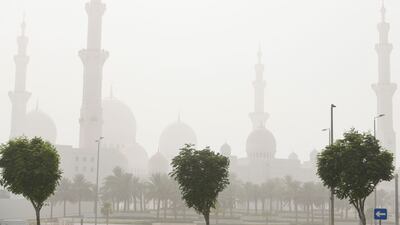
Hazy skies above the Sheikh Zayed Grand Mosque in Abu Dhabi. Khushnum Bhandari / The National -

Drivers have been urged to take care during challenging weather conditions. Chris Whiteoak / The National



