
LIVE: Latest from the Fifa World Cup 2022
Sheikh Mohammed bin Rashid has praised Tunisia's performance at the World Cup, saying the team made Arabs proud.
The Vice President and Ruler of Dubai said watching the Carthage Eagles was "real football".
Tunisia defeated France 1-0 in Qatar on Wednesday night but did not score enough points to progress to the second round.
The defeat was profound for France who are fourth in Fifa's current world rankings and won the World Cup 2018 in Russia.
"An Arab victory and a distinctive imprint on the World Cup," Sheikh Mohammed wrote on Twitter.
Tunisia - ranked 30th by Fifa - will return home to a heroes' welcome.
In Tunis, fans celebrated late into the night.
“I felt as if we got our revenge for 75 years of colonialism,” said law student Sarah Abdel Majid, 26, at a cafe in the Tunis neighbourhood of L'Aouina.
“We beat the world champion, so it’s fine if we did not go through to the next round,” she added, tears of joy streaming down her face.
Saudi Arabia and Mexico both crashed out of the World Cup on Wednesday night - but entertained spectators with an at times wild back and forth play.
The Green Falcons' Salem Aldawsari scored in the 95th minute, after two goals from Mexico early in the second half, to make the score 2-1 by the final whistle.
"This game is officially bananas," wrote The Athletic's Felipe Cárdenas.
Saudi Arabia's performance has captivated the Gulf and sent the Kingdom football-mad.
For Mexico, supported by thousands of fans who made the 13,000km journey to Qatar, it is the first time in 44 years that the El Tri have not progressed to the second round.
-

Saudi Arabia's Salem Al Dawsari fires the ball past Mexico goalkeeper Guillermo Ochoa in their World Cup Group C 2-1 defeat to the Central American team at Lusail Stadium, Qatar, on Wednesday, Novemeber 30, 2022. AP -

Salem Al Dawsari of Saudi Arabia scores against Mexico. Getty -
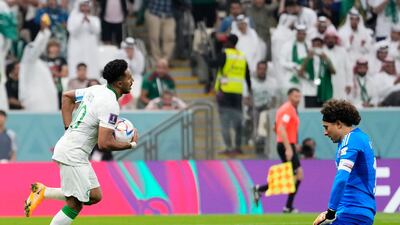
Saudi Arabia's Salem Al Dawsari runs back with the ball after scoring against Mexico. AP -

Mexico's Henry Martin after scoring the opening goal against Saudi Arabia. AP -

Mexico's Cesar Montes and Uriel Antuna celebrate after Henry Martin's goal. AP -

Mexico's Henry Martin, left, celebrates with Jesus Gallardo. AP -

Mexico's Luis Chavez, right, celebrates scoring the second goal. PA -

Luis Chavez of Mexico celebrates with teammates after scoring. Getty -

Mexico's Hector Moreno tussles with Saudi Arabia's Firas Al Buraikan. AP -

Saudi Arabia's Hassan Tambakti pulls the jersey of Mexico's Henry Martin. AP -

Saudi Arabia's Sultan Al Ghannam in action with Mexico's Jesus Gallardo. Reuters
GULF MEN'S LEAGUE
Pool A Dubai Hurricanes, Bahrain, Dubai Exiles, Dubai Tigers 2
Pool B Abu Dhabi Harlequins, Jebel Ali Dragons, Dubai Knights Eagles, Dubai Tigers
Opening fixtures
Thursday, December 5
6.40pm, Pitch 8, Abu Dhabi Harlequins v Dubai Knights Eagles
7pm, Pitch 2, Jebel Ali Dragons v Dubai Tigers
7pm, Pitch 4, Dubai Hurricanes v Dubai Exiles
7pm, Pitch 5, Bahrain v Dubai Eagles 2
Recent winners
2018 Dubai Hurricanes
2017 Dubai Exiles
2016 Abu Dhabi Harlequins
2015 Abu Dhabi Harlequins
2014 Abu Dhabi Harlequins
Juventus v Napoli, Sunday, 10.45pm (UAE)
Match on Bein Sports
COMPANY PROFILE
Name: Lamsa
Founder: Badr Ward
Launched: 2014
Employees: 60
Based: Abu Dhabi
Sector: EdTech
Funding to date: $15 million
Sole survivors
- Cecelia Crocker was on board Northwest Airlines Flight 255 in 1987 when it crashed in Detroit, killing 154 people, including her parents and brother. The plane had hit a light pole on take off
- George Lamson Jr, from Minnesota, was on a Galaxy Airlines flight that crashed in Reno in 1985, killing 68 people. His entire seat was launched out of the plane
- Bahia Bakari, then 12, survived when a Yemenia Airways flight crashed near the Comoros in 2009, killing 152. She was found clinging to wreckage after floating in the ocean for 13 hours.
- Jim Polehinke was the co-pilot and sole survivor of a 2006 Comair flight that crashed in Lexington, Kentucky, killing 49.
While you're here
National Editorial: Donald Trump has left his mark on the Middle East
Con Coughlin: The thorn in the side of Biden's foreign policy team
James Reinl: Biden’s Yemen U-turn gets thumbs-up overseas
Raghida Dergham: Will Biden's 'maximum diplomacy' with Iran work?
Reading List
Practitioners of mindful eating recommend the following books to get you started:
Savor: Mindful Eating, Mindful Life by Thich Nhat Hanh and Dr Lilian Cheung
How to Eat by Thich Nhat Hanh
The Mindful Diet by Dr Ruth Wolever
Mindful Eating by Dr Jan Bays
How to Raise a Mindful Eaterby Maryann Jacobsen
While you're here
Chitrabhanu Kadalayil: Singapore election is more than just a family feud over LKY's legacy
Sholto Byrnes: Robert Mugabe and Lee Kuan Yew: two leaders with very different legacies
Dr Vivian Balakrishnan: UAE and Singapore can be partners for a world in transition
Nick March: Singapore and UAE are on the move – in airport development
Mercer, the investment consulting arm of US services company Marsh & McLennan, expects its wealth division to at least double its assets under management (AUM) in the Middle East as wealth in the region continues to grow despite economic headwinds, a company official said.
Mercer Wealth, which globally has $160 billion in AUM, plans to boost its AUM in the region to $2-$3bn in the next 2-3 years from the present $1bn, said Yasir AbuShaban, a Dubai-based principal with Mercer Wealth.
“Within the next two to three years, we are looking at reaching $2 to $3 billion as a conservative estimate and we do see an opportunity to do so,” said Mr AbuShaban.
Mercer does not directly make investments, but allocates clients’ money they have discretion to, to professional asset managers. They also provide advice to clients.
“We have buying power. We can negotiate on their (client’s) behalf with asset managers to provide them lower fees than they otherwise would have to get on their own,” he added.
Mercer Wealth’s clients include sovereign wealth funds, family offices, and insurance companies among others.
From its office in Dubai, Mercer also looks after Africa, India and Turkey, where they also see opportunity for growth.
Wealth creation in Middle East and Africa (MEA) grew 8.5 per cent to $8.1 trillion last year from $7.5tn in 2015, higher than last year’s global average of 6 per cent and the second-highest growth in a region after Asia-Pacific which grew 9.9 per cent, according to consultancy Boston Consulting Group (BCG). In the region, where wealth grew just 1.9 per cent in 2015 compared with 2014, a pickup in oil prices has helped in wealth generation.
BCG is forecasting MEA wealth will rise to $12tn by 2021, growing at an annual average of 8 per cent.
Drivers of wealth generation in the region will be split evenly between new wealth creation and growth of performance of existing assets, according to BCG.
Another general trend in the region is clients’ looking for a comprehensive approach to investing, according to Mr AbuShaban.
“Institutional investors or some of the families are seeing a slowdown in the available capital they have to invest and in that sense they are looking at optimizing the way they manage their portfolios and making sure they are not investing haphazardly and different parts of their investment are working together,” said Mr AbuShaban.
Some clients also have a higher appetite for risk, given the low interest-rate environment that does not provide enough yield for some institutional investors. These clients are keen to invest in illiquid assets, such as private equity and infrastructure.
“What we have seen is a desire for higher returns in what has been a low-return environment specifically in various fixed income or bonds,” he said.
“In this environment, we have seen a de facto increase in the risk that clients are taking in things like illiquid investments, private equity investments, infrastructure and private debt, those kind of investments were higher illiquidity results in incrementally higher returns.”
The Abu Dhabi Investment Authority, one of the largest sovereign wealth funds, said in its 2016 report that has gradually increased its exposure in direct private equity and private credit transactions, mainly in Asian markets and especially in China and India. The authority’s private equity department focused on structured equities owing to “their defensive characteristics.”
Ten tax points to be aware of in 2026
1. Domestic VAT refund amendments: request your refund within five years
If a business does not apply for the refund on time, they lose their credit.
2. E-invoicing in the UAE
Businesses should continue preparing for the implementation of e-invoicing in the UAE, with 2026 a preparation and transition period ahead of phased mandatory adoption.
3. More tax audits
Tax authorities are increasingly using data already available across multiple filings to identify audit risks.
4. More beneficial VAT and excise tax penalty regime
Tax disputes are expected to become more frequent and more structured, with clearer administrative objection and appeal processes. The UAE has adopted a new penalty regime for VAT and excise disputes, which now mirrors the penalty regime for corporate tax.
5. Greater emphasis on statutory audit
There is a greater need for the accuracy of financial statements. The International Financial Reporting Standards standards need to be strictly adhered to and, as a result, the quality of the audits will need to increase.
6. Further transfer pricing enforcement
Transfer pricing enforcement, which refers to the practice of establishing prices for internal transactions between related entities, is expected to broaden in scope. The UAE will shortly open the possibility to negotiate advance pricing agreements, or essentially rulings for transfer pricing purposes.
7. Limited time periods for audits
Recent amendments also introduce a default five-year limitation period for tax audits and assessments, subject to specific statutory exceptions. While the standard audit and assessment period is five years, this may be extended to up to 15 years in cases involving fraud or tax evasion.
8. Pillar 2 implementation
Many multinational groups will begin to feel the practical effect of the Domestic Minimum Top-Up Tax (DMTT), the UAE's implementation of the OECD’s global minimum tax under Pillar 2. While the rules apply for financial years starting on or after January 1, 2025, it is 2026 that marks the transition to an operational phase.
9. Reduced compliance obligations for imported goods and services
Businesses that apply the reverse-charge mechanism for VAT purposes in the UAE may benefit from reduced compliance obligations.
10. Substance and CbC reporting focus
Tax authorities are expected to continue strengthening the enforcement of economic substance and Country-by-Country (CbC) reporting frameworks. In the UAE, these regimes are increasingly being used as risk-assessment tools, providing tax authorities with a comprehensive view of multinational groups’ global footprints and enabling them to assess whether profits are aligned with real economic activity.
Contributed by Thomas Vanhee and Hend Rashwan, Aurifer
Mohammed bin Zayed Majlis
Analysis
Members of Syria's Alawite minority community face threat in their heartland after one of the deadliest days in country’s recent history. Read more



