



Emiratis who work in the private sector are eligible to receive a Dh7,000 monthly salary top-up, as per rules announced by government leaders in November last year.
The move is designed to attract more Emiratis away from government jobs, where salaries tend to be higher.
This week, new rules were announced for private sector companies with 20 to 49 employees.
Here's everything you need to know about Emiratisation in the UAE:
What is Emiratisation?
The government has been trying to boost the number of Emiratis who work in the private sector through its Emiratisation drive.
While public sector hours and wages have been traditionally more attractive, the government has been encouraging Emiratis to develop more skills in the workforce.
In September 2022, authorities set out quotas for hiring Emiratis for the first time and gave private companies deadlines to reach them.
Private sector companies with at least 50 employees needed to ensure 3 per cent of their workforce was made up of Emiratis by July 7.
On July 11, the Ministry of Human Resources and Emiratisation announced a new update to the rules, whereby private companies with 20 to 49 employees are now included in the government's Emiratisation drive.
The new rules now apply to companies across 14 economic sectors including property, education, construction and health care.
The Emirati employment rate is projected to increase to 6 per cent in 2024, 8 per cent in 2025 and 10 per cent in 2026.
Those end-of-year goals remain in place, but private businesses must now make sure they reach those targets, with an increase of 1 per cent every six months.
The measures apply to skilled positions and companies in free zones are exempt. They are, however, encouraged to participate in the scheme.
Businesses are being asked to increase the number of citizens they hire by 2 per cent each year to reach 10 per cent by the start of 2027.
What are the top-up payments?
Officials say they are pragmatic about the expectations of Emirati university graduates, in particular those who want a good starting salary.
At the same time, they know that private businesses operate in a highly competitive market and cannot pay people higher salaries simply to hit a quota.
The salary top-up was introduced for this reason.
-
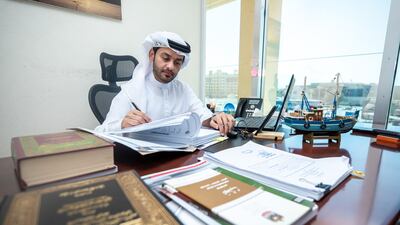
Rashed Abdulla Al Sumaity, an associate at Galadari Advocates & Legal Consultants in Dubai. The legal and banking professions have the highest Emiratisation in the private sector. All photos by Victor Besa / The National -

Official announcements show the UAE government’s resolve to encourage citizens to take on private sector jobs and persuade companies to take Emiratis on board. -

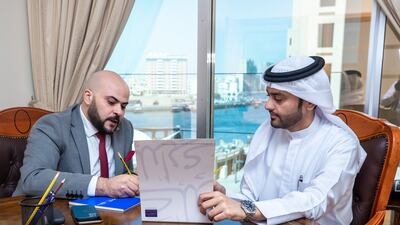
Raka Roy (R), partner at Galadari Advocates & Legal Consultants and Eslam Oraif, legal counsel, break down the government announcements that offer extra salary and benefits to UAE citizens taking jobs in the private sector. -

Rashed Abdulla Al Sumaity (R) with Eslam Oraif of Galadari Advocates & Legal Consultants. The UAE government's Nafis scheme has set a target of 75,000 Emiratis in private sector jobs by 2026. -
The UAE Cabinet approved that private companies with more than 50 employees should have at least a 2 per cent Emirati workforce by 2021. -

UAE government support programmes will empower and protect Emirati employees in the private sector. -

Salary incentives are being offered to Emirati university graduates and UAE citizens in training for skilled jobs.


For example, an Emirati graduate being offered Dh13,000 a month in a starting role would take home Dh18,000 under the original Nafis programme, set out in September 2021.
This rose to Dh20,000 following the decision made in November 2022.
There are other benefits available, particularly for those who have children, with Dh800 per child given every month and up to Dh3,200 per family.
What happens if companies don't hit the deadline?
Private companies who failed to meet the July 7 deadline for Emiratisation targets now face fines of up to Dh500,000.
Earlier this month, the ministry said it would be reviewing companies' compliance with the required targets, and a fine of Dh42,000 would be imposed for each Emirati not employed.
Companies who fabricate or mislead authorities regarding their Emiratisation numbers will also face steep fines.
Previously, it was announced that firms that fail to reach the 4 per cent mark in 2023 would pay Dh84,000 for each Emirati not hired, with this figure rising to Dh120,000 per worker for 2026.
For private companies with 20 to 49 employees, those that fail to employ at least one Emirati in 2024 will face a fine of Dh96,000 ($26,000).
That fine will increase to Dh108,000 ($30,000) for businesses that have not employed at least two Emiratis in 2025.
Which companies are hiring the most?
As of July 9, about 80,000 Emiratis are now working in the private sector – a leap of 30,000 in the past six months.
About 79,000 Emiratis have secured jobs in the private sector, the highest figure since the Emiratisation drive began.
Semi-government companies and local banks are currently the main employers of Emiratis in the private sector.
Companies such as Emirates Global Aluminium and Strata, the aircraft parts manufacturer in Al Ain, are major employers of UAE citizens, with thousands on the payroll.
However, Emiratis have since been hired in teaching and healthcare positions.
It is the wholly privately owned businesses that officials want to see act.
What happens next?
In 2021, officials announced an investment of Dh24 billion to create 75,000 new private sector jobs for UAE citizens.
A year later, the country's leaders said they wanted 75,000 Emiratis to enter the private sector workforce over the next four years.
With 80,000 Emiratis having joined the private sector as of this months, the initial target has been surpassed, showing huge growth within the sector.
In June, a PwC Middle East Emiratisation survey found that the majority of Emirati graduates have expressed an interest in joining the private sector.
It polled citizens working in the private and public sectors, as well as graduates entering the workplace.
According to the poll, entering the private sector is strong among the younger generation (61 per cent interested), and two thirds of those currently working in private companies are considering a return to the public sector.
“It is a moving market with new graduates coming in stream and thousands of jobs are created,” a Nafis spokesman said last year.
“We believe that in our dynamic economy, there will always be opportunities for everyone. In the meantime, we can tell you that what we see on the ground is very promising, but we aspire to see more.”

