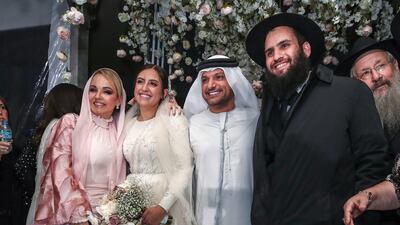
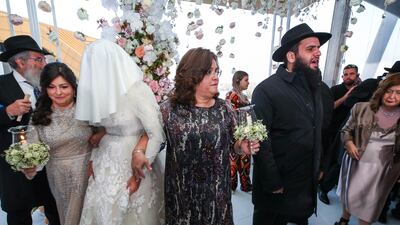
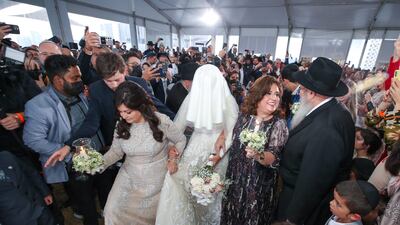
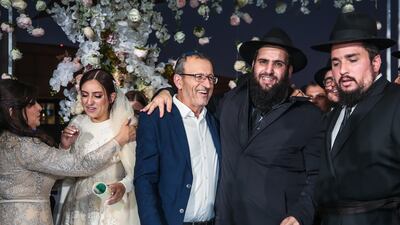
• Nogah and Itamar Bareket, the first Israeli couple to have a civil marriage in Abu Dhabi. All photos: Khushnum Bhandari / The National
    Nogah and Itamar Bareket, the first Israeli couple to have a civil marriage in Abu Dhabi. All photos: Khushnum Bhandari / The National
  • Officials say that five secular Israeli couples, who are not permitted to have non-religious weddings in Israel, have registered to be married in the Emirati capital.
    Officials say that five secular Israeli couples, who are not permitted to have non-religious weddings in Israel, have registered to be married in the Emirati capital.
  • Nogah's ring. The couple plan to move to the Emirates in the near future.
    Nogah's ring. The couple plan to move to the Emirates in the near future.
  • An Emirati court official smiles as the process is complete.
    An Emirati court official smiles as the process is complete.
  • More than 3,000 couples have married in Abu Dhabi's judicial court in the past year.
    More than 3,000 couples have married in Abu Dhabi's judicial court in the past year.

Secular Israeli couple choose Abu Dhabi civil court for marriage


  • English
  • Arabic

Abu Dhabi's civil court has registered the first marriage between an Israeli couple.

In a simple ceremony held at the Abu Dhabi Judicial Department, groom Itamar Bareket and bride Nogah Meroz Mioni, both 26, tied the knot on Monday.

The couple flew from Tel Aviv on Saturday ahead of the occasion.

Civil marriages are not permitted in Israel and only religious leaders can perform marriage ceremonies. ADJD officials said five Israeli couples have applied for civil marriages so far.

Many Israelis are seeking civil marriages all over the world. Abu Dhabi is a short flight and a lovely destination so I'm sure many more will follow
Nogah Bareket

More are expected due to direct flights between Israel and the Emirati capital.

"It was really exciting. We got really emotional," Mr Bareket, who works for a tech company in Tel Aviv, told The National.

"We follow a secular life and in Israel, we don't have the option of a civil marriage."

It is common for secular Israelis to travel to the Maldives, Seychelles or Cyprus for civil marriages.

"We don't follow any religious sect and wanted the ceremony to be as closest to our lives as possible," said Nogah, who works in education.

The couple applied to have a civil marriage in the UAE online last month and were given a date for the ceremony.

An Emirati court official smiled and posed for photos with the happy couple as she completed the brief proceedings.

"My parents were the first Israeli couple to get a civil marriage in Seychelles. So this feel like a family tradition," Nogah said with a laugh.

"I know many Israelis are seeking civil marriages all over the world. They look at Seychelles and Maldives. Abu Dhabi is a short flight and a lovely destination so I'm sure many more will follow," she said.

The couple plan to move to the UAE and settle here soon.

"I'm not a religious person but today is the Jewish New Year and it is a remarkable date - we are glad that our marriage starts with the start of the new year," Nogah said.

Whether to allow civil marriage in Israel remains a major debate.

About half of Israeli adults want their party to push for civil marriage to be legalised in the November electrions, a poll last month showed, while Orthodox voters are strongly opposed.

To date, at least 3,000 civil marriages have been performed at Abu Dhabi's new family court. The process is entirely separate to the UAE's state marriage system, which is based on Islamic teachings.

The dedicated family court, part of legislation introduced in November to better support residents in the emirate, hears all cases related to marriage, custody, divorce, paternity, inheritance and personal status.

Last month, guests from around the world flew into Abu Dhabi to join celebrations of the biggest Jewish wedding held in the UAE.

UAE's largest Jewish wedding - in pictures

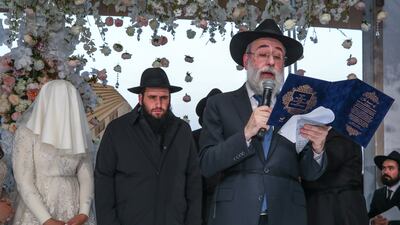
  • Rabbi Levi Duchman and Lea Hadad during their wedding ceremony in Abu Dhabi. All photos: Victor Besa / The National
    Rabbi Levi Duchman and Lea Hadad during their wedding ceremony in Abu Dhabi. All photos: Victor Besa / The National
  • The newlyweds with Dr Omar Al Muthanna and wife, Shamma Mohammed.
    The newlyweds with Dr Omar Al Muthanna and wife, Shamma Mohammed.
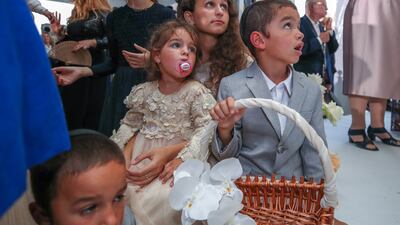
  • More than 1,500 guests were in attendance.
    More than 1,500 guests were in attendance.
  • Rabbi Duchman, centre, is escorted to the chuppah, the wedding canopy, by his father, Rabbi Sholom Duchman, and father-in-law, Rabbi Menachem Hadad.
    Rabbi Duchman, centre, is escorted to the chuppah, the wedding canopy, by his father, Rabbi Sholom Duchman, and father-in-law, Rabbi Menachem Hadad.
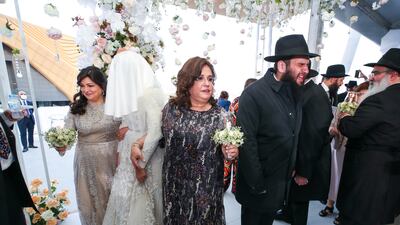
  • Ms Hadad, centre, is escorted to the chuppah by her mother, Batcheva Hadad, and mother-in-law, Feige Duchman.
    Ms Hadad, centre, is escorted to the chuppah by her mother, Batcheva Hadad, and mother-in-law, Feige Duchman.
  • It was the largest Jewish wedding in the UAE since the signing of the Abraham Accords.
    It was the largest Jewish wedding in the UAE since the signing of the Abraham Accords.
  • The Rabbi of Singapore during the ceremony.
    The Rabbi of Singapore during the ceremony.
  • Since 2014, Rabbi Duchman has built the infrastructure for Jewish life across the Emirates.
    Since 2014, Rabbi Duchman has built the infrastructure for Jewish life across the Emirates.
  • Rabbi Mendel Duchman blows the horn during the ceremony.
    Rabbi Mendel Duchman blows the horn during the ceremony.
  • Ms Hadad, centre, with her mother and mother-in-law.
    Ms Hadad, centre, with her mother and mother-in-law.
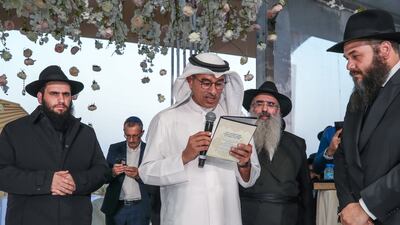
  • Mohamed Al Abbar was a guest at the wedding.
    Mohamed Al Abbar was a guest at the wedding.
Ten tax points to be aware of in 2026

1. Domestic VAT refund amendments: request your refund within five years

If a business does not apply for the refund on time, they lose their credit.

2. E-invoicing in the UAE

Businesses should continue preparing for the implementation of e-invoicing in the UAE, with 2026 a preparation and transition period ahead of phased mandatory adoption. 

3. More tax audits

Tax authorities are increasingly using data already available across multiple filings to identify audit risks. 

4. More beneficial VAT and excise tax penalty regime

Tax disputes are expected to become more frequent and more structured, with clearer administrative objection and appeal processes. The UAE has adopted a new penalty regime for VAT and excise disputes, which now mirrors the penalty regime for corporate tax.

5. Greater emphasis on statutory audit

There is a greater need for the accuracy of financial statements. The International Financial Reporting Standards standards need to be strictly adhered to and, as a result, the quality of the audits will need to increase.

6. Further transfer pricing enforcement

Transfer pricing enforcement, which refers to the practice of establishing prices for internal transactions between related entities, is expected to broaden in scope. The UAE will shortly open the possibility to negotiate advance pricing agreements, or essentially rulings for transfer pricing purposes. 

7. Limited time periods for audits

Recent amendments also introduce a default five-year limitation period for tax audits and assessments, subject to specific statutory exceptions. While the standard audit and assessment period is five years, this may be extended to up to 15 years in cases involving fraud or tax evasion. 

8. Pillar 2 implementation 

Many multinational groups will begin to feel the practical effect of the Domestic Minimum Top-Up Tax (DMTT), the UAE's implementation of the OECD’s global minimum tax under Pillar 2. While the rules apply for financial years starting on or after January 1, 2025, it is 2026 that marks the transition to an operational phase.

9. Reduced compliance obligations for imported goods and services

Businesses that apply the reverse-charge mechanism for VAT purposes in the UAE may benefit from reduced compliance obligations. 

10. Substance and CbC reporting focus

Tax authorities are expected to continue strengthening the enforcement of economic substance and Country-by-Country (CbC) reporting frameworks. In the UAE, these regimes are increasingly being used as risk-assessment tools, providing tax authorities with a comprehensive view of multinational groups’ global footprints and enabling them to assess whether profits are aligned with real economic activity. 

Contributed by Thomas Vanhee and Hend Rashwan, Aurifer

Updated: September 27, 2022, 8:51 AM