• Shepherds tend their sheep in a dry wheat field during a sandstorm on the outskirts of the city of Tabqa, in Syria. All photos: AFP
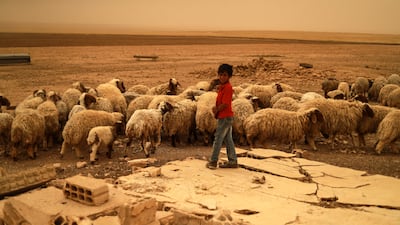
    Shepherds tend their sheep in a dry wheat field during a sandstorm on the outskirts of the city of Tabqa, in Syria. All photos: AFP
  • Wheat fields are drying to a crisp because of severe drought and low rainfall in the once-fertile region in Syria's north-east.
    Wheat fields are drying to a crisp because of severe drought and low rainfall in the once-fertile region in Syria's north-east.
  • Farmers whose crops have been scorched by the heat now rely on income from other farmers, who use their fields to graze animals.
    Farmers whose crops have been scorched by the heat now rely on income from other farmers, who use their fields to graze animals.
  • Before the war that erupted in 2011, Syria's wheat production was enough to meet local demand.
    Before the war that erupted in 2011, Syria's wheat production was enough to meet local demand.
  • Harvests have plunged to record lows, leading to increased dependence on imports especially from key government ally, Russia.
    Harvests have plunged to record lows, leading to increased dependence on imports especially from key government ally, Russia.
  • The UN's Food and Agriculture Organisation says the 210,000 tonnes of wheat grain produced in Hasakeh province during the 2020-2021 winter cropping season were only 26 per cent of the previous year.
    The UN's Food and Agriculture Organisation says the 210,000 tonnes of wheat grain produced in Hasakeh province during the 2020-2021 winter cropping season were only 26 per cent of the previous year.
  • Arid land during a sandstorm in the countryside of Tabqa.
    Arid land during a sandstorm in the countryside of Tabqa.
  • Syria is among the countries most vulnerable and poorly prepared for climate change, which is forecast to worsen, posing a further threat to the wheat harvests that are an essential income source for a war-battered population.
    Syria is among the countries most vulnerable and poorly prepared for climate change, which is forecast to worsen, posing a further threat to the wheat harvests that are an essential income source for a war-battered population.
  • North-east Syria is about 0.8°C hotter today than it was 100 years ago with a decreased mean rainfall of about 18 millimetres per month over the same period, says a report released in April by iMMAP, a data-focused non-profit organisation based in Washington.
    North-east Syria is about 0.8°C hotter today than it was 100 years ago with a decreased mean rainfall of about 18 millimetres per month over the same period, says a report released in April by iMMAP, a data-focused non-profit organisation based in Washington.
  • By 2050, temperatures are expected to be at least 2°C higher while precipitation falls by 11 per cent, iMMAP says.
    By 2050, temperatures are expected to be at least 2°C higher while precipitation falls by 11 per cent, iMMAP says.
  • Children watch as a shepherd guides his sheep during a sandstorm on the outskirts of Tabqa.
    Children watch as a shepherd guides his sheep during a sandstorm on the outskirts of Tabqa.
  • The low harvest in 2020-2021 came with an estimated 60 per cent of Syria's population food-insecure, the UN says.
    The low harvest in 2020-2021 came with an estimated 60 per cent of Syria's population food-insecure, the UN says.
  • Local authorities are trying to support farmers, despite a lack of resources to confront an agricultural crisis compounded by inflation and shortages of fuel and water.
    Local authorities are trying to support farmers, despite a lack of resources to confront an agricultural crisis compounded by inflation and shortages of fuel and water.
  • Imports have continued since Russia's February invasion of Ukraine but the war in Kyiv has sparked fears of a supply crisis as wheat fields shrivel.
    Imports have continued since Russia's February invasion of Ukraine but the war in Kyiv has sparked fears of a supply crisis as wheat fields shrivel.
  • Farmers say they want higher prices from the government for their produce.
    Farmers say they want higher prices from the government for their produce.

Middle East must do more to predict disasters from climate change, report warns


Daniel Bardsley
  • English
  • Arabic

As the Middle East faces severe consequences from climate change, action needs to be taken to identify threats that could lead to humanitarian disasters, a conference heard on Tuesday.

At the launch in Dubai of a report called 'Anticipatory Action in the Mena region: State of Play and Accelerating Action', officials said greater investment was needed to help communities before crises developed.

Efforts could include advance support for poorer areas that face disruption to their agricultural production as a result of climate change.

The International Monetary Fund in March issued a stark warning that the Middle East and Central Asia face dire economic and financial consequences if nothing is done to address the worsening climate crisis.

Warnings have been there, but the decision-making process has not been lined up to say, ‘This is what we’re going to do.’ That’s what anticipatory action can do
Oscar Ekdahl,
World Food Programme

In its report, the IMF said so far this century, in an average year, climate disasters in the Middle East and Central Asia have injured or displaced 7 million people, caused more than 2,600 deaths and resulted in $2 billion in damage.

The conference at International Humanitarian City to launch the latest report on Tuesday — titled 'Road to Cop27: Anticipatory Action Milestones and Way Forward' — heard that many parts of the region were not ready for the food insecurity, droughts and increased natural disasters that stem from climate change.

“Over the past couple of years, it’s become clear to all of us how seriously the region is at risk,” said Dane McQueen, director of programmes and partnerships at the office of the UAE Climate Change Special Envoy.

“Given that we’re warming twice as fast as the rest of the globe, it’s likely that we’ll see growing impacts that we don’t have many great options to alleviate.”

While the threats are significant, Mr McQueen said “so many of these climate disasters are predictable” and it was important for action to take place before problems, such as food insecurity, developed in particular areas.

Humanitarian agencies should, he suggested, release funds to combat looming threats based on forecasts, as this would allow for a timely response.

“We’re keen to work with all climate and humanitarian actors to see what we can achieve at Cop27, Cop28 and probably Cop29 and 30,” Mr McQueen said, referencing the forthcoming UN Climate Change Conferences, the next two of which will be held in the region, in Egypt this year and in the UAE in 2023.

Better prepared

As well as causing average temperatures to increase, climate change is expected to lead to a greater frequency of extreme weather events, including droughts and floods, that can result in humanitarian crises.

The report, released by the World Food Programme (WFP) and the Overseas Development Institute, a London-based organisation, highlights how anticipatory action — taken before a disaster to mitigate its most damaging effects and to speed up recovery — comes on top of established approaches to disaster reduction and seasonal preparedness.

“To date, there has been no concentrated attention paid to the progress and potential for anticipatory action across the region,” the report states.

“Given the extent of humanitarian action in the region, there is great hope that applying lessons from the global experience, as well as bringing experiences from the Mena region to the fore, will help advance this agenda.”

  • Engineers carry solar panels on to the roof of a property in Barcelona in September 2022. Spain and other Mediterranean countries have generated record amounts of power from wind and solar farms. Bloomberg
    Engineers carry solar panels on to the roof of a property in Barcelona in September 2022. Spain and other Mediterranean countries have generated record amounts of power from wind and solar farms. Bloomberg
  • Smoke rises from brick factory stacks in Nahrawan, Baghdad. Tackling emissions from heavy industry is crucial to tackling global warming. Reuters
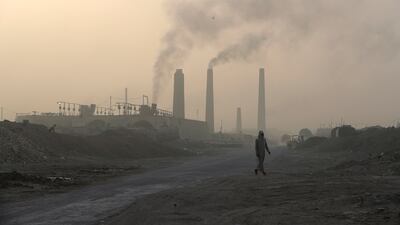
    Smoke rises from brick factory stacks in Nahrawan, Baghdad. Tackling emissions from heavy industry is crucial to tackling global warming. Reuters
  • A boy stands near a flock of sheep as a sandstorm approaches in the Syrian countryside of Tabqa. Syria is among the countries most vulnerable and poorly prepared for climate change, which is expected to worsen. AFP
    A boy stands near a flock of sheep as a sandstorm approaches in the Syrian countryside of Tabqa. Syria is among the countries most vulnerable and poorly prepared for climate change, which is expected to worsen. AFP
  • Mountains of smouldering rubbish at the Bhalswa landfill in New Delhi, India. Reuters
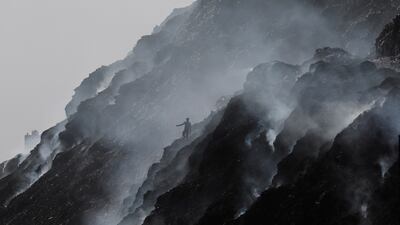
    Mountains of smouldering rubbish at the Bhalswa landfill in New Delhi, India. Reuters
  • Greenpeace activists take part in a climate change protest in front of the Brandenburg Gate in Berlin in May. AP
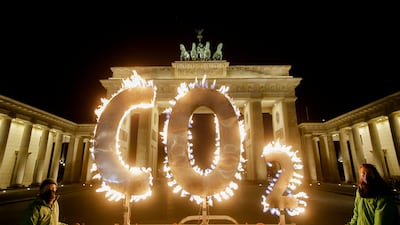
    Greenpeace activists take part in a climate change protest in front of the Brandenburg Gate in Berlin in May. AP
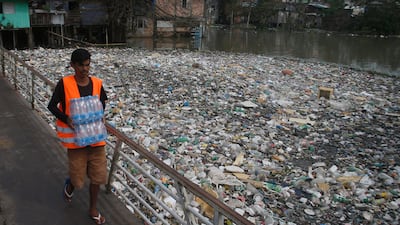
  • A man carries water bottles across the heavily polluted Negro River in Manaus, Brazil. About 35 tonnes of rubbish are removed daily from the river. AP
    A man carries water bottles across the heavily polluted Negro River in Manaus, Brazil. About 35 tonnes of rubbish are removed daily from the river. AP
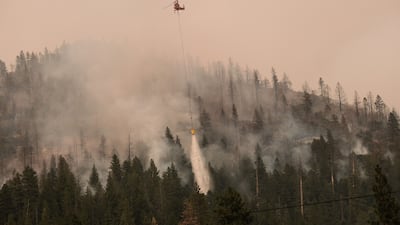
  • A helicopter drops water on a brush fire in California. Bloomberg
    A helicopter drops water on a brush fire in California. Bloomberg
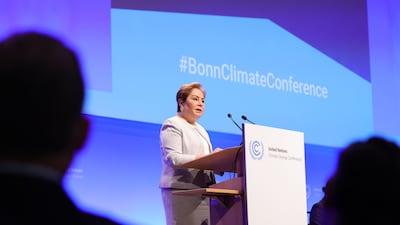
  • UN climate chief Patricia Espinosa speaks on the opening day of the Bonn climate change conference in Germany. Getty
    UN climate chief Patricia Espinosa speaks on the opening day of the Bonn climate change conference in Germany. Getty
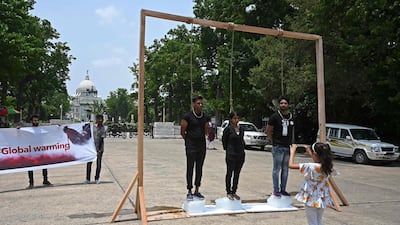
  • Activists take part in a demonstration to raise awareness of global warming, during an event to mark World Environment Day in Kolkata. AFP
    Activists take part in a demonstration to raise awareness of global warming, during an event to mark World Environment Day in Kolkata. AFP
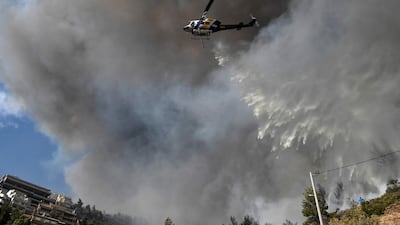
  • A helicopter drops water on a bushfire near a residential district in Athens. The fire forced residents to flee. AFP
    A helicopter drops water on a bushfire near a residential district in Athens. The fire forced residents to flee. AFP
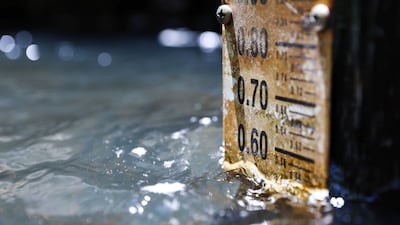
  • A gauge measures water levels in the Rio Nambe river, in New Mexico. Ninety per cent of the state is experiencing extreme drought. Getty
    A gauge measures water levels in the Rio Nambe river, in New Mexico. Ninety per cent of the state is experiencing extreme drought. Getty
  • Afghan refugees search for recyclable material from heaps of rubbish in Karachi, Pakistan. AP
    Afghan refugees search for recyclable material from heaps of rubbish in Karachi, Pakistan. AP
  • A climate activist ties herself to the net during the semi-final tennis match between Croatia's Marin Cilic and Norway's Casper Ruud at the French Open in Roland Garros in Paris. AP
    A climate activist ties herself to the net during the semi-final tennis match between Croatia's Marin Cilic and Norway's Casper Ruud at the French Open in Roland Garros in Paris. AP
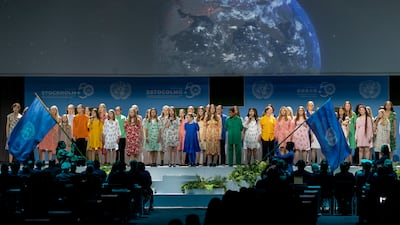
  • A dance group performs at a climate summit in Stockholm, Sweden. Getty
    A dance group performs at a climate summit in Stockholm, Sweden. Getty
  • US climate envoy John Kerry talks to a delegate at the Stockholm 50 climate summit. Getty
    US climate envoy John Kerry talks to a delegate at the Stockholm 50 climate summit. Getty
  • A boat is stranded during low tide at the Chebayesh marsh in Dhi Qar province, Iraq. Reuters
    A boat is stranded during low tide at the Chebayesh marsh in Dhi Qar province, Iraq. Reuters
  • A woman crosses a polluted river in Dhaka, Bangladesh. EPA
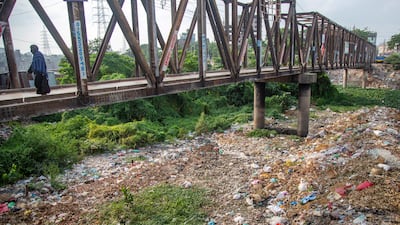
    A woman crosses a polluted river in Dhaka, Bangladesh. EPA
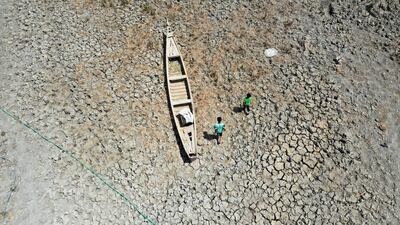
  • A man walks past an abandoned boat in the bed of a drought-affected reservoir on the outskirts of Sana'a, Yemen. EPA
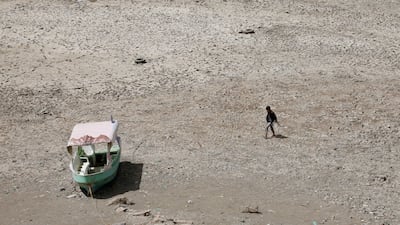
    A man walks past an abandoned boat in the bed of a drought-affected reservoir on the outskirts of Sana'a, Yemen. EPA

The report outlines four key components: forecasting, risk information and early warning systems; planning; financing; and delivery.

An essential part of delivering action is, the report stated, “effective disaster management and social protection systems that can deliver timely assistance to at-risk populations”.

While it says “efforts are being made” to enhance forecasting and risk information in the Mena region, the report warns that capacity, co-ordination and the translation of warnings into action is inadequate.

The report says systems need to be strengthened and greater support from governments is needed, while funds must be sourced from across the globe.

“Ultimately, dedicated funding to prioritise anticipatory action in the context of broader efforts to reduce and manage disaster risk, and to enhance preparedness, will be required,” the report says.

Growing food insecurity

Until now, warnings of impending crises have sometimes not been acted on, suggested Oscar Ekdahl, a Cairo-based regional programme officer for disaster risk management and climate change at the WFP.

“In the past, there have been early warnings of drought but we’ve not acted,” he said.

“Warnings have been there, but the decision-making process has not been lined up to say, ‘This is what we’re going to do.’ That’s what anticipatory action can do."

Mageed Yahia, director of the WFP for the GCC, told the conference there could not be “a more pressing time” when it came to the region’s food situation.

Mageed Yahia said 345 million people around the world face acute food insecurity – double the pre-pandemic number. Leslie Pableo / The National

“Three years after the pandemic and the cost of increasing food prices and ongoing conflicts and the impact of climate change are driving the number in the population in need of humanitarian assistance,” he said.

Now, he said, 345 million people around the world face acute food insecurity — double the pre-pandemic number.

He said the WFP was investing in early-warning systems in countries such as Jordan and Yemen to identify where food insecurity may develop.

“We hope that more partners will join us in moving ahead,” he said.

“I’m also encouraged that there is representation from the UAE. The UAE is taking bold steps to reduce emissions and to respond to climate change at home and abroad.”

Dr Emad Adly, general co-ordinator at the Arab Network for Environment and Development, told the conference that Cop27, to be held in Sharm El Sheikh in November, offered an opportunity to strengthen advance action to prevent crises.

He said organisations, including UN agencies and international organisations, would be able to develop projects outside of the main conference agenda.

“We have to give more support to the hotspots in our countries,” he said.

Islamophobia definition

A widely accepted definition was made by the All Party Parliamentary Group on British Muslims in 2019: “Islamophobia is rooted in racism and is a type of racism that targets expressions of Muslimness or perceived Muslimness.” It further defines it as “inciting hatred or violence against Muslims”.

The%20new%20Turing%20Test
%3Cp%3EThe%20Coffee%20Test%3C%2Fp%3E%0A%3Cp%3E%3Cem%3EA%20machine%20is%20required%20to%20enter%20an%20average%20American%20home%20and%20figure%20out%20how%20to%20make%20coffee%3A%20find%20the%20coffee%20machine%2C%20find%20the%20coffee%2C%20add%20water%2C%20find%20a%20mug%20and%20brew%20the%20coffee%20by%20pushing%20the%20proper%20buttons.%3C%2Fem%3E%3C%2Fp%3E%0A%3Cp%3EProposed%20by%20Steve%20Wozniak%2C%20Apple%20co-founder%3C%2Fp%3E%0A
What can victims do?

Always use only regulated platforms

Stop all transactions and communication on suspicion

Save all evidence (screenshots, chat logs, transaction IDs)

Report to local authorities

Warn others to prevent further harm

Courtesy: Crystal Intelligence

RESULTS

5pm: Maiden (PA) Dh80,000 1,400m
Winner: JAP Almahfuz, Fernando Jara (jockey), Irfan Ellahi (trainer).

5.30pm: Handicap (PA) Dh90,000 1,400m​​​​​​​
Winner: AF Momtaz, Antonio Fresu, Musabah Al Muhairi.

6pm: Handicap (TB) Dh100,000 1,400m​​​​​​​
Winner: Yaalail, Fernando Jara, Ali Rashid Al Raihe.

6.30pm: Abu Dhabi Championship Listed (PA) Dh180,000 1,600m​​​​​​​
Winner: Ihtesham, Szczepan Mazur, Ibrahim Al Hadhrami.

7pm: Wathba Stallions Cup Handicap (PA) Dh70,000 1,600m​​​​​​​
Winner: Dahess D’Arabie, Fernando Jara, Helal Al Alawi.

7.30pm: Maiden (PA) Dh80,000 2.200m
​​​​​​​Winner: Ezz Al Rawasi, Connor Beasley, Helal Al Alawi.

The specs

Engine: Dual 180kW and 300kW front and rear motors

Power: 480kW

Torque: 850Nm

Transmission: Single-speed automatic

Price: From Dh359,900 ($98,000)

On sale: Now

How to help

Send “thenational” to the following numbers or call the hotline on: 0502955999
2289 – Dh10
2252 – Dh 50
6025 – Dh20
6027 – Dh 100
6026 – Dh 200

Updated: August 10, 2022, 11:06 AM