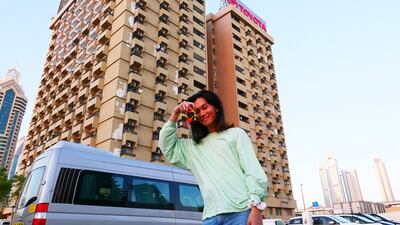
Dubai's famous Toyota Building lights up Sheikh Zayed Road again


John Dennehy
  • English
  • Arabic

In an era before Burj Khalifa, there were two landmarks to tell you you had arrived in Dubai. One was the World Trade Centre and the other was the Toyota Building.

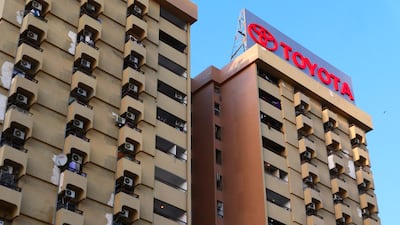
Named so because of its neon sign, the Toyota Building served as a reference point as the city expanded. In 2018, the sign disappeared.

The two-block residential tower is properly known as the Nasser Rashid Lootah Building and its owners, the NRL Group, told The National that the advertising contract with Toyota was renewed recently.

“The contract ended several years ago but it has started again,” the group said.

The English sign was restored to the side of the building that greets drivers heading north towards Sharjah, while an Arabic sign has been installed on the opposite side.

Al Futtaim Toyota also said on Monday the sign was back “by popular demand” following a survey.

There is a lot of nostalgia and fond memories that Dubai residents associate with the billboard. Bringing it back is our tribute to the spirit of Dubai
Vincent Wijnen,
senior managing director, Al Futtaim Automotive

“There is a lot of nostalgia and fond memories that Dubai residents associate with the billboard,” said Vincent Wijnen, senior managing director at Al Futtaim Automotive. “Bringing it back is our tribute to the spirit of Dubai.”

The significance of the Lootah tower, however, goes far beyond a simple sign, and, like all old buildings in Dubai, it has a story to tell.

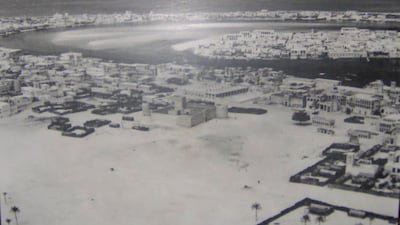
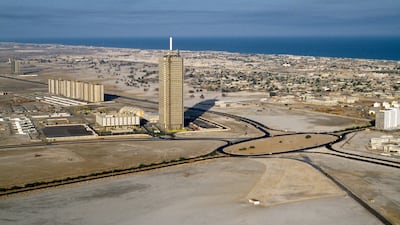
It appeared on the city’s skyline at some point in the late 1970s. Archive photographs taken by Gulf News photographers from the World Trade Centre in 1979 show it close to completion.

It was one of the few high-rises in Dubai then, surrounded by nothing but sand, beside what was known as Defence Roundabout. All Futtaim Toyota said the sign was installed in the 1980s but neon was not new in Dubai.

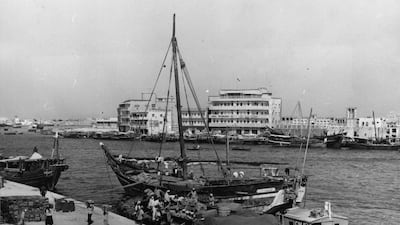
“Neon signage had … already lit up the night sky for nearly two decades from on top of buildings along Dubai Creek,” said Todd Reisz, author of Showpiece City: How Architecture Made Dubai.

Rather than the sign, Mr Reisz said the building’s significance lies more in representing a new phase in Dubai’s expansion.

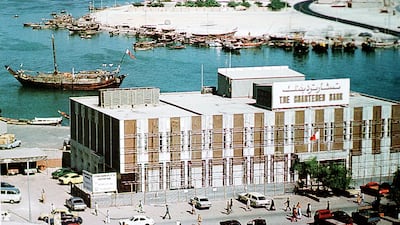
“The Toyota signage and the building below it were part of a ramped-up campaign to stretch the city beyond the Creek, towards the city’s developing new ports,” said Mr Reisz, referring to Port Rashid, Dubai Drydocks and Jebel Ali Port.

“Probably completed in the late 1970s or early 1980s just after the World Trade Centre, the Lootah building helped to configure the Abu Dhabi road, not yet known as Sheikh Zayed Road, as the city’s spine.”

The building reflects its era. Its concrete, shaded balconies and smaller windows offered residents respite from the searing heat.

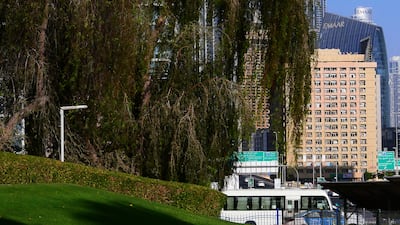
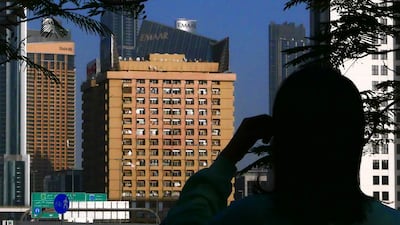
Over the years, however, the tower has been overshadowed by modern skyscrapers, including the world's tallest building, Burj Khalifa.

Its once white exterior has been painted brown but older external air conditioning units still dot the exterior. On the ground floor are some small shops including a grocery, laundry and restaurant. A rudimentary street gym has closed, with locks on the door and faded posters of musclemen yellowing on the walls.

That the building remains is a statement in itself and many residents still call it home. The NRL Group said it plans a maintenance programme soon.

Yasser Elsheshtawy, adjunct professor of architecture at Columbia University in the US and expert on urbanism in the Gulf, cautioned against getting too nostalgic about such buildings as there are times when people need to step back and look at what the city needs.

“It is natural to think fondly of some of these buildings and associate some romantic idea of the ‘good old times’ and sense of community,” he said. “But this could be wishful thinking and not truly what existed at the time.

“The danger is that nostalgia is attached to these buildings. I personally don’t think much would be lost if it were to be demolished. People who live there need to be relocated and given appropriate housing. It could be a park and provide an open air space for people in that area.”

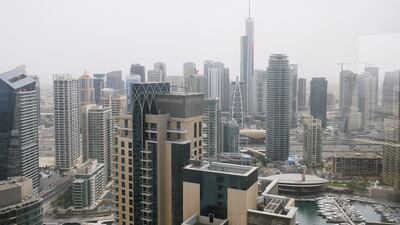
The Lootah building is now surrounded by skyscrapers. Pawan Singh / The National

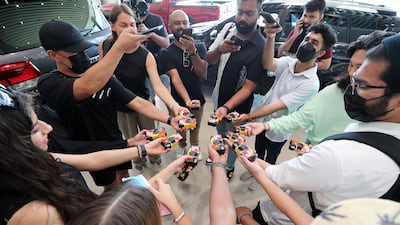
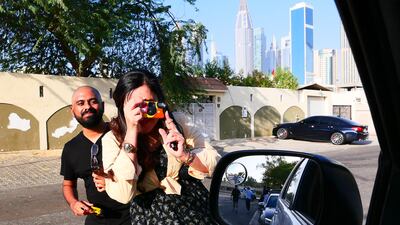
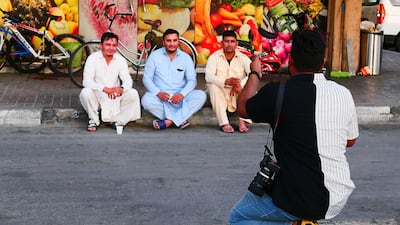
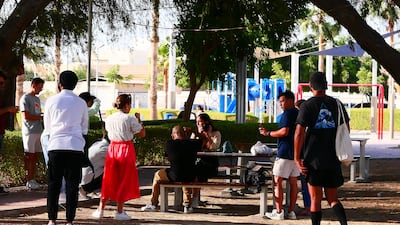
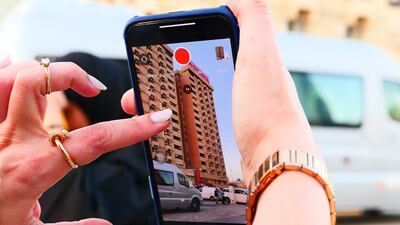
The privately-owned tower and wider neighbourhood have been the subject of a recent photographic tour run by Dubai’s Gulf Photo Plus that examined the area’s history and urban development.

“Toyota have done a great service to the participants and residents by highlighting this local icon,” said Gulf Photo Plus’s Raz Hansrod.

“And [by] using the opportunity of the sign reinstatement to share cultural insights with participants and the wider community,” said Mr Hansrod, who said Toyota had contacted them about a tour and they worked together to place the building in a historic context.

This tour also reflects the surge of interest in the UAE’s architectural heritage over the past few years, including Mr Reisz’s and Prof Elsheshtawy's work.

Sultan Sooud Al Qassemi and Mr Reisz also co-edited Building Sharjah, a book which documented modernist architecture in the emirate. Sharjah Art Foundation has restored buildings such as the Flying Saucer, while the Sharjah Architecture Triennial holds walking tours of historic neighbourhoods.

In Abu Dhabi, a modern heritage initiative aims to safeguard its historic architecture, while in 2018 Dubai Municipality launched one of its own.

But questions will always swirl about redevelopment when it comes to these buildings.

“There have been multiple rumours about pending demolition,” Mr Reisz said.

“That’s not surprising considering that it is clearly of another era and now in the midst of a new district targeting an income level beyond that of current residents. The building once announced Dubai’s economic advancement. Today, it survives as a hope for a more demographically integrated Dubai.”

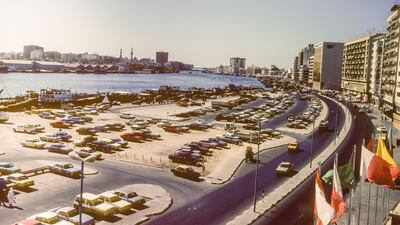
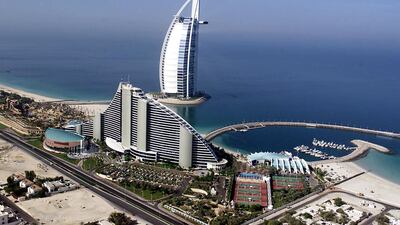
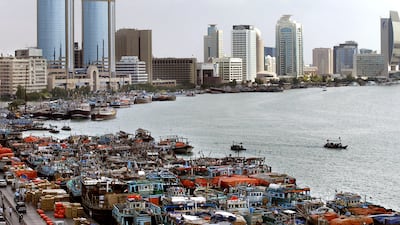
Dubai's development through the years — in pictures

Timeline

2012-2015

The company offers payments/bribes to win key contracts in the Middle East

May 2017

The UK SFO officially opens investigation into Petrofac’s use of agents, corruption, and potential bribery to secure contracts

September 2021

Petrofac pleads guilty to seven counts of failing to prevent bribery under the UK Bribery Act

October 2021

Court fines Petrofac £77 million for bribery. Former executive receives a two-year suspended sentence 

December 2024

Petrofac enters into comprehensive restructuring to strengthen the financial position of the group

May 2025

The High Court of England and Wales approves the company’s restructuring plan

July 2025

The Court of Appeal issues a judgment challenging parts of the restructuring plan

August 2025

Petrofac issues a business update to execute the restructuring and confirms it will appeal the Court of Appeal decision

October 2025

Petrofac loses a major TenneT offshore wind contract worth €13 billion. Holding company files for administration in the UK. Petrofac delisted from the London Stock Exchange

November 2025

180 Petrofac employees laid off in the UAE

Who's who in Yemen conflict

Houthis: Iran-backed rebels who occupy Sanaa and run unrecognised government

Yemeni government: Exiled government in Aden led by eight-member Presidential Leadership Council

Southern Transitional Council: Faction in Yemeni government that seeks autonomy for the south

Habrish 'rebels': Tribal-backed forces feuding with STC over control of oil in government territory

Mercer, the investment consulting arm of US services company Marsh & McLennan, expects its wealth division to at least double its assets under management (AUM) in the Middle East as wealth in the region continues to grow despite economic headwinds, a company official said.

Mercer Wealth, which globally has $160 billion in AUM, plans to boost its AUM in the region to $2-$3bn in the next 2-3 years from the present $1bn, said Yasir AbuShaban, a Dubai-based principal with Mercer Wealth.

Within the next two to three years, we are looking at reaching $2 to $3 billion as a conservative estimate and we do see an opportunity to do so,” said Mr AbuShaban.

Mercer does not directly make investments, but allocates clients’ money they have discretion to, to professional asset managers. They also provide advice to clients.

“We have buying power. We can negotiate on their (client’s) behalf with asset managers to provide them lower fees than they otherwise would have to get on their own,” he added.

Mercer Wealth’s clients include sovereign wealth funds, family offices, and insurance companies among others.

From its office in Dubai, Mercer also looks after Africa, India and Turkey, where they also see opportunity for growth.

Wealth creation in Middle East and Africa (MEA) grew 8.5 per cent to $8.1 trillion last year from $7.5tn in 2015, higher than last year’s global average of 6 per cent and the second-highest growth in a region after Asia-Pacific which grew 9.9 per cent, according to consultancy Boston Consulting Group (BCG). In the region, where wealth grew just 1.9 per cent in 2015 compared with 2014, a pickup in oil prices has helped in wealth generation.

BCG is forecasting MEA wealth will rise to $12tn by 2021, growing at an annual average of 8 per cent.

Drivers of wealth generation in the region will be split evenly between new wealth creation and growth of performance of existing assets, according to BCG.

Another general trend in the region is clients’ looking for a comprehensive approach to investing, according to Mr AbuShaban.

“Institutional investors or some of the families are seeing a slowdown in the available capital they have to invest and in that sense they are looking at optimizing the way they manage their portfolios and making sure they are not investing haphazardly and different parts of their investment are working together,” said Mr AbuShaban.

Some clients also have a higher appetite for risk, given the low interest-rate environment that does not provide enough yield for some institutional investors. These clients are keen to invest in illiquid assets, such as private equity and infrastructure.

“What we have seen is a desire for higher returns in what has been a low-return environment specifically in various fixed income or bonds,” he said.

“In this environment, we have seen a de facto increase in the risk that clients are taking in things like illiquid investments, private equity investments, infrastructure and private debt, those kind of investments were higher illiquidity results in incrementally higher returns.”

The Abu Dhabi Investment Authority, one of the largest sovereign wealth funds, said in its 2016 report that has gradually increased its exposure in direct private equity and private credit transactions, mainly in Asian markets and especially in China and India. The authority’s private equity department focused on structured equities owing to “their defensive characteristics.”

Pharaoh's curse

British aristocrat Lord Carnarvon, who funded the expedition to find the Tutankhamun tomb, died in a Cairo hotel four months after the crypt was opened.
He had been in poor health for many years after a car crash, and a mosquito bite made worse by a shaving cut led to blood poisoning and pneumonia.
Reports at the time said Lord Carnarvon suffered from “pain as the inflammation affected the nasal passages and eyes”.
Decades later, scientists contended he had died of aspergillosis after inhaling spores of the fungus aspergillus in the tomb, which can lie dormant for months. The fact several others who entered were also found dead withiin a short time led to the myth of the curse.

'The Coddling of the American Mind: How Good Intentions and Bad Ideas are Setting up a Generation for Failure' ​​​​
Greg Lukianoff and Jonathan Haidt, Penguin Randomhouse

UAE currency: the story behind the money in your pockets
SPEC%20SHEET%3A%20SAMSUNG%20GALAXY%20S23%20ULTRA
%3Cp%3E%3Cstrong%3EDisplay%3A%3C%2Fstrong%3E%206.8%22%20edge%20quad-HD%2B%20dynamic%20Amoled%202X%2C%20Infinity-O%2C%203088%20x%201440%2C%20500ppi%2C%20HDR10%2B%2C%20120Hz%3C%2Fp%3E%0A%3Cp%3E%3Cstrong%3EProcessor%3A%3C%2Fstrong%3E%204nm%20Qualcomm%20Snapdragon%208%20Gen%202%2C%2064-bit%20octa-core%3C%2Fp%3E%0A%3Cp%3E%3Cstrong%3EMemory%3A%3C%2Fstrong%3E%208%2F12GB%20RAM%3C%2Fp%3E%0A%3Cp%3E%3Cstrong%3EStorage%3A%3C%2Fstrong%3E%20128%2F256%2F512GB%2F1TB%20(only%20128GB%20has%20an%208GB%20RAM%20option)%3C%2Fp%3E%0A%3Cp%3E%3Cstrong%3EPlatform%3A%3C%2Fstrong%3E%20Android%2013%3C%2Fp%3E%0A%3Cp%3E%3Cstrong%3EMain%20camera%3A%3C%2Fstrong%3E%20quad%2012MP%20ultra-wide%20f%2F2.2%20%2B%20200MP%20wide%20f%2F1.7%20%2B%2010MP%20telephoto%20f%2F4.9%20%2B%2010MP%20telephoto%202.4%3B%203x%2F10x%20optical%20zoom%2C%20Space%20Zoom%20up%20to%20100x%3B%20auto%20HDR%2C%20expert%20RAW%3C%2Fp%3E%0A%3Cp%3E%3Cstrong%3EVideo%3A%3C%2Fstrong%3E%208K%4024%2F30fps%2C%204K%4060fps%2C%20full-HD%4060fps%2C%20HD%4030fps%2C%20full-HD%20super%20slo-mo%40960fps%3C%2Fp%3E%0A%3Cp%3E%3Cstrong%3EFront%20camera%3A%3C%2Fstrong%3E%2012MP%20f%2F2.2%3C%2Fp%3E%0A%3Cp%3E%3Cstrong%3EBattery%3A%3C%2Fstrong%3E%205000mAh%2C%20fast%20wireless%20charging%202.0%2C%20Wireless%20PowerShare%3C%2Fp%3E%0A%3Cp%3E%3Cstrong%3EConnectivity%3A%3C%2Fstrong%3E%205G%2C%20Wi-Fi%2C%20Bluetooth%205.2%2C%20NFC%3C%2Fp%3E%0A%3Cp%3E%3Cstrong%3EI%2FO%3A%3C%2Fstrong%3E%20USB-C%3B%20built-in%20Galaxy%20S%20Pen%3C%2Fp%3E%0A%3Cp%3E%3Cstrong%3ESIM%3A%3C%2Fstrong%3E%20single%20nano%20%2F%20nano%20%2B%20eSIM%20%2F%20nano%20%2B%20nano%20%2B%20eSIM%20%2F%20nano%20%2B%20nano%3C%2Fp%3E%0A%3Cp%3E%3Cstrong%3EColours%3A%3C%2Fstrong%3E%20cream%2C%20green%2C%20lavender%2C%20phantom%20black%3B%20online%20exclusives%3A%20graphite%2C%20lime%2C%20red%2C%20sky%20blue%3C%2Fp%3E%0A%3Cp%3E%3Cstrong%3EPrice%3A%3C%2Fstrong%3E%20Dh4%2C949%20for%20256GB%2C%20Dh5%2C449%20for%20512GB%2C%20Dh6%2C449%20for%201TB%3B%20128GB%20unavailable%20in%20the%20UAE%3C%2Fp%3E%0A
Groom and Two Brides

Director: Elie Semaan

Starring: Abdullah Boushehri, Laila Abdallah, Lulwa Almulla

Rating: 3/5

COMPANY%20PROFILE%20
%3Cp%3E%3Cstrong%3ECompany%20name%3A%20%3C%2Fstrong%3ENomad%20Homes%3Cbr%3E%3Cstrong%3EStarted%3A%20%3C%2Fstrong%3E2020%3Cbr%3E%3Cstrong%3EFounders%3A%20%3C%2Fstrong%3EHelen%20Chen%2C%20Damien%20Drap%2C%20and%20Dan%20Piehler%3Cbr%3E%3Cstrong%3EBased%3A%3C%2Fstrong%3E%20UAE%20and%20Europe%3Cbr%3E%3Cstrong%3EIndustry%3C%2Fstrong%3E%3A%20PropTech%3Cbr%3E%3Cstrong%3EFunds%20raised%20so%20far%3A%3C%2Fstrong%3E%20%2444m%3Cbr%3E%3Cstrong%3EInvestors%3A%3C%2Fstrong%3E%20Acrew%20Capital%2C%2001%20Advisors%2C%20HighSage%20Ventures%2C%20Abstract%20Ventures%2C%20Partech%2C%20Precursor%20Ventures%2C%20Potluck%20Ventures%2C%20Knollwood%20and%20several%20undisclosed%20hedge%20funds%3C%2Fp%3E%0A
The specs

Engine: 4.0-litre V8 twin-turbocharged and three electric motors

Power: Combined output 920hp

Torque: 730Nm at 4,000-7,000rpm

Transmission: 8-speed dual-clutch automatic

Fuel consumption: 11.2L/100km

On sale: Now, deliveries expected later in 2025

Price: expected to start at Dh1,432,000

How to avoid crypto fraud
  • Use unique usernames and passwords while enabling multi-factor authentication.
  • Use an offline private key, a physical device that requires manual activation, whenever you access your wallet.
  • Avoid suspicious social media ads promoting fraudulent schemes.
  • Only invest in crypto projects that you fully understand.
  • Critically assess whether a project’s promises or returns seem too good to be true.
  • Only use reputable platforms that have a track record of strong regulatory compliance.
  • Store funds in hardware wallets as opposed to online exchanges.
ETFs explained

Exhchange traded funds are bought and sold like shares, but operate as index-tracking funds, passively following their chosen indices, such as the S&P 500, FTSE 100 and the FTSE All World, plus a vast range of smaller exchanges and commodities, such as gold, silver, copper sugar, coffee and oil.

ETFs have zero upfront fees and annual charges as low as 0.07 per cent a year, which means you get to keep more of your returns, as actively managed funds can charge as much as 1.5 per cent a year.

There are thousands to choose from, with the five biggest providers BlackRock’s iShares range, Vanguard, State Street Global Advisors SPDR ETFs, Deutsche Bank AWM X-trackers and Invesco PowerShares.

Updated: January 31, 2023, 10:36 AM