



A visually impaired student in Abu Dhabi has spoken of her journey from living in denial to becoming an advocate for change and accessibility.
Price Maccarthy, 22, from Ghana, has no vision in one eye and only partial sight in the other. Her vision has been impaired since she was 7, but she often hid her disability from others.
On Monday, she graduated in legal studies and was happy to be a part of the New York University Abu Dhabi commencement ceremony.
She said coming to Abu Dhabi for university changed her life.
Ms Maccarthy said she was studying aerospace engineering in Ghana when she had to undergo surgery at the age of 16 to improve her vision.
“At that time, the vision in my other eye was fluctuating and the doctors were trying to stabilise it, but it did not work,” she said.
She had to take time off for the surgery, missed some exams and was asked to repeat the year at the university.
Ms Maccarthy felt dejected at the thought of repeating the year and decided to move to Abu Dhabi to study for a bachelor's degree in legal studies, with the goal of later studying for a doctorate in the field.
“When I started at NYUAD, I was just in denial that I had a disability because my parents told me that it was something I had to hide,” said Ms Maccarthy.
“A friend of mine saw me struggling, tripping, falling and having blackouts so she took me to the Moses Centre office, a centre for accessibility and accommodation at NYUAD.”
During the pandemic, her eyesight deteriorated further and the university had to provide her with a walking stick.

Several people on campus reached out and told her about different ways she could seek help or advice.
It was then that she realised that although departments were trying to help students, the students themselves were unaware of what was being offered to them.
“I decided to take matters into my own hands. I thought what better way to do it than through joining the student government?” said Ms Maccarthy.
The student government is a student-led organisation at the university that serves the student body.
Ms Maccarthy was elected to the position of chairwoman of the diversity committee.
“It was the beginning of my accessibility advocacy journey. For the first time in my life, it felt like, instead of waiting for departments to reach out to me and ask me how they could be accessible, I could set up meetings with people in administration and say, 'these are some things I noticed and this is how you could help',” she said.
“During the pandemic, the university changed entry and exit routes but that meant the routes that visually impaired students had memorised or how they went about navigating the campus changed significantly.”
At that time, students were asked to collect deliveries in the evening from a different entrance than usual.
But visually impaired people were not used to this. So, Ms Maccarthy ensured that students who had vision problems were allowed to receive deliveries from the usual entry point.
She also had menu placards at a university cafeteria replaced with QR codes to make it easier for students to know food options.
Usually, in such cases, the QR code tactile indicator works by placing a Braille sticker over the QR Code that helps people with limited eyesight and they know what to order. Before the new system was brought in, students with vision problems had to depend on others to read out the menu to them.
She also focused on making university events more accessible by asking others to remove disability-related barriers.
Ms Maccarthy said there were areas that all universities could focus on to make campus life easier for students with disabilities.
Universities should focus on mobility training which can help people with disabilities get acquainted with their environment, teaching them the routes to classrooms.
She said people focused on creating awareness and educating others, but not enough time was spent focusing on the needs of disabled people.
“It's mostly about education for the greater public, so that they are not ignorant about certain things, or what to say or what not to say.”
NYUAD commencement ceremony 2022 - in pictures
-
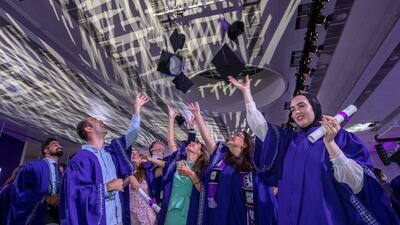
More than 360 New York University Abu Dhabi students from 85 countries received their degrees at the university’s ninth commencement ceremony on Monday. All photos: Victor Besa / The National -
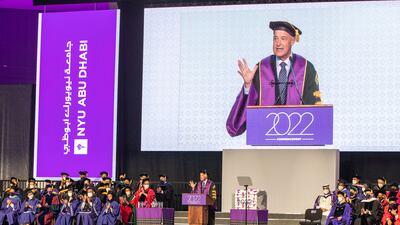
NYU President Andrew Hamilton speaking at the graduation ceremony in Abu Dhabi. -

Students were able to graduate at an in-person ceremony on Monday for the first time since the Covid-19 pandemic began. -

This year, graduates were delighted to be met with all the traditional pomp and splendour. -

A partnership between New York University and the Abu Dhabi government, NYUAD welcomed its inaugural class in 2010. -
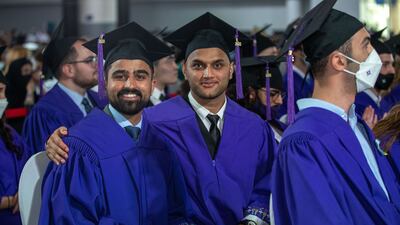
Wajahat Mirza and Uttam Mishra smile on their graduation day. -
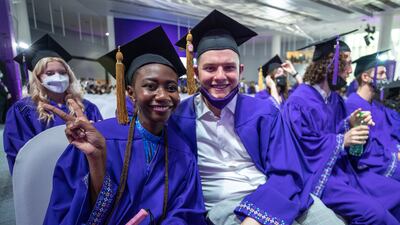
Price Maccarthy and Kacper Madejek Kim pose for the camera in their ceremonial gowns. -

Kathia Faz Nowak and Nadja Fenzic were among the hundreds of graduates happy to attend the ceremony in person. -
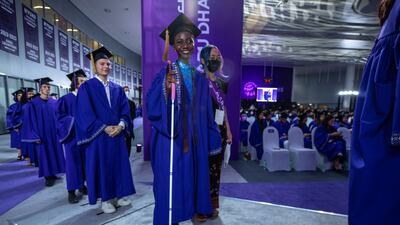
Graduates line up to receive their diplomas. -
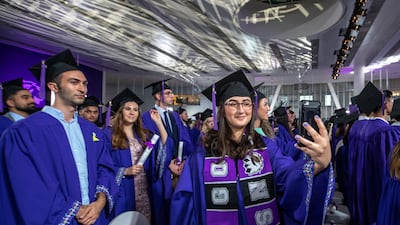
A happy graduate takes a selfie.



