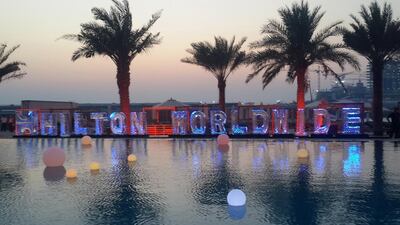
• UV rays from the sun can wreak havoc on human skin, experts have warned. Pawan Singh / The National
    UV rays from the sun can wreak havoc on human skin, experts have warned. Pawan Singh / The National
  • Experts have warned of the perils of not covering up in the extreme heat. Chris Whiteoak / The National
    Experts have warned of the perils of not covering up in the extreme heat. Chris Whiteoak / The National
  • The current UV rating in Dubai suggests there is a high risk for people sunning themselves without protection. Chris Whiteoak / The National
    The current UV rating in Dubai suggests there is a high risk for people sunning themselves without protection. Chris Whiteoak / The National
  • Sunblock of at least factor 50 is advised if sunning yourself in the UAE. Pawan Singh / The National
    Sunblock of at least factor 50 is advised if sunning yourself in the UAE. Pawan Singh / The National
  • The UV rays from the sun are increasing all the time, along with skin cancer rates. Khushnum Bhandari / The National
    The UV rays from the sun are increasing all the time, along with skin cancer rates. Khushnum Bhandari / The National

Dubai and Abu Dhabi weather in summer: Skin damage warning over ultra-high UV levels


Patrick Ryan
  • English
  • Arabic

UAE sun-seekers are being urged to take care while topping up their tans as the heat climbs this summer.

Skin experts pointed out the health risks as temperatures begin to climb.

May is Skin Cancer Awareness Month.

One in every three cancers diagnosed in the world today is a skin cancer, and even though survival rates are high, so is complacency say doctors.

In recent weeks, BBC Weather, one of the few global forecasters to publish daily UV levels, rated levels in the UAE as 'extreme' - the highest on its chart.

Dr Shivani Wadhwa, one of the country’s top dermatologists, at Fakeeh University Hospital in Dubai, said current UV levels were already in the high-risk category.

“In Dubai, the sun shines very strongly, even in winter,” she said.

Dr Shivani Wadhwa, specialist dermatologist at Fakeeh University Hospital, Dubai Silicon Oasis.

The UV index in the summer months, between March and September, is usually the highest.

“At the moment, the UV index is in the range of 8-9, which is considered a high-risk category.”

The index is an international standard measurement of the intensity of radiation emitting from the Sun.

Summer sunshine can be a health risk

Most skin types are able to get a perfect tan when the index is between 3 and 7, anything above that is considered dangerous to the skin.

“Sunburn is one of the most dangerous results of sun damage,” Dr Wadhwa said.

“However, other related issues include damaged skin cells, damaged blood vessels, skin that starts to look wrinkled, dry, patchy and stretchy."

Because of sun damage, the skin becomes prone to further damage such as bruising, and the slow healing of cuts.

“The most serious threat is of skin cancer, and its prevalence is increasing globally,” she said.

According to the World Health Organisation (WHO) there are between two and three million new cases of skin cancer every year around the world.

The WHO said the numbers were rising because more UV radiation finds its way to the Earth’s surface as the ozone layer continues to be depleted by pollution.

Another Dubai dermatologist said it was vital that people care for their skin in the Middle East.

“Applying a broad spectrum sunscreen with a SPF of 50+, depending on your skin type, will protect your skin from dryness and damage from harsh UV radiation,” said Dr Saima Anwar, a dermatologist from the Nova Clinic.

  • Courtesy Gulf Ice and Modern Ice Factory​
    Courtesy Gulf Ice and Modern Ice Factory​
  • Courtesy The Dubai Mall
    Courtesy The Dubai Mall
  • Courtesy Nysa Spa
    Courtesy Nysa Spa
  • Courtesy Talise Ottoman Spa
    Courtesy Talise Ottoman Spa
  • Courtesy Desert Snow
    Courtesy Desert Snow
  • Courtesy Cryotherapy, Jumeirah Emirates Towers
    Courtesy Cryotherapy, Jumeirah Emirates Towers
  • Victor Besa for The National
    Victor Besa for The National

“If you are staying outdoors for more than two hours then remember to reapply the sunscreen, and I’d recommend even more frequent use for people taking part in outdoor sports, water sports or swimming.

“One thing to remember is to always make sure you protect your eyes, lips and feet as well.”

Cover up to stay safe

Covering up during peak sunshine hours is key to staying safe in the heat, another dermatologist said.

“Unprotected skin will be damaged and can burn in minutes,” said Edwidge Gandin, a beautician from Pastels Salon in Dubai.

“In addition to wearing sunscreen, avoid the sun between 11am and 3pm. If you are in the sun, cover up, and wear a hat, sunglasses and sunscreen.

“Also, don’t forget that white sand and other bright surfaces reflect UV and increase UV exposure.”

The most common mistake people make in the sun is they forget to reapply their sunblock, which needs to be touched up every two hours, she said.

By exposing your skin to the sun, you will accelerate the ageing process and see visible signs of damage,” Ms Gandin said.

“Aside from suffering from the redness associated with sunburn, your skin will take on a dehydrated appearance and you will see sunspots, pigmentation differences occurring on the surface of the skin,” she said.

“Although a tan may be a beauty ideal, it is better to avoid tanning because a tan is evidence of the skin having been damaged.”


Director: Laxman Utekar

Cast: Vicky Kaushal, Akshaye Khanna, Diana Penty, Vineet Kumar Singh, Rashmika Mandanna

Rating: 1/5

Dust and sand storms compared

Sand storm

  • Particle size: Larger, heavier sand grains
  • Visibility: Often dramatic with thick "walls" of sand
  • Duration: Short-lived, typically localised
  • Travel distance: Limited 
  • Source: Open desert areas with strong winds

Dust storm

  • Particle size: Much finer, lightweight particles
  • Visibility: Hazy skies but less intense
  • Duration: Can linger for days
  • Travel distance: Long-range, up to thousands of kilometres
  • Source: Can be carried from distant regions
Who has been sanctioned?

Daniella Weiss and Nachala
Described as 'the grandmother of the settler movement', she has encouraged the expansion of settlements for decades. The 79 year old leads radical settler movement Nachala, whose aim is for Israel to annex Gaza and the occupied West Bank, where it helps settlers built outposts.

Harel Libi & Libi Construction and Infrastructure
Libi has been involved in threatening and perpetuating acts of aggression and violence against Palestinians. His firm has provided logistical and financial support for the establishment of illegal outposts.

Zohar Sabah
Runs a settler outpost named Zohar’s Farm and has previously faced charges of violence against Palestinians. He was indicted by Israel’s State Attorney’s Office in September for allegedly participating in a violent attack against Palestinians and activists in the West Bank village of Muarrajat.

Coco’s Farm and Neria’s Farm
These are illegal outposts in the West Bank, which are at the vanguard of the settler movement. According to the UK, they are associated with people who have been involved in enabling, inciting, promoting or providing support for activities that amount to “serious abuse”.

Mercer, the investment consulting arm of US services company Marsh & McLennan, expects its wealth division to at least double its assets under management (AUM) in the Middle East as wealth in the region continues to grow despite economic headwinds, a company official said.

Mercer Wealth, which globally has $160 billion in AUM, plans to boost its AUM in the region to $2-$3bn in the next 2-3 years from the present $1bn, said Yasir AbuShaban, a Dubai-based principal with Mercer Wealth.

Within the next two to three years, we are looking at reaching $2 to $3 billion as a conservative estimate and we do see an opportunity to do so,” said Mr AbuShaban.

Mercer does not directly make investments, but allocates clients’ money they have discretion to, to professional asset managers. They also provide advice to clients.

“We have buying power. We can negotiate on their (client’s) behalf with asset managers to provide them lower fees than they otherwise would have to get on their own,” he added.

Mercer Wealth’s clients include sovereign wealth funds, family offices, and insurance companies among others.

From its office in Dubai, Mercer also looks after Africa, India and Turkey, where they also see opportunity for growth.

Wealth creation in Middle East and Africa (MEA) grew 8.5 per cent to $8.1 trillion last year from $7.5tn in 2015, higher than last year’s global average of 6 per cent and the second-highest growth in a region after Asia-Pacific which grew 9.9 per cent, according to consultancy Boston Consulting Group (BCG). In the region, where wealth grew just 1.9 per cent in 2015 compared with 2014, a pickup in oil prices has helped in wealth generation.

BCG is forecasting MEA wealth will rise to $12tn by 2021, growing at an annual average of 8 per cent.

Drivers of wealth generation in the region will be split evenly between new wealth creation and growth of performance of existing assets, according to BCG.

Another general trend in the region is clients’ looking for a comprehensive approach to investing, according to Mr AbuShaban.

“Institutional investors or some of the families are seeing a slowdown in the available capital they have to invest and in that sense they are looking at optimizing the way they manage their portfolios and making sure they are not investing haphazardly and different parts of their investment are working together,” said Mr AbuShaban.

Some clients also have a higher appetite for risk, given the low interest-rate environment that does not provide enough yield for some institutional investors. These clients are keen to invest in illiquid assets, such as private equity and infrastructure.

“What we have seen is a desire for higher returns in what has been a low-return environment specifically in various fixed income or bonds,” he said.

“In this environment, we have seen a de facto increase in the risk that clients are taking in things like illiquid investments, private equity investments, infrastructure and private debt, those kind of investments were higher illiquidity results in incrementally higher returns.”

The Abu Dhabi Investment Authority, one of the largest sovereign wealth funds, said in its 2016 report that has gradually increased its exposure in direct private equity and private credit transactions, mainly in Asian markets and especially in China and India. The authority’s private equity department focused on structured equities owing to “their defensive characteristics.”

The specs

Engine: Dual 180kW and 300kW front and rear motors

Power: 480kW

Torque: 850Nm

Transmission: Single-speed automatic

Price: From Dh359,900 ($98,000)

On sale: Now

Formula%204%20Italian%20Championship%202023%20calendar
%3Cp%3EApril%2021-23%3A%20Imola%3Cbr%3EMay%205-7%3A%20Misano%3Cbr%3EMay%2026-28%3A%20SPA-Francorchamps%3Cbr%3EJune%2023-25%3A%20Monza%3Cbr%3EJuly%2021-23%3A%20Paul%20Ricard%3Cbr%3ESept%2029-Oct%201%3A%20Mugello%3Cbr%3EOct%2013-15%3A%20Vallelunga%3C%2Fp%3E%0A
Spec%20sheet
%3Cp%3E%3Cstrong%3EDisplay%3A%3C%2Fstrong%3E%204.7%22%20Retina%20HD%2C%201334%20x%20750%2C%20625%20nits%2C%201400%3A1%2C%20True%20Tone%2C%20P3%3Cbr%3E%3Cstrong%3EChip%3A%3C%2Fstrong%3E%20Apple%20A15%20Bionic%2C%206-core%20CPU%2C%204-core%20GPU%2C%2016-core%20Neural%20Engine%3Cbr%3E%3Cstrong%3ECamera%3A%3C%2Fstrong%3E%2012MP%2C%20f%2F1.8%2C%205x%20digital%20zoom%2C%20Smart%20HDR%2C%20Deep%20Fusion%3Cbr%3E%3Cstrong%3EVideo%3A%3C%2Fstrong%3E%204K%2B%40%2024%2F30%2F60fps%2C%20full%20HD%2B%40%2030%2F60fps%2C%20HD%2B%40%2030%20fps%3Cstrong%3E%3Cbr%3EFront%20camera%3A%20%3C%2Fstrong%3E7MP%2C%20f%2F2.2%2C%20Smart%20HDR%2C%20Deep%20Fusion%3B%20HD%20video%2B%40%2030fps%3Cbr%3E%3Cstrong%3EBattery%3A%3C%2Fstrong%3E%20Up%20to%2015%20hours%20video%2C%2050%20hours%20audio%3B%2050%25%20fast%20charge%20in%2030%20minutes%20with%2020W%20charger%3B%20wireless%20charging%3Cbr%3E%3Cstrong%3EBiometrics%3A%3C%2Fstrong%3E%20Touch%20ID%3Cbr%3E%3Cstrong%3EDurability%3A%3C%2Fstrong%3E%20IP67%2C%20dust%2C%20water%20resistant%20up%20to%201m%20for%2030%20minutes%3Cbr%3E%3Cstrong%3EPrice%3A%3C%2Fstrong%3E%20From%20Dh1%2C849%3C%2Fp%3E%0A
Ten tax points to be aware of in 2026

1. Domestic VAT refund amendments: request your refund within five years

If a business does not apply for the refund on time, they lose their credit.

2. E-invoicing in the UAE

Businesses should continue preparing for the implementation of e-invoicing in the UAE, with 2026 a preparation and transition period ahead of phased mandatory adoption. 

3. More tax audits

Tax authorities are increasingly using data already available across multiple filings to identify audit risks. 

4. More beneficial VAT and excise tax penalty regime

Tax disputes are expected to become more frequent and more structured, with clearer administrative objection and appeal processes. The UAE has adopted a new penalty regime for VAT and excise disputes, which now mirrors the penalty regime for corporate tax.

5. Greater emphasis on statutory audit

There is a greater need for the accuracy of financial statements. The International Financial Reporting Standards standards need to be strictly adhered to and, as a result, the quality of the audits will need to increase.

6. Further transfer pricing enforcement

Transfer pricing enforcement, which refers to the practice of establishing prices for internal transactions between related entities, is expected to broaden in scope. The UAE will shortly open the possibility to negotiate advance pricing agreements, or essentially rulings for transfer pricing purposes. 

7. Limited time periods for audits

Recent amendments also introduce a default five-year limitation period for tax audits and assessments, subject to specific statutory exceptions. While the standard audit and assessment period is five years, this may be extended to up to 15 years in cases involving fraud or tax evasion. 

8. Pillar 2 implementation 

Many multinational groups will begin to feel the practical effect of the Domestic Minimum Top-Up Tax (DMTT), the UAE's implementation of the OECD’s global minimum tax under Pillar 2. While the rules apply for financial years starting on or after January 1, 2025, it is 2026 that marks the transition to an operational phase.

9. Reduced compliance obligations for imported goods and services

Businesses that apply the reverse-charge mechanism for VAT purposes in the UAE may benefit from reduced compliance obligations. 

10. Substance and CbC reporting focus

Tax authorities are expected to continue strengthening the enforcement of economic substance and Country-by-Country (CbC) reporting frameworks. In the UAE, these regimes are increasingly being used as risk-assessment tools, providing tax authorities with a comprehensive view of multinational groups’ global footprints and enabling them to assess whether profits are aligned with real economic activity. 

Contributed by Thomas Vanhee and Hend Rashwan, Aurifer

Updated: May 12, 2022, 7:45 AM