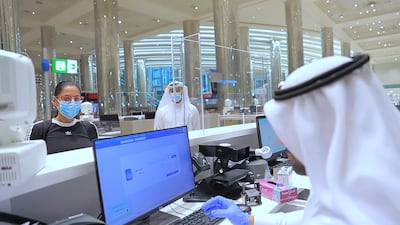
Parents of both Aadithyan Nair and Rishabh Java can now keep sponsoring their sons until they are 25.

UAE’s new visa sponsorship rules for sons a 'huge relief' for parents


Sarwat Nasir
  • English
  • Arabic

Parents in the UAE have expressed their relief at new rules allowing them to sponsor male children until the age of 25.

The UAE’s new visa rule will apparently help them cut costs and not stress over visas whether they were visiting as students or tourists.

The updated law does not affect unmarried daughters as they can remain on their parents’ sponsorship indefinitely.

The change was one of many new visas rules approved by the UAE Cabinet on Monday.

Previously, parents could sponsor their sons only until age 18, and then renew for another three years, provided they were studying in a university.

Students used to have to purchase a university’s visa sponsorship if they chose to study in the UAE, while those studying abroad would come back on visit visas to see their families.

Vinay Java, an Indian parent in Sharjah, said the new rule meant his 19-year-old son Rishabh could better plan for his future, including continuing his studies abroad.

“When my son turns 21, he would have to get his own visa and that was a big worry for us. But this announcement yesterday is a huge relief, and we know that he’ll be able to continue his education without us having to worry about how he’ll enter the UAE,” he said.

“Generally for kids his age, the visa is a big worry because they get stressed about having to get visit visa. It’s a headache.”

Because Rishabh is an Indian citizen with a US visa on his passport, he qualifies for a 14-day visa on arrival to the UAE. But that is not long enough for him to spend an entire summer with his family.

Dr Faizal Malik, a parent in Dubai, has a 19-year-old son who is studying in the UK.

Even though his son Rayyan is a UK citizen and can obtain a UAE visit visa on arrival, Dr Faizal said the UAE was his home and preferred to be on a UAE residency visa, so he can have health insurance.

  • The UAE is offering new types of visa, including options for long-stay tourists, jobseekers, accomplished professionals, star students and high-net-worth individuals. Wam
    The UAE is offering new types of visa, including options for long-stay tourists, jobseekers, accomplished professionals, star students and high-net-worth individuals. Wam
  • A 60-day visit visa for tourists is now standard instead of a 30-day one. Christopher Pike / Bloomberg
    A 60-day visit visa for tourists is now standard instead of a 30-day one. Christopher Pike / Bloomberg
  • The Job Exploration Entry Visa was created to attract young talent and skilled professionals. Photo: Dubai Airports
    The Job Exploration Entry Visa was created to attract young talent and skilled professionals. Photo: Dubai Airports
  • Holders of the Green Visa for Skilled Employees and Freelancers will be able to bring any first-degree relative to live with them. Khushnum Bhandari / The National
    Holders of the Green Visa for Skilled Employees and Freelancers will be able to bring any first-degree relative to live with them. Khushnum Bhandari / The National
  • A five-year multi-entry tourist visa has been introduced. This does not require a sponsor and allows the holder to stay in the country for up to 90 consecutive days, as long as they have $4,000 or its equivalent in their bank account. Christopher Pike / Bloomberg
    A five-year multi-entry tourist visa has been introduced. This does not require a sponsor and allows the holder to stay in the country for up to 90 consecutive days, as long as they have $4,000 or its equivalent in their bank account. Christopher Pike / Bloomberg
  • A Green Residence visa for an investor or partner in a company provides five-year residency. It replaces the previous residence permit, which was valid for two years. Photo: DMCC
    A Green Residence visa for an investor or partner in a company provides five-year residency. It replaces the previous residence permit, which was valid for two years. Photo: DMCC
  • The five-year Green Residence for Skilled Employees visa is to attract experienced professionals, freelancers, investors and entrepreneurs. AFP
    The five-year Green Residence for Skilled Employees visa is to attract experienced professionals, freelancers, investors and entrepreneurs. AFP
  • The 10-year Golden Residence Scheme visa is open to investors, entrepreneurs, scientists and certain other professionals; humanitarians, first responders, and outstanding students and recent graduates. Photo: National Geographic
    The 10-year Golden Residence Scheme visa is open to investors, entrepreneurs, scientists and certain other professionals; humanitarians, first responders, and outstanding students and recent graduates. Photo: National Geographic
  • The Golden Visa for Outstanding Students and Graduates is available to secondary school pupils and undergraduates of exceptional academic ability, as well as outstanding graduates of UAE universities and the best 100 universities worldwide. Pawan Singh / The National
    The Golden Visa for Outstanding Students and Graduates is available to secondary school pupils and undergraduates of exceptional academic ability, as well as outstanding graduates of UAE universities and the best 100 universities worldwide. Pawan Singh / The National

“Having him on a UAE residency visa gives us a lot of comfort, especially during the uncertainty faced due to Covid-19,” said Dr Malik.

“If he’s on a UAE residency visa, he can stay longer if he wishes to and he does not have to pay for a visa every time he visits.”

Dr Malik, the pro vice-chancellor at the Amity University in Dubai, said the new visa law would have a “huge impact” on parents and students because it offered flexibility.

“Students won’t have to look for a student visa once they graduate and they can join a university without this stress,” he said.

“Parents will save costs and avoid the headache of applying for student visas. It’s a win-win situation for all three stakeholders – the parents, students and the university.”


Mercer, the investment consulting arm of US services company Marsh & McLennan, expects its wealth division to at least double its assets under management (AUM) in the Middle East as wealth in the region continues to grow despite economic headwinds, a company official said.

Mercer Wealth, which globally has $160 billion in AUM, plans to boost its AUM in the region to $2-$3bn in the next 2-3 years from the present $1bn, said Yasir AbuShaban, a Dubai-based principal with Mercer Wealth.

Within the next two to three years, we are looking at reaching $2 to $3 billion as a conservative estimate and we do see an opportunity to do so,” said Mr AbuShaban.

Mercer does not directly make investments, but allocates clients’ money they have discretion to, to professional asset managers. They also provide advice to clients.

“We have buying power. We can negotiate on their (client’s) behalf with asset managers to provide them lower fees than they otherwise would have to get on their own,” he added.

Mercer Wealth’s clients include sovereign wealth funds, family offices, and insurance companies among others.

From its office in Dubai, Mercer also looks after Africa, India and Turkey, where they also see opportunity for growth.

Wealth creation in Middle East and Africa (MEA) grew 8.5 per cent to $8.1 trillion last year from $7.5tn in 2015, higher than last year’s global average of 6 per cent and the second-highest growth in a region after Asia-Pacific which grew 9.9 per cent, according to consultancy Boston Consulting Group (BCG). In the region, where wealth grew just 1.9 per cent in 2015 compared with 2014, a pickup in oil prices has helped in wealth generation.

BCG is forecasting MEA wealth will rise to $12tn by 2021, growing at an annual average of 8 per cent.

Drivers of wealth generation in the region will be split evenly between new wealth creation and growth of performance of existing assets, according to BCG.

Another general trend in the region is clients’ looking for a comprehensive approach to investing, according to Mr AbuShaban.

“Institutional investors or some of the families are seeing a slowdown in the available capital they have to invest and in that sense they are looking at optimizing the way they manage their portfolios and making sure they are not investing haphazardly and different parts of their investment are working together,” said Mr AbuShaban.

Some clients also have a higher appetite for risk, given the low interest-rate environment that does not provide enough yield for some institutional investors. These clients are keen to invest in illiquid assets, such as private equity and infrastructure.

“What we have seen is a desire for higher returns in what has been a low-return environment specifically in various fixed income or bonds,” he said.

“In this environment, we have seen a de facto increase in the risk that clients are taking in things like illiquid investments, private equity investments, infrastructure and private debt, those kind of investments were higher illiquidity results in incrementally higher returns.”

The Abu Dhabi Investment Authority, one of the largest sovereign wealth funds, said in its 2016 report that has gradually increased its exposure in direct private equity and private credit transactions, mainly in Asian markets and especially in China and India. The authority’s private equity department focused on structured equities owing to “their defensive characteristics.”

Updated: April 20, 2022, 4:34 AM