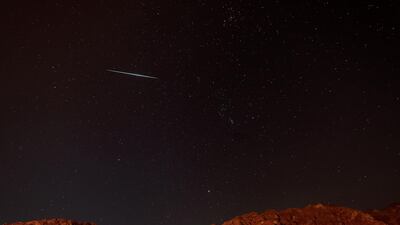
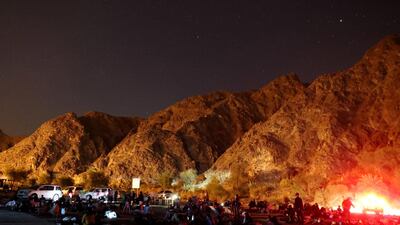
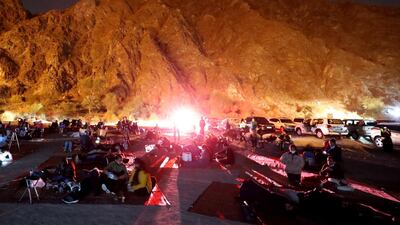
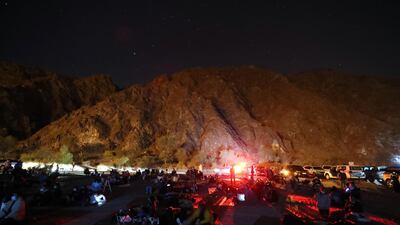
• The annual Perseids meteor showers draws a crowd of more than 150 stargazers to the Al Qudra desert to watch the show in August, 2020. Pawan Singh / The National
    The annual Perseids meteor showers draws a crowd of more than 150 stargazers to the Al Qudra desert to watch the show in August, 2020. Pawan Singh / The National
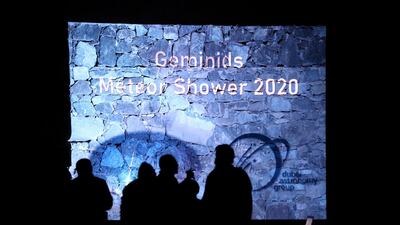
  • Dubai Astronomy Group organised a stargazing event but hazy, cloudy and humid weather caused low visibility, making the meteors harder to see. Pawan Singh / The National
    Dubai Astronomy Group organised a stargazing event but hazy, cloudy and humid weather caused low visibility, making the meteors harder to see. Pawan Singh / The National
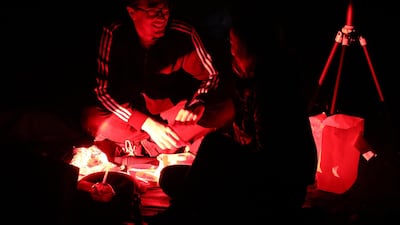
  • When a meteorite reaches a certain magnitude, it turns into a 'fireball', with a large and bright red appearance. Pawan Singh / The National
    When a meteorite reaches a certain magnitude, it turns into a 'fireball', with a large and bright red appearance. Pawan Singh / The National
  • Advanced telescopes provided by Dubai Astronomy Group help members of the crowd observe different planets. Mars, Saturn and Jupiter are visible to the naked eye, but the telescopes give clearer views. Pawan Singh / The National
    Advanced telescopes provided by Dubai Astronomy Group help members of the crowd observe different planets. Mars, Saturn and Jupiter are visible to the naked eye, but the telescopes give clearer views. Pawan Singh / The National
  • Mars becomes visible each year, but is at its brightest from August to October. Pawan Singh / The National
    Mars becomes visible each year, but is at its brightest from August to October. Pawan Singh / The National
  • Residents in the UAE can still see Mars in the night sky. It appears as a bright red "dot". Pawan Singh / The National
    Residents in the UAE can still see Mars in the night sky. It appears as a bright red "dot". Pawan Singh / The National
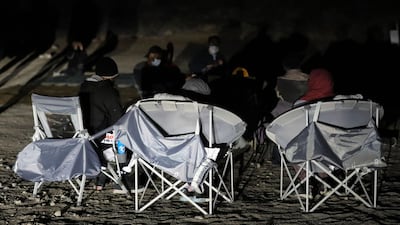
  • High levels of light pollution also caused low visibility of the meteor showers. Pawan Singh / The National
    High levels of light pollution also caused low visibility of the meteor showers. Pawan Singh / The National
  • Residents turn out to watch the Perseids meteor showers in Al Qudra desert, Dubai. Pawan Singh / The National
    Residents turn out to watch the Perseids meteor showers in Al Qudra desert, Dubai. Pawan Singh / The National
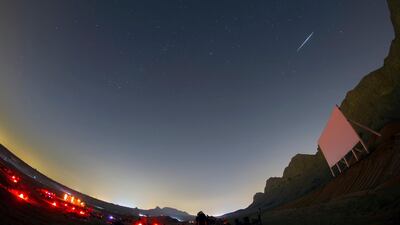
  • The Perseids meteor showers were more visible in other parts of the world. Here are the meteors flying across the sky above a camping site at the Negev desert in Israel. AFP
    The Perseids meteor showers were more visible in other parts of the world. Here are the meteors flying across the sky above a camping site at the Negev desert in Israel. AFP
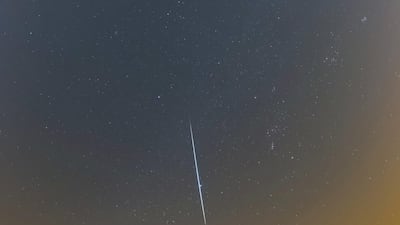
  • A meteor streaks past stars in the night sky above the Necropolis for the victims of Fascism, in Novi Travnik, Bosnia and Herzegovina. Reuters
    A meteor streaks past stars in the night sky above the Necropolis for the victims of Fascism, in Novi Travnik, Bosnia and Herzegovina. Reuters

Lyrids meteor shower to streak across UAE skies during Ramadan


Sarwat Nasir
  • English
  • Arabic

One of the oldest recorded meteor showers will grace UAE skies this Ramadan.

The Lyrids meteor shower, an annual event that takes place in spring, will streak across the skies on April 22 and 23.

It is possible, however, that visibility could be affected by the brightness of the Moon, which will be present all night long.

Known as one of the most stunning meteor showers, it will produce about 10 to 15 meteors an hour at its peak.

The Lyrids are created by debris from Comet Thatcher, with recordings of sightings that go back 2,700 years.

Nasa said Chinese astronomers in 687BC reported meteors “falling like rain”.

“The Lyrids are known for their fast and bright meteors. Though not as fast or as plentiful as the famous Perseids in August, Lyrids can surprise watchers with as many as 100 meteors seen per hour,” Nasa said on its website.

“Lyrids frequently leave glowing dust trains behind them as they streak through the Earth's atmosphere. These trains can be observable for several seconds.”

These heavy showers have occurred in the past, including in 1803 in Virginia, 1922 in Greece, 1945 in Japan and the US in 1982.

The comet itself takes about 415 years to orbit the Sun and it is expected to be visible to viewers on Earth again in the year 2276.

It is best to observe these celestial events away from light pollution. They can be seen with the naked eye, but telescopes enhance the experience.

The next observable event in the UAE’s skies is on May 16, when the first of the four supermoons of the year will appear.

The average distance between the Moon and Earth is 384,472 kilometres, but this supermoon will be 362,127km from the planet.

Another supermoon will be visible on June 14, at a distance of 357,658km.

Geminids meteor shower in the UAE – in pictures

  • A Geminids meteor shower lit up UAE skies on December 13, 2020. Chris Whiteoak / The National
    A Geminids meteor shower lit up UAE skies on December 13, 2020. Chris Whiteoak / The National
  • About 200 people turned up at Wadi Shawka in Ras Al Khaimah to watch the celestial event as part of a gathering organised by the Dubai Astronomy Group. Chris Whiteoak / The National
    About 200 people turned up at Wadi Shawka in Ras Al Khaimah to watch the celestial event as part of a gathering organised by the Dubai Astronomy Group. Chris Whiteoak / The National
  • The Geminid meteor shower in Mleiha, Sharjah. Prabhu Astrophotography for The National
    The Geminid meteor shower in Mleiha, Sharjah. Prabhu Astrophotography for The National
  • Another shot of the Geminid meteor shower from Mleiha, Sharjah. Prabhu Astrophotography for The National
    Another shot of the Geminid meteor shower from Mleiha, Sharjah. Prabhu Astrophotography for The National
  • The showers were the most visible ones of the year in the UAE and were at their peak from 10pm to 2am. Chris Whiteoak / The National
    The showers were the most visible ones of the year in the UAE and were at their peak from 10pm to 2am. Chris Whiteoak / The National
  • Clear skies and no Moon interference enhanced the experience. Chris Whiteoak / The National
    Clear skies and no Moon interference enhanced the experience. Chris Whiteoak / The National
  • Those who watched away from light pollution were wowed by the large number of 'shooting stars'. Chris Whiteoak / The National
    Those who watched away from light pollution were wowed by the large number of 'shooting stars'. Chris Whiteoak / The National
  • People of all ages attended the gathering. Chris Whiteoak / The National
    People of all ages attended the gathering. Chris Whiteoak / The National
  • Members of the Dubai Astronomy Group gave presentations and educated guests on the celestial event. Chris Whiteoak / The National
    Members of the Dubai Astronomy Group gave presentations and educated guests on the celestial event. Chris Whiteoak / The National
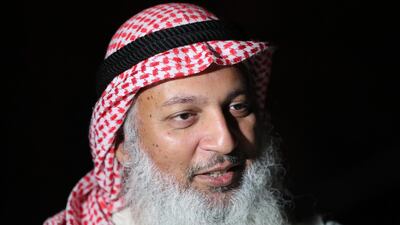
  • Hasan Al Hariri, chief executive of the Dubai Astronomy Group. Chris Whiteoak / The National
    Hasan Al Hariri, chief executive of the Dubai Astronomy Group. Chris Whiteoak / The National
  • The showers were visible to the naked eye, but telescopes were available to see the 'shooting stars' up close and observe other planets. Chris Whiteoak / The National
    The showers were visible to the naked eye, but telescopes were available to see the 'shooting stars' up close and observe other planets. Chris Whiteoak / The National
Updated: April 11, 2022, 12:54 PM