

A trailblazing Emirati locked inside a remote Russian centre for four months to advance understanding of journeys into deep space has opened up about life in near-isolation.
Saleh Al Ameri is one of six international crew members who are now halfway through an eight-month project aimed at replicating missions to the Moon and Mars and testing the psychological and physiological effect on humans living in the extreme environments that astronauts face during space travel.
The NEK experimental complex in Moscow which has become home for this intrepid group has its own atmosphere and air pressure to create a space-like environment.
Mr Al Ameri, 31, and his team members, three Russians and two Americans, are focused solely on supporting efforts to explore other worlds and for months have had little knowledge of life on their own planet.
They have had no access to social media or the internet since November 4, while contact with family is limited.
In his first media interview since the mission began, Mr Al Ameri told The National of his daily schedule, experiments and the unique challenges he is facing under the Sirius 20/21 project.
“The biggest challenge for me, apart from the isolation, is the lack of information and less communication with people in the outside world,” he said.
“We don’t have internet or social media platforms here. If we want to know something, the only way is to ask the people in the mission control centre. To overcome these things, we try to keep ourselves busy.”
-
Saleh Al Ameri lived inside a remote Russian plant, in near-isolation, as part of an eight-month spaceflight research project. Locked away on November 4, he conducted several experiments. All photos: Mohammed bin Rashid Space Centre -
Mr Al Ameri is part of the Sirius 20/21 project that measures the psychological and physiological effect on humans living in the extreme environments that astronauts face during space travel. -
The international crew of six entered the NEK experimental complex in Moscow on November 4, where scientists are observing their behaviour using cameras installed throughout the centre. -
Mr Al Ameri inside the centre in Moscow. -
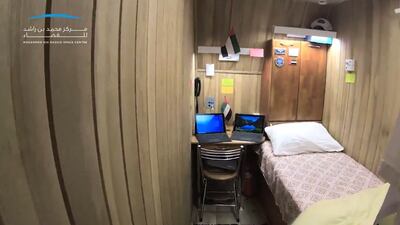
Mr Al Ameri's room in the complex. Each participant has a similar small space for privacy, while a small living room allows them to socialise and watch television. Each bedroom has a bed, desk and cupboard. -
Aballa Al Hammadi, the back-up Emirati for the project, checks in on his colleague Mr Al Ameri, who is inside the complex. -
Mr Al Ameri, 31, is the first Arab to be part of an analogue mission – field tests that simulate lengthy space journeys. These are crucial to understanding how space flight affects the body and mind, as governments and private companies work towards landing people on the Moon and Mars. -
He celebrated the UAE's Golden Jubilee on December 2 inside the centre. -
His colleagues celebrated the UAE's Golden Jubilee with him. -
Crew members simulated a space journey to the Moon as part one of the experiments. They docked their 'spacecraft' with an interplanetary station and then transferred to a transport ship that will take them to the Moon.

To communicate with The National, Mr Al Ameri answered questions in a video that was shared with a mission control right outside of the complex in Moscow. It monitors the crew around the clock.
He is allowed to communicate with them only and can make limited phone calls to close family members.
This is the Arab world’s first analogue mission, field tests that simulate long space journey to understand how space flight affects the body and mind.
Mr Al Ameri, a mechanical engineer, is helping to develop research that is needed to send humans on deep space missions in future.
The experiments are part of a five-year research programme by Russia’s Institute of Biomedical Problems and Nasa’s Human Research Programme.
It involves three Sirius missions, the first of which was completed in 2019 when six crew members lived in isolation for four months.
The final and most challenging mission is expected to last for 12 months.
Daily routine inside Russian pod
The crew wakes up every day at 7am to take health measurements, including blood pressure, weight and temperature.
After sharing the data with doctors and a medical support team, they shower and get dressed for the day.
“Then, we eat our breakfast together, we make our daily personal content and then we share our ideas, concerns and questions with the mission control centre,” Mr Al Ameri said.
From 9am to 1pm, the crew carries out scientific experiments.
This is followed by a 30-minute lunch break and then a 90-minute rest period.
“After, we do our exercises. We work together until usually 6.30pm or 7pm. Our dinner starts at 7pm and then we make the daily personal content again, where we summarise everything we did for the day,” he said.
“We also prepare ourselves for the next day, including for scientific experiments.”
Before going to bed at 11pm, the crew have some more free time, where they watch films or read books.
Virtual space missions
The crew are using simulators and virtual reality headsets to carry out long-duration space missions, including ones to the International Space Station, Moon-orbiting station Lunar Gateway and on the lunar surface.
So far, Mr Al Ameri has “driven” a lunar rover on the Moon’s surface to collect samples and transported them to a lunar base.
He has virtually piloted a spaceship and docked it with the ISS and the Lunar Gateway, and has flown in the orbit of the Moon and Mars.
More recently, he performed a simulation of extravehicular activity (EVA), spacesuits that astronauts wear to perform spacewalks.
He “walked on the lunar surface” using instruments that simulate lunar gravity.
“During the EVA, we need to check its effectiveness with the physiological sensors to get the data for our health and psychological status,” Mr Al Ameri said.
“We walked on the lunar surface with a simulation of lunar gravity and also to collect some samples.
“After that, we go back by driving a lunar rover. Once we are back at the lander, we are done with the EVA.”
The experiments help to create scenarios that might unfold during actual space missions.
While analogue missions do have limitations, such as not really being exposed to microgravity and dangerous radiation, they are helping considerably with research.
The project is allowing scientists to understand how long periods of isolation during deep space missions would affect a person's mind and body.
What does he do in his spare time?
During his spare time, Mr Al Ameri reads books, watches films and plays chess with his colleagues.
“Sometimes we share our experiences. We have an international crew, so it's nice and interesting to know about their culture," he said.
“We all also agreed to do a weekly maintenance and check everything to see if it is working properly inside the facility.
“Sometimes, we sit together and share our experiences and stories. I remember that during the UAE’s National Day, they were so interested to know about our culture, our traditions our habits, and also the Arabic language.”
Mr Al Ameri and his colleagues have another four months to go inside the experimental complex.

