

“Nothing is more precious than the camel's milk,” said Yaslam Al Seiari, 65, as he watched his team milk Al Rahi, a locally bred animal.
A large metal dish collected the frothy white milk.
“When you drink it, you feel that unique taste … and it gives you energy and boosts your morale.”
Mr Al Seiari lives in Al Ain. But during the annual camel milking competition at Sheikh Zayed Heritage Festival, he and his team set up a tent in the sands of Al Wathba, Abu Dhabi, for several days.
“We don't move out of here until the competition ends.”
About 300 camels from the UAE and other Gulf countries are taking part in the six-day contest, which runs until Tuesday and aims to promote and preserve Emirati heritage. The camels compete in three categories according to breed.
-

Camels are brought to the milking area before the Al Wathba Milking Competition at the Sheikh Zayed Heritage Festival. All photos: Victor Besa / The National -
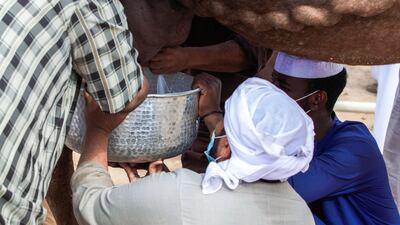
Only farmers or camel owners are allowed in the milking area and no fast movements are allowed to avoid causing stress for the camels. -
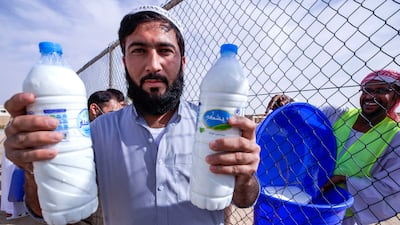
After the milk is weighed, it is poured into drums which are collected by locals and visitors outside the gated competition area. -
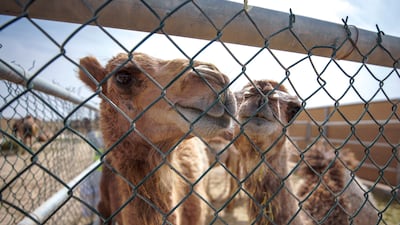
Calves in the gated area. -
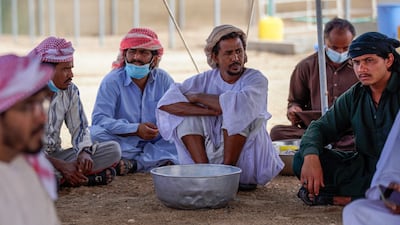
Camel farmers wait in a tent before the festival gates open. -
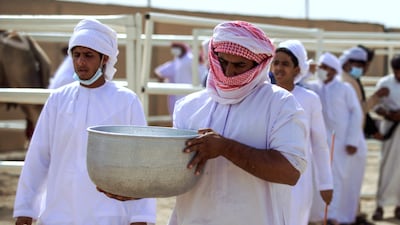
The milk is brought to the judges' tent. -
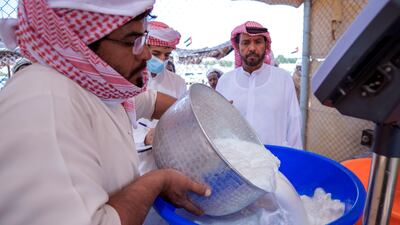
It is then weighed. -
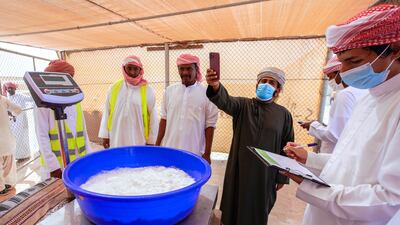
Milk is placed on the scales. -

Three hundred camels compete for first place In the competition. -
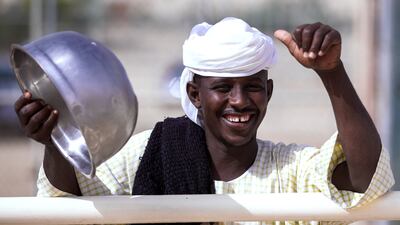
A bowl for milking. -
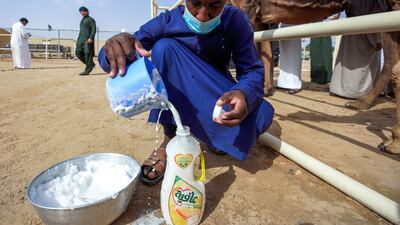
A baby bottle is filled for a calf. -
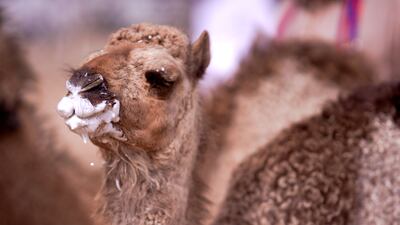
This calf looks well fed after sucking on a bottle of its mother's milk.


“I have around 30 to 40 camels. Three camels are participating in the camel milking competition, each belongs to one category: Al Majahim [dark-skinned camels from Saudi Arabia]; Mahaliyyat [those from the UAE and Oman]; and Maftouh [From other countries],” Mr Al Seiari said.
The camels are milked twice a day: first after sunrise and then in the afternoon. The milk is weighed before the organising committee and recorded daily. The camel that produces the greatest yield wins.
Mr Al Seiari described the significance of camel milking in the past.
“We are Bedouins,” he said. “[If] they had visitors, they would host them, slaughter a camel and serve its meat for dinner and milk a camel for them to drink.”
In those days, Mr Al Seiari's camels used to graze the ground and survive for up to 10 days without water. But now his camels are being fed properly.
“If your camel has been well fed, milk it and it will produce, for example, 13kg milk in the morning and 9kg to 10kg in the afternoon.”
After Al Rahi’s milk was measured, the team poured some of it into a bottle and fed her four calves. The rest was distributed among camel owners, handlers and visitors.
“This is a tradition [we should hold on to],” Mr Al Seiari said. “The late [UAE Founding Father] Sheikh Zayed, may he rest in peace and may his children long live, said: Camels are a graceful gift to us. Don't be complacent.”
Mohsin Al Menhali, 36, is counting on his 7-year-old camel Mabrouka, which he selected from among 50 camels at his farm in Abu Dhabi. “I purchased this camel for Dh100,000,” he said.
“I won second place in Al Dhafra competition a month ago. I am hoping to win the first place at Sheikh Zayed Festival.”
Mabrouka belongs to the dark-skinned Majahim breed that are originally from Najd in Saudi Arabia.
“The Majahim camels produce lots of milk while the local red camels are light and good for racing,” he added.

Mr Al Menhali’s father and his older brothers participated in milking competitions for 20 years. When Mr Al Menhali grew up, he carried on with the tradition. Later, he says, his younger brothers and children will take the reins.
He explains how he learned to milk camels.
“In childhood, I used to accompany my father. He trained me since I was a child. We have inherited this tradition from our forefathers, since 500 or 1,000 years ago.”
“In the olden days, people loved to drink camel milk. It is nutritious and is a substitute to food and water. If a person falls ill, milk was given as a boosting nutrient. There was no need to eat if you drank milk.”
Mr Al Menhali said special attention is now given to the camel’s diet to ensure the yield is bountiful.
“Camels feed on berseem [green grass eaten by animals], this is the most important food they eat. Next are bread and dates as these increase the milk produce.”
At the end of the milking competition, the winner of each of the three categories will be awarded a prize of Dh300,000. The runner-up will receive Dh200,000 and the third-place competitor will get Dh100,000.
“We love this competition despite that the prizes were little,” Mr Al Menhali said. “But today, thanks to God and our sheikhs, especially [Deputy Prime Minister and Minister of Presidential Affairs] Sheikh Mansour bin Zayed, prizes have increased to Dh300,000 and Dh200,000. This is a good prize.
“This is why people buy more camels and the number of participants increases yearly. More competitions arise and more prizes are awarded.
“Our country values traditions and we love our country because of its rich heritage.”

