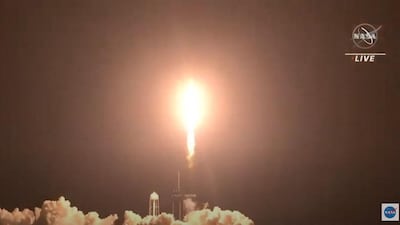
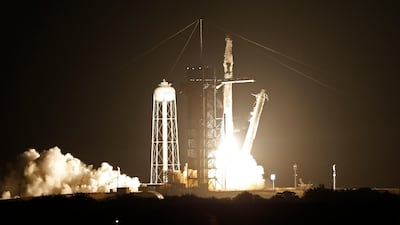
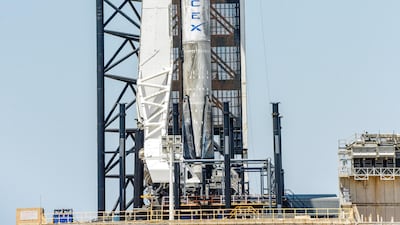
A Dubai nanosatellite that aims to improve the emirate’s utility network is set to go into orbit on a SpaceX rocket on Thursday.
The Dewasat-1 cubesat will be launched at 7.30pm, UAE time, from Florida’s Kennedy Space Centre. Its departure will be streamed live.
The Dubai Water and Electricity Authority announced its Space-D programme last year. It is an effort to improve operations, maintenance and the planning of its networks by using nanosatellite technology.
This involves launching a nanosat constellation that will support Dewa’s primary satellite.
Utility companies can benefit from satellite technology. It allows them to monitor and map their infrastructure as well as track the environmental impact their operations have. The data can also help these companies improve their services.
Dewasat-1, an imaging satellite, will be able to better monitor high-voltage transmission lines, substations, buildings and solar power stations.
Dewa also expects that the satellite will enhance the performance and efficiency of the photovoltaic solar panels at the Mohammed bin Rashid Al Maktoum Solar Park, the world’s largest single-site solar park.
Dewasat-1 is the first among many other satellites Dewa plans to launch.
Saeed Al Tayer, chief executive of Dewa, said the programme would strengthen Dubai's electricity and water networks.
“The programme aims to build Dewa’s capabilities and train Emirati professionals to use space technologies to enhance its electricity and water networks,” he said when the programme was first announced.
“The programme will take advantage of Fourth Industrial Revolution technologies such as the Internet of Things, artificial intelligence and blockchain to exchange information with the help of satellite communications and earth observation technologies.”
The utility authority has teamed up with US-based NanoAvionics, a small satellite manufacturer, to build Dewasat-1, a three-unit cubesat, and a six-unit cubesat.
Cubesats are miniature satellites that offer easier and cheaper access to space. Some schools have programmes where pupils build 1-unit cubesats, but space companies build more complex ones that are up to three units.
They can be used for a range of applications, including taking images of Earth, monitoring climate change and producing other data.
Under the agreement, NanoAvionics will also manage the launch, construct the ground station at the solar park and train Emirati professionals.
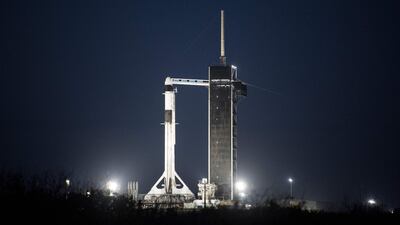
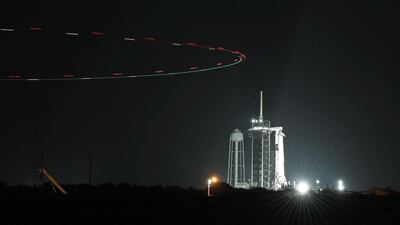
SpaceX rocket launch in April 2021 - in pictures
Timeline
2012-2015
The company offers payments/bribes to win key contracts in the Middle East
May 2017
The UK SFO officially opens investigation into Petrofac’s use of agents, corruption, and potential bribery to secure contracts
September 2021
Petrofac pleads guilty to seven counts of failing to prevent bribery under the UK Bribery Act
October 2021
Court fines Petrofac £77 million for bribery. Former executive receives a two-year suspended sentence
December 2024
Petrofac enters into comprehensive restructuring to strengthen the financial position of the group
May 2025
The High Court of England and Wales approves the company’s restructuring plan
July 2025
The Court of Appeal issues a judgment challenging parts of the restructuring plan
August 2025
Petrofac issues a business update to execute the restructuring and confirms it will appeal the Court of Appeal decision
October 2025
Petrofac loses a major TenneT offshore wind contract worth €13 billion. Holding company files for administration in the UK. Petrofac delisted from the London Stock Exchange
November 2025
180 Petrofac employees laid off in the UAE
Zidane's managerial achievements
La Liga: 2016/17
Spanish Super Cup: 2017
Uefa Champions League: 2015/16, 2016/17, 2017/18
Uefa Super Cup: 2016, 2017
Fifa Club World Cup: 2016, 2017
Most sought after workplace benefits in the UAE
- Flexible work arrangements
- Pension support
- Mental well-being assistance
- Insurance coverage for optical, dental, alternative medicine, cancer screening
- Financial well-being incentives
What's in the deal?
Agreement aims to boost trade by £25.5bn a year in the long run, compared with a total of £42.6bn in 2024
India will slash levies on medical devices, machinery, cosmetics, soft drinks and lamb.
India will also cut automotive tariffs to 10% under a quota from over 100% currently.
Indian employees in the UK will receive three years exemption from social security payments
India expects 99% of exports to benefit from zero duty, raising opportunities for textiles, marine products, footwear and jewellery
Mercer, the investment consulting arm of US services company Marsh & McLennan, expects its wealth division to at least double its assets under management (AUM) in the Middle East as wealth in the region continues to grow despite economic headwinds, a company official said.
Mercer Wealth, which globally has $160 billion in AUM, plans to boost its AUM in the region to $2-$3bn in the next 2-3 years from the present $1bn, said Yasir AbuShaban, a Dubai-based principal with Mercer Wealth.
“Within the next two to three years, we are looking at reaching $2 to $3 billion as a conservative estimate and we do see an opportunity to do so,” said Mr AbuShaban.
Mercer does not directly make investments, but allocates clients’ money they have discretion to, to professional asset managers. They also provide advice to clients.
“We have buying power. We can negotiate on their (client’s) behalf with asset managers to provide them lower fees than they otherwise would have to get on their own,” he added.
Mercer Wealth’s clients include sovereign wealth funds, family offices, and insurance companies among others.
From its office in Dubai, Mercer also looks after Africa, India and Turkey, where they also see opportunity for growth.
Wealth creation in Middle East and Africa (MEA) grew 8.5 per cent to $8.1 trillion last year from $7.5tn in 2015, higher than last year’s global average of 6 per cent and the second-highest growth in a region after Asia-Pacific which grew 9.9 per cent, according to consultancy Boston Consulting Group (BCG). In the region, where wealth grew just 1.9 per cent in 2015 compared with 2014, a pickup in oil prices has helped in wealth generation.
BCG is forecasting MEA wealth will rise to $12tn by 2021, growing at an annual average of 8 per cent.
Drivers of wealth generation in the region will be split evenly between new wealth creation and growth of performance of existing assets, according to BCG.
Another general trend in the region is clients’ looking for a comprehensive approach to investing, according to Mr AbuShaban.
“Institutional investors or some of the families are seeing a slowdown in the available capital they have to invest and in that sense they are looking at optimizing the way they manage their portfolios and making sure they are not investing haphazardly and different parts of their investment are working together,” said Mr AbuShaban.
Some clients also have a higher appetite for risk, given the low interest-rate environment that does not provide enough yield for some institutional investors. These clients are keen to invest in illiquid assets, such as private equity and infrastructure.
“What we have seen is a desire for higher returns in what has been a low-return environment specifically in various fixed income or bonds,” he said.
“In this environment, we have seen a de facto increase in the risk that clients are taking in things like illiquid investments, private equity investments, infrastructure and private debt, those kind of investments were higher illiquidity results in incrementally higher returns.”
The Abu Dhabi Investment Authority, one of the largest sovereign wealth funds, said in its 2016 report that has gradually increased its exposure in direct private equity and private credit transactions, mainly in Asian markets and especially in China and India. The authority’s private equity department focused on structured equities owing to “their defensive characteristics.”
Poacher
%3Cp%3E%3Cstrong%3EDirector%3A%20%3C%2Fstrong%3ERichie%20Mehta%26nbsp%3B%3C%2Fp%3E%0A%3Cp%3E%3Cstrong%3EStarring%3A%3C%2Fstrong%3E%20Nimisha%20Sajayan%2C%20Roshan%20Mathew%2C%20Dibyendu%20Bhattacharya%3C%2Fp%3E%0A%3Cp%3E%3Cstrong%3ERating%3A%20%3C%2Fstrong%3E3%2F5%3C%2Fp%3E%0A
Motori Profile
Date started: March 2020
Co-founder/CEO: Ahmed Eissa
Based: UAE, Abu Dhabi
Sector: Insurance Sector
Size: 50 full-time employees (Inside and Outside UAE)
Stage: Seed stage and seeking Series A round of financing
Investors: Safe City Group