


Conservationists are reporting a major decline in the trafficking of cheetah cubs from the Horn of Africa into the Middle East – a trend that offers hope for their survival.
Five years on from the introduction of tough laws that banned the illegal sale of wildlife and unregulated private zoos in the UAE, their impact is at last being felt in Africa.
Cheetah Conservation Fund
Tighter border controls and the prosecution of those bringing wildlife into the region illegally has resulted in waning demand for cheetah cubs, according to the Cheetah Conservation Fund (CCF) in Somaliland, East Africa.
“The increased enforcement by Somaliland in the Gulf [of Aden] and along known smuggling routes, plus the increased community awareness for poaching as a crime has led to a major decline in cub trafficking,” said Susan Yannetti, the CCF’s Middle East ambassador.
-
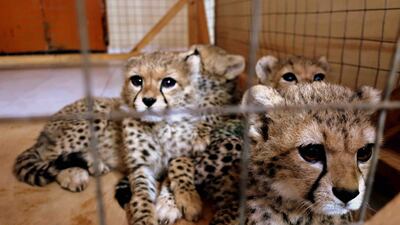
Four cubs confiscated by the Somaliland Ministry of Environment and Rural Development arrive at the CCF Safe House in Hargeisa. Photo: CCF -
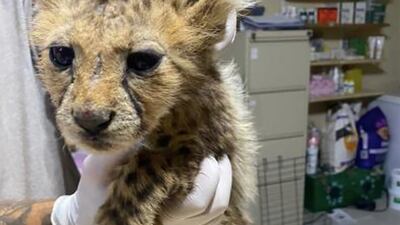
One of 10 cubs rescued by Somaliland Police. Photo: CCF -
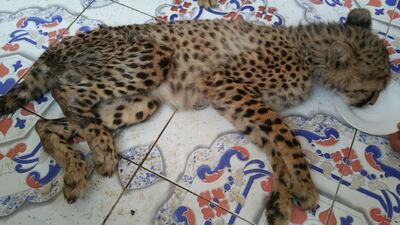
One of the six severely malnourished and dehydrated cubs confiscated from smugglers. The cub was so weak, it could not stand to drink but is now receiving proper veterinary care and nutrition. Photo: CCF -
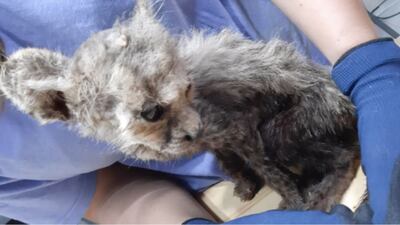
One of the cheetah cubs recovered from smugglers off the coast of Somaliland. Conservations believe the 12 animals were destined from the black market in the Arbian Peninsular. Photo: CCF -
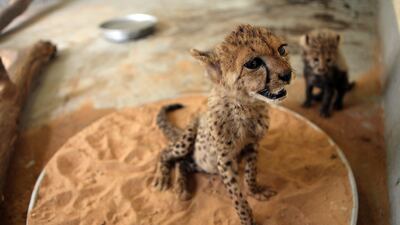
Despite a nationwide ban, exotic animals such as cheetah cubs continue to be sold on social media accounts. Sammy Dallal / The National -
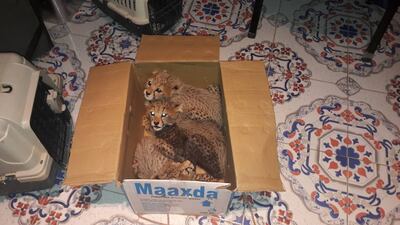
Conservationists in the Horn of Africa claim they are facing a poaching 'epidemic' as demand for cheetahs in the Gulf soars. Photo: CCF -

There are now fewer than 7,500 cheetahs in the wild. Photo: CCF -
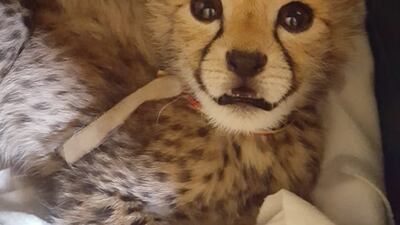
The Cheetah Conservation Fund says it is struggling to keep up with the rehabilitation of the animals as so many are being intercepted. Photo: CCF -
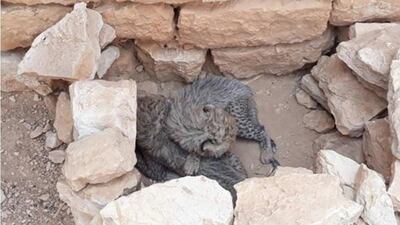
The Cheetah Conservation Fund is the global leader in the research and conservation of the animals. Photo: CCF -

Four cheetah cubs were rescued on the UAE-Saudi Arabia border, with two turned over to Al Ain Zoo by the Ministry of Environment and Climate Change. Reem Mohammed / The National


“We still have 67 cheetahs in Hargeisa; people are still taking them as a means of thwarting predation ... others think selling cubs is a good idea, so our work is far from done.
“But we do believe the heyday of the cub trade has passed.
“People all over the world are becoming aware that taking cheetahs from the wild to be pets will lead to their extinction, and that most people don't want to lose the species.”
Owing to tighter airport controls as well as more training from the authorities on wildlife trafficking methods, cheetahs are rarely trafficked through airports, conservationists said.
Animals being trafficked by sea and then driven across land borders is a more likely route into the region.
“Cubs are smuggled with drugs, antiquities, other wild species and humans heading to the Middle East,” Ms Yannetti said.
“The consumer demand for cheetahs as pets among the general public has been mostly quashed and the remainder driven underground.”
The conservation fund said about five per cent of all captive cheetahs are registered in the UAE.
In September and October, a team from the Somaliland Ministry of Environment and Rural Development rescued 11 cheetah cubs taken from the wild in four separate incidents.
The cubs were rounded up during a sweep of the Sool and Saraar districts based on intelligence generated during a wildlife conference held in July.
The cubs were estimated to have been between five to six weeks old at the time of confiscation, and are recovering at a wildlife sanctuary in Hargeisa.
A man was arrested in association with the seizure.
“The ministry is glad to be working in the eastern regions to raise awareness for the illegal nature of poaching of wildlife,” said Abdinassir Hussein, the ministry's wildlife director.
“We want to discourage others from taking cheetah cubs and other wild animals from our landscapes. It is against the law for any reason.”
Training and educational workshops have been held under the Legal Intelligence for Cheetah Illicit Trade project to increase Somaliland’s capacity to stop the illegal trade in cheetahs and other wildlife.
The action is part of a wider effort to protect the species by cutting supply, as well as demand.
Dr Laurie Marker, the CCF’s founder and executive director, said loss of habitat, climate change and human-wildlife conflict remain the biggest challenges to saving the cheetah from extinction. Just 7,500 are thought to exist in the wild.
“One of the solutions is reducing demand for cheetah,” she said.
“There is more awareness now in the UAE resulting from the wildlife laws that were implemented five years ago.
“It takes time for them to take effect.
“But we know a lot of animals that were in private hands have either been confiscated or handed over to facilities where they have permits, like Dubai Safari or private facilities.
“A lot of work has been done to educate people and that is making a difference.”
In a recent report by Interpol, a global crackdown on the illegal wildlife trade recovered 29 big cats at border crossings across the world.
The report did not specify what species of cats were intercepted, or from where.
During Operation Thunder, Interpol identified several trends, including a greater use of online platforms to organise cross-border trafficking, more forging of travel documents and links with wider criminal networks.
In Namibia, 14 trafficking cases were linked to the illegal trade of pharmaceuticals, food and car parts.
The government of Somaliland has donated 800 hectares of land to the conservation fund's centre in Hargeisa to expand and cater for more cheetahs in a natural habitat.
It should be completed by the end of next year.
The centre also has three safe houses where cheetahs are taken once they are intercepted before entering rehabilitation and recovery programmes.
Rare creatures in the Middle East: in pictures
-

Blanford's fox, a rare species native to the Middle East and Central Asia, was spotted on Jebel Hafeet. Courtesy: Environment Agency Abu Dhabi. -
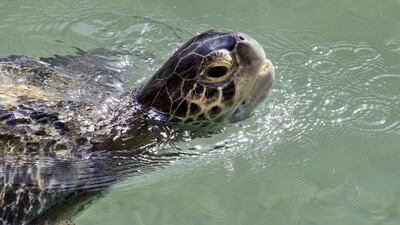
Environment Agency Abu Dhabi and The National Aquarium will launch a turtle rehabilitation programme to save hawksbill turtles. Jaime Puebla / The National -

The Arabian leopard is currently listed as critically endangered. Pawan Singh / The National -
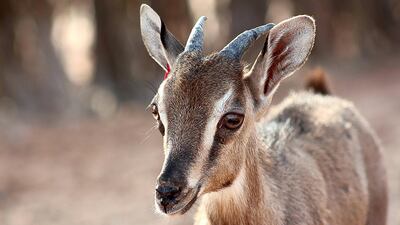
The Arabian tahr has been categorised as an endangered species, with a global population of less than 5,000. Courtesy: TDIC -
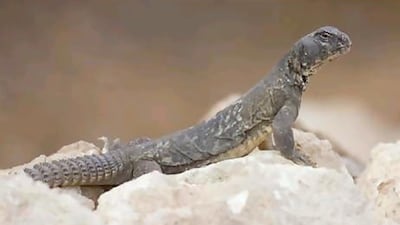
Egyptian spiny-tailed lizard is a vulnerable species. It is found in much of the Middle East. Their numbers have declined over the years and two sub-species exist in the UAE. Courtesy: IUCN -
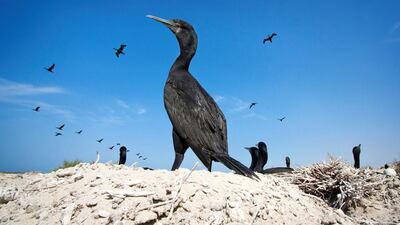
The Socotra cormorant (Phalacrocorax nigrogularis) is a threatened species. It is found in several Gulf states, including the UAE. It is threatened by development and oil spills and has a total population of less than half a million. Courtesy: Rob Gubiani -

The Houbara bustard is classified as a vulnerable species by the International Union for Conservation of Nature. Courtesy: International Fund For Houbara Conservation



