



Researchers in the UK have sent human muscle cells to the International Space Station to tackle the effects of ageing.
The MicroAge project by the University of Liverpool was launched into space on a SpaceX rocket on Tuesday. It was expected to arrive at the station on Wednesday afternoon.
Scientists will study age-related loss of muscle mass and function by exposing the samples to microgravity conditions.
Humans face these problems as they age, but astronauts experience them at a faster rate because of long-duration space missions.
The research could help scientists discover ways to significantly reduce these health conditions in ageing people and astronauts.
“Identification of the underlying mechanisms responsible for this loss of muscle mass and strength with age has been the subject of our research for a number of years,” Professor Anne McArdle from the University’s Institute of Life Course and Medical Sciences said.
“Astronauts in microgravity lose their muscle mass and strength at an accelerated rate compared with older people on earth, providing a unique model to rapidly determine the mechanisms underlying muscle loss not only in astronauts, but with relevance to older people on earth.”

Scientists grew “mini-muscles” from human muscle cells in a laboratory. They were stored in 24 containers, which were sent to space.
Some of the muscles will be electrically stimulated to create the effect of ‘exercise’.
Others will be exposed to increased amounts of protective heat shock proteins, which have been proven to provide protection against age-related muscle wasting.
At the end of the experiment, the samples will be frozen and returned to Earth for analysis.
Prof Malcolm Jackson, the project lead, said the team had worked hard for more than three years.
“Ageing is one of the greatest challenges of the 21st century and so the opportunity to use microgravity to help understand the mechanisms underlying age-related muscle loss is really exciting,” he said.
The UK Space Agency has contributed £1.1 million in funding for the study.
Dr Graham Turnock, chief executive of the agency, said the space station has helped carry out cutting-edge research since it started operating 20 years ago.
“As we celebrate all that has been achieved over the last two decades this new funding puts UK academics at the forefront of future pioneering scientific research, allowing us to gain knowledge that will improve life on Earth,” he said.
Scientists have been using the space station to study age-related conditions for several years.
One of the most extensive research projects was carried out when Nasa astronaut Scott Kelly lived on the floating laboratory for a year, while his twin Mark stayed on Earth.
It was discovered that Mr Kelly’s telomeres – the 'caps' that protect chromosomes from damage – had grown longer while in space and rapidly shrunk once he returned to Earth, to become shorter than when he departed for the mission.
Telomeres shorten as people age, while unusually longer ones can be associated with cancer.
Former UK science minister Sam Gyimah said that research from the MicroAge project could help people with ageing disorders “live longer”.
“This research will help those with muscle conditions to live longer, healthier, happier lives, and is a great example of our modern Industrial Strategy in action – transforming life on earth through out-of-this-world research,” he said.
US astronaut Scott Kelly at Expo 2020 Dubai - in pictures
-
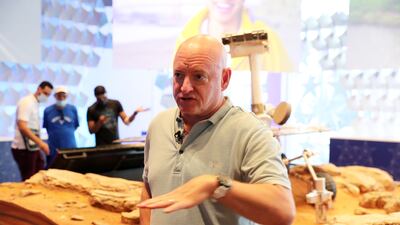
Scott Kelly, American astronaut at the US pavilion at the Expo 2020 site in Dubai on October 6, 2021. All images Pawan Singh / The National -

Scott Kelly, American astronaut (second from left) at the US pavilion at Expo 2020 in Dubai on October 6, 2021. -
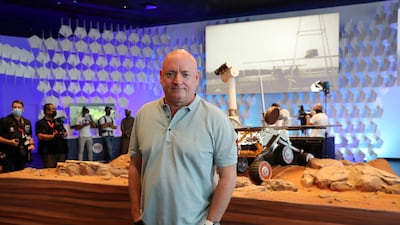
Scott Kelly, American astronaut at the US pavilion at Expo. -
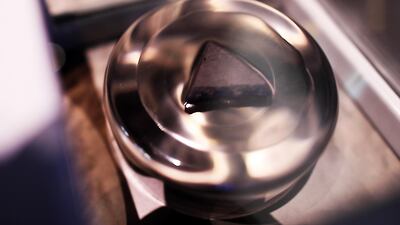
Moon rock on display at the US pavilion at Expo 2020.



