



After 20 years in the making, the James Webb Space Telescope is finally set for launch.
On Christmas Eve, the $10 billion space observatory will lift-off on a European Ariane 5 rocket from a spaceport near Kourou in French Guiana, South America.
The telescope will be capable of looking back 13.5 billion years to see the first stars and galaxies of the universe and search for signs of life.
It has been in development by US and European space agencies for two decades and faced several delays.
After several launch delays this year alone, a date of December 22 was set, but technical issues pushed it to December 24 at 4.20pm Gulf Standard Time.

The team discovered a faulty data cable between the telescope and launch pad equipment at the spaceport, which was causing communication issues between the two.
The problem was resolved and the launch was back on. Dozens of engineers and scientists will be working through the holidays to make the launch a success.
“For us this is a historic moment that took 20 years to come. What we have not understood is what happened about 13.5 billion years ago, when a universe that was largely made out of protons and helium turned into something that made galaxies for the first time,” Thomas Zurbuchen, science mission directorate associate administrator for Nasa, said at a space conference held in Dubai earlier this year.
“That’s what we’re going to observe. It’ll be like looking at baby pictures of that universe.”
What’s special about this telescope?
Once operational, the James Webb Space Telescope would be 100 times more powerful than the Hubble Space Telescope, which for 31 years has made countless discoveries and provided millions of images of planets, galaxies, nebulas and stars.
It would be placed in a different orbit than the Hubble and much further out in space, allowing it to see greater distances.
That position in space is known as a Lagrange point, meaning it will follow Earth around the Sun
This strategic location would enable it to see further in space than any other telescope. It would detect some of the first galaxies, study the atmospheres of exoplanets, or planets outside of the Solar System, and search for any oxygen present.
How will it see back in time?
To study the early universe, the telescope will be able to see 13.5 billion light years away, meaning it will see 13.5 billion years back in time.
Telescopes are described as ‘time-travel machines’ because they observe distant objects. The light from these objects take years to travel to Earth, so the telescope sees the object at the moment it released the light.
Mirrors are an important component. On the James Webb Space Telescope, 18 primary mirrors are built together in the shape of a honeycomb that measures 6.5 metres in diameter – six times bigger in area than Hubble’s.
To help reflect infrared light more efficiently, the mirror is covered with a thin coating of gold.
The mirror will be kept at a temperature of minus 233°C to shield it from the Sun. It has a five-layer sunshield that is the size of a tennis court, which makes the heat from the Sun more than a million times weaker.
Wonders of space - in pictures
-
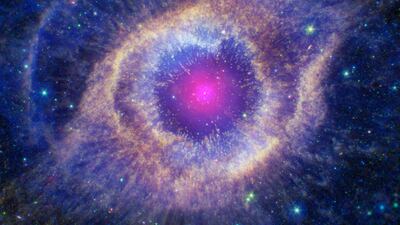
Helix Nebula is a phase when a star like the Sun runs out of fuel, it expands and its outer layers puff off, and then the core of the star shrinks. All photos: Nasa -
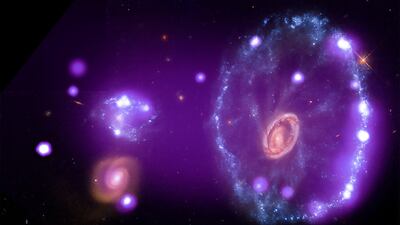
This Cartwheel Galaxy resembles a bull's eye, which is appropriate because its appearance is partly due to a smaller galaxy that passed through the middle of this object. -
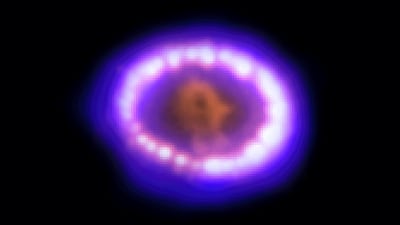
On February 24, 1987, observers in the southern hemisphere saw a new object in a nearby galaxy called the Large Magellanic Cloud. This was one of the brightest supernova explosions in centuries and soon became known as Supernova 1987A. -
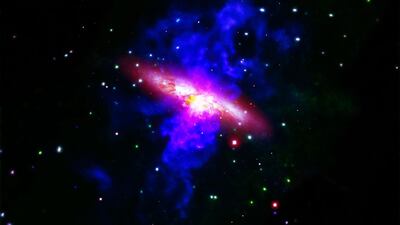
Messier 82, or M82, is a galaxy that is oriented edge-on to Earth. This gives astronomers an interesting view of what happens as this galaxy undergoes bursts of star formations. -
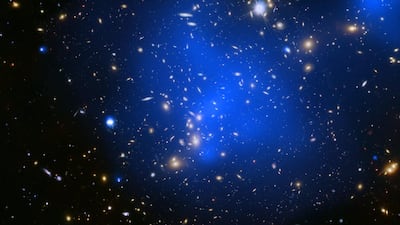
Galaxy clusters are the largest objects in the universe held together by gravity. They contain enormous amounts of superheated gas, with temperatures of tens of millions of degrees, which glow brightly in X-rays and can be observed across millions of light years between galaxies. -

What will be the next star in our Milky Way galaxy to explode as a supernova? Astronomers aren't certain, but one candidate is in Eta Carinae, a volatile system containing two massive stars that closely orbit each other.



