


Astronomers have captured a new image of a powerful jet emerging from the M87 galaxy’s supermassive black hole.
The observations have revealed that the jet of energy can travel trillions of kilometres once spewed from the black hole and the helix-like structure of the jet.
A high-resolution image, captured by the Karl G Jansky Very Large Array, a powerful radio astronomy observatory in New Mexico, shows that the jet has a corkscrew-shaped structure.
Astronomers have learnt that the galactic jet stretched almost 3,300 light years from the galaxy’s supermassive black hole.
It is the farthest distance a magnetic field has been detected in a jet.
The findings were published in The Astrophysical Journal Letters.
“By making high-quality VLA images at several different radio wavelengths of the galaxy Messier 87 (M87), we were able to reveal the 3-dimensional structure of the magnetic field in this jet for the first time,” Alice Pasetto, of the National Autonomous University of Mexico, said.
“The material in this jet traces a double helix, similar to the structure of DNA.”

Supermassive black holes are the largest type and have millions to billions of times the mass of the Sun.
Their gravitation pull is so strong that they destroy all nearby matter, including gas and dust.
But some surrounding particles escape moments before capture and are blown violently into space, creating jets.
The jet was emitted from the first black hole ever to be imaged. Detected 55 million light years away from Earth, its discovery was used to confirm Albert Einstein’s theory of relativity.
“M87 is relatively near to us and its jet is very powerful, making it an excellent target for study. The clues it gives us can help us understand this very important and ubiquitous phenomenon in the universe,” Jose L Gomez, a co-author of the study, said.
Researchers behind the study used the telescope to reveal details of the magnetic field by tracing the alignment of radio waves emitted from it.
They also measured the magnetic field’s strength across different parts of the jet, helping create the highest resolution and detailed images of the galaxy’s jet.
“Helical magnetic fields are expected close to the black hole, and are thought to play a highly important role in channelling the material into a narrow jet, but we didn’t expect to find such a strong helical field extending so far outward,” Jose M Marti, another co-author of the study, said.
The findings will help astronomers deepen their understanding of black holes and their jets.
For decades, they have been trying to solve the mysteries of the space objects and how they occur.
In July, the Event Horizon Telescope, consisting of eight radio observatories that act as one Earth-sized telescope, caught an enormous jet escaping from a black hole in the centre of the Centaurus A galaxy.
Top astronomical events of 2021 - in pictures:
-
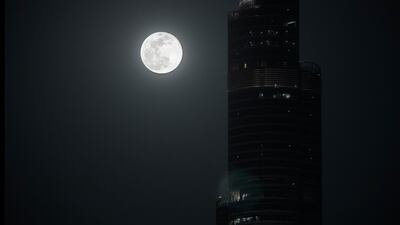
The remaining eight months of 2021 will see several astronomical events. 'The National' lists the top 7 must-see ones that will be visible in UAE's skies. On May 26, a full Moon supermoon will occur. It will be the biggest and brightest of the year. Antonie Robertson / The National -
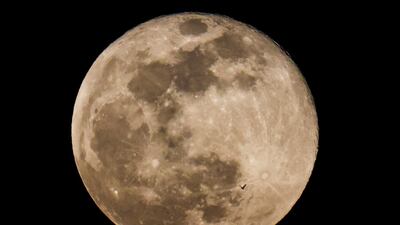
June 24 will be the last chance to spot a supermoon in 2021. The full Moon will not seem as big as the one in May, but it will still be bright enough to spot with the naked eye. Reuters -
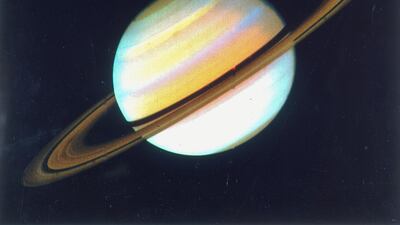
This is a colour-enhanced view of Saturn in 1980 and was taken from the Voyager 2 spacecraft. On August 2, the giant gas planet will be at opposition with Earth and will be visible all night long. It will be the best time to photograph the second largest planet in the solar system. Getty Images -
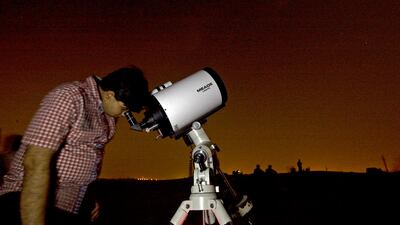
The Perseids meteor shower will be visible in the UAE from August 12 to August 13. At its peak, the shower produces up to 60 meteors per hour and can appear as fireballs shooting across the skies. Jeff Topping / The National -
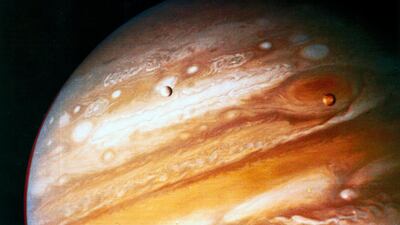
Jupiter will be at opposition on August 19, making a close approach to Earth and becoming visible. This will the best time to observe the largest planet of the solar system and its four large Moons, which will appear as dots next to it. Getty Images -

The Leonids meteor shower will take place on November 18. While these showers are not as visible in the UAE, they still put on a stellar show if weather conditions are favourable and if they are observed away from light pollution. They are also the fastest travelling meteors, at a speed of 71 kilometres per second. Reuters -
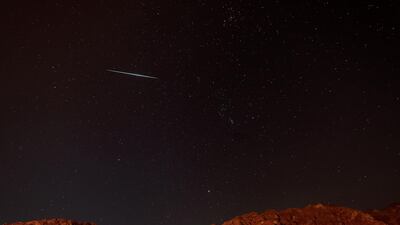
On December 14, the Geminids meteor shower will light up the UAE's skies. It is one of the best celestial events of the year in the Emirates and are highly visible. Chris Whiteoak / The National



