• This hemispheric view of Venus, as revealed by more than a decade of radar investigations culminating in the 1990-1994 Magellan mission, is centered on the North Pole. NASA's Magellan spacecraft imaged more than 98 per cent of Venus.
    This hemispheric view of Venus, as revealed by more than a decade of radar investigations culminating in the 1990-1994 Magellan mission, is centered on the North Pole. NASA's Magellan spacecraft imaged more than 98 per cent of Venus.
  • A combination picture shows the planet Venus as it transits across the face of the sun as seen from the Greenwich Observatory on June 8, 2004 in London. The rare astronomical event last occurred in 1882, while the next transit is due in 2012. Getty Images
    A combination picture shows the planet Venus as it transits across the face of the sun as seen from the Greenwich Observatory on June 8, 2004 in London. The rare astronomical event last occurred in 1882, while the next transit is due in 2012. Getty Images
  • This photo of Venus was taken by the Galileo spacecraft.
    This photo of Venus was taken by the Galileo spacecraft.
  • In the early evening hours of the Space Shuttle Atlantis' first day in space for the four-day STS-30 mission, the Magellan spacecraft is released into space to begin its long journey to the planet Venus for an extensive radar mapping mission.
    In the early evening hours of the Space Shuttle Atlantis' first day in space for the four-day STS-30 mission, the Magellan spacecraft is released into space to begin its long journey to the planet Venus for an extensive radar mapping mission.
  • NASA's Mariner 2 was the world's first successful interplanetary spacecraft. Launched August 27, 1962, on an Atlas-Agena rocket, Mariner 2 passed within about 34,000 kilometers (21,000 miles) of Venus.
    NASA's Mariner 2 was the world's first successful interplanetary spacecraft. Launched August 27, 1962, on an Atlas-Agena rocket, Mariner 2 passed within about 34,000 kilometers (21,000 miles) of Venus.
  • This archival image shows engineers at NASA's Jet Propulsion Laboratory looking at data related to the Venus flyby of Mariner 2 on Dec. 14, 1962. This was the first successful flyby of another planet.
    This archival image shows engineers at NASA's Jet Propulsion Laboratory looking at data related to the Venus flyby of Mariner 2 on Dec. 14, 1962. This was the first successful flyby of another planet.
  • Earth observation captured by crew members onboard Atlantis, Orbiter Vehicle (OV) 104, shows the sunset over the Earth as well as the planet Venus near the center of the frame.
    Earth observation captured by crew members onboard Atlantis, Orbiter Vehicle (OV) 104, shows the sunset over the Earth as well as the planet Venus near the center of the frame.
  • Artist conception of surface of Venus. Courtesy NASA / Rick Guidice
    Artist conception of surface of Venus. Courtesy NASA / Rick Guidice
  • This radar image from NASA's Magellan spacecraft is of a half crater located in the rift between Rhea and Theia Montes in Beta Regio on Venus and has been cut by many fractures or faults since it was formed by the impact of a large asteroid.
    This radar image from NASA's Magellan spacecraft is of a half crater located in the rift between Rhea and Theia Montes in Beta Regio on Venus and has been cut by many fractures or faults since it was formed by the impact of a large asteroid.
  • This figure shows the volcanic peak Idunn Mons in the Imdr Regio area of Venus. The topographic backbone (brown color) was derived from data obtained by NASA's Magellan spacecraft and the overlay was derived from data from ESA's Venus Express Spacecraft.
    This figure shows the volcanic peak Idunn Mons in the Imdr Regio area of Venus. The topographic backbone (brown color) was derived from data obtained by NASA's Magellan spacecraft and the overlay was derived from data from ESA's Venus Express Spacecraft.
  • This radar mosaic from NASA's Magellan spacecraft shows a 600 kilometres segment of the longest channel discovered on Venus in 1990.
    This radar mosaic from NASA's Magellan spacecraft shows a 600 kilometres segment of the longest channel discovered on Venus in 1990.
  • This is an updated montage of planetary images taken by spacecraft managed by NASA's Jet Propulsion Laboratory in Pasadena, CA. Included are (from top to bottom) images of Mercury, Venus, Earth (and Moon), Mars, Jupiter, Saturn, Uranus and Neptune.
    This is an updated montage of planetary images taken by spacecraft managed by NASA's Jet Propulsion Laboratory in Pasadena, CA. Included are (from top to bottom) images of Mercury, Venus, Earth (and Moon), Mars, Jupiter, Saturn, Uranus and Neptune.
  • This chart compares the first Earth-size planets found around a sun-like star to planets in our own solar system, Earth and Venus. NASA's Kepler mission discovered the newfound planets, called Kepler-20e and Kepler-20f.
    This chart compares the first Earth-size planets found around a sun-like star to planets in our own solar system, Earth and Venus. NASA's Kepler mission discovered the newfound planets, called Kepler-20e and Kepler-20f.
  • The June 5, 2012 transit of Venus, the small dot to the right of centre, was captured by a Johnson Space Center photographer in Rocket Park. Courtesy: NASA
    The June 5, 2012 transit of Venus, the small dot to the right of centre, was captured by a Johnson Space Center photographer in Rocket Park. Courtesy: NASA

How UAE's Venus mission will shed light on 'hellish' hot and cloudy planet


Daniel Bardsley
  • English
  • Arabic

In six decades of missions to Venus, much has been learnt about the “hellish” hot, cloudy and acidic conditions on the second planet from the Sun.

But many questions remain, including why Venus developed such an extreme climate, whether volcanic activity continues and if cooler parts of the atmosphere contain micro organisms.

A mission announced this week by the UAE could help scientists gain a better understanding of a planet very similar in size and density to Earth, but very different in character.

Sheikh Mohammed bin Rashid, Vice President and Ruler of Dubai, unveiled plans for a mission to launch in 2028 that will visit Venus and explore seven asteroids in the Asteroid Belt, a circular region of the solar system that approximately fits between Mars and Jupiter.

Manned missions are all but impossible
Prof Ian Crawford

“I’m sure this will be helpful in the overall context of Venus science. It is likely to be one of several missions to Venus in the next decade,” said Ian Crawford, professor of planetary science and astrobiology at Birkbeck University of London.

Nasa, previously accused of neglecting the planet, recently announced two Venus missions, expected in 2028 to 2030, to analyse its atmosphere, geological features and surface topography.

The European Space Agency’s EnVision Venus orbiter is expected to launch in the early 2030s, collecting data that could help scientists understand why Earth and Venus are so different.

  • Sarah Al Amiri, Minister of State for Advanced Sciences, at the launch of a project to explore Venus from 2028. All photos: Ministry of Presidential Affairs / Dubai Media Office
    Sarah Al Amiri, Minister of State for Advanced Sciences, at the launch of a project to explore Venus from 2028. All photos: Ministry of Presidential Affairs / Dubai Media Office
  • Ministers and VIPs listen as Ms Al Amiri sets out details of the five-year mission.
    Ministers and VIPs listen as Ms Al Amiri sets out details of the five-year mission.
  • Sheikh Mohamed bin Zayed, Crown Prince of Abu Dhabi and Deputy Supreme Commander of the Armed Forces, and Sheikh Mohammed bin Rashid, Vice President and Ruler of Dubai, attend the project launch.
    Sheikh Mohamed bin Zayed, Crown Prince of Abu Dhabi and Deputy Supreme Commander of the Armed Forces, and Sheikh Mohammed bin Rashid, Vice President and Ruler of Dubai, attend the project launch.
  • Sheikh Hamdan bin Mohammed, Crown Prince of Dubai, Sheikh Mohamed bin Zayed and Sheikh Mohammed bin Rashid at the launch.
    Sheikh Hamdan bin Mohammed, Crown Prince of Dubai, Sheikh Mohamed bin Zayed and Sheikh Mohammed bin Rashid at the launch.
  • Ministers, rulers and dignitaries attend the launch of the Venus project with Ms Al Amiri.
    Ministers, rulers and dignitaries attend the launch of the Venus project with Ms Al Amiri.
  • Ms Al Amiri explains the project and sets out the five-year mission timeline.
    Ms Al Amiri explains the project and sets out the five-year mission timeline.

The early missions to Venus

Missions to Venus began in the early 1960s, with the former Soviet Union and Nasa launching numerous spacecraft, although much of this early exploration was unsuccessful.

Several fly-bys were achieved, however, and spacecraft also entered Venus’s atmosphere, with the 1967 mission by the Soviet Union’s Venera 4 indicating that this atmosphere was rich in carbon dioxide. The planet is also covered in thick sulphuric acid clouds.

Venus’s atmospheric pressure is 92 times that of Earth at sea level – enough, it has been said, to crush submarines – and it traps energy from the Sun and from Venus itself, creating a surface temperature of about 467°C, highly inhospitable for life, including astronauts.

“Manned missions are all but impossible,” Prof Crawford said. “There have been a handful of robotic missions, all Russian spacecraft, from the 1970s, which successfully parachuted and landed.”

It is, he added, “virtually impossible for equipment to survive very long” on the planet, given the extreme conditions.

Venera 7, another Soviet mission, landed on Venus in 1970, although its parachute ripped on the way down and the spacecraft transmitted only weak signals back to the Earth.

Venera 8 landed on Venus in 1972, achieving what has been described as the first completely successful landing on another planet.

Three years later Venera 9 took pictures on the surface, while in 1978 a Nasa spacecraft, Pioneer, provided evidence that there may once have been oceans on Venus.

A 1989 Nasa orbiter, Magellan, used radar to determine that the surface of Venus was highly volcanic.

“It carried a radar that penetrated through the clouds,” said Prof Crawford, explaining that it indicated that the surface was also relatively young, perhaps formed from volcanic activity 500 million years ago.

“This seems very old, but in the history of the solar system, that’s quite recent.”

There have now been about 40 missions to Venus, a planet that typically takes spacecraft about four months to reach – abaout 40 times as long as it takes to get to the Moon.

A planet still poorly understood

Despite these many missions, Prof Jane Greaves of the School of Physics and Astronomy at Cardiff University in the UK said Venus remained poorly understood because “most telescope observations see only the cloud tops”.

Prof Greaves and a team of other astronomers announced a year ago that by using powerful telescopes they had detected signs of a rare molecule called phosphine, made of hydrogen and phosphorus, in Venus’s clouds.

On Earth, phosphine is made by micro organisms in environments without oxygen, so the discovery raised the intriguing prospect that there may be life in Venus’s upper atmosphere.

Further missions by spacecraft to Venus could lead to a better understanding of Venus’s atmosphere and indicate whether life really may exist there.

“Follow-up could include confirming [the presence of phosphine] by direct sampling in the clouds, and looking for other molecules like ammonia or methane that could be life-related,” Prof Greaves said.

Research has indicated that for billions of years Venus’s surface had moderate temperatures and liquid water, tying in with Nasa’s observations that there may have been oceans, and even living organisms.

But conditions changed about 700 million years ago and since then the surface of Venus has been extremely hot. Researchers are keen to discover more about what caused this shift.

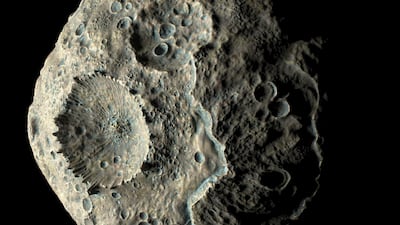
  • A rendering of the Psyche asteroid
    A rendering of the Psyche asteroid
  • Hills are covered with fallen and burnt trees after a meteorite hit in 1908. Getty
    Hills are covered with fallen and burnt trees after a meteorite hit in 1908. Getty
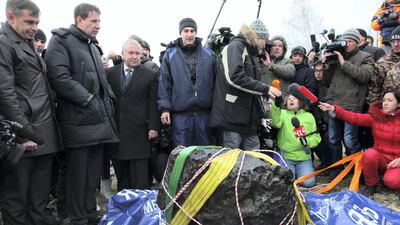
  • People look at what scientists believe to be a chunk of the Chelyabinsk meteor in 2013. AP
    People look at what scientists believe to be a chunk of the Chelyabinsk meteor in 2013. AP
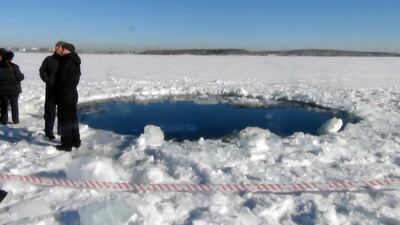
  • People standing near a six-metre hole in the ice of a frozen lake, reportedly the site of a meteor fall, outside the town of Chebakul in central Russia. AFP
    People standing near a six-metre hole in the ice of a frozen lake, reportedly the site of a meteor fall, outside the town of Chebakul in central Russia. AFP
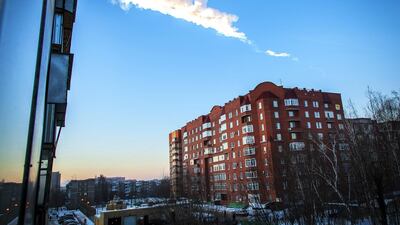
  • A meteorite trail is seen above a residential apartment block in the Urals city of Chelyabinsk in 2013. AFP
    A meteorite trail is seen above a residential apartment block in the Urals city of Chelyabinsk in 2013. AFP
  • The Asteroid Terrestrial-impact Last Alert System (Atlas), pictured in Hawaii.
    The Asteroid Terrestrial-impact Last Alert System (Atlas), pictured in Hawaii.
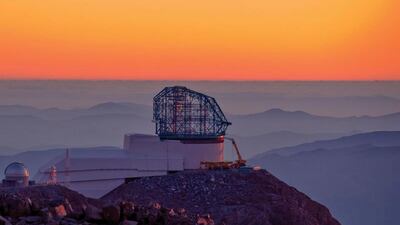
  • The Vera C. Rubin Observatory, under construction in 2019, promises to reveal more objects faster than any previous telescope. Photo: LSST
    The Vera C. Rubin Observatory, under construction in 2019, promises to reveal more objects faster than any previous telescope. Photo: LSST
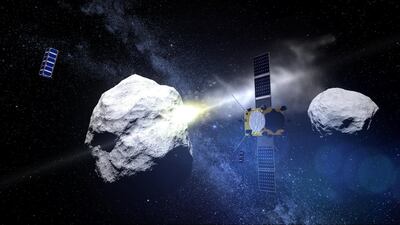
  • A computer-generated image shows the impact of the Dart projectile on the binary asteroid system, Didymos. ESA/AFP
    A computer-generated image shows the impact of the Dart projectile on the binary asteroid system, Didymos. ESA/AFP
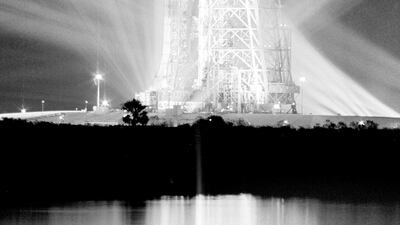
  • Spotlights illuminate the Saturn V booster rocket on the launch pad at the Kennedy Space Centre in Florida carrying the Apollo 8 spacecraft and its crew of three astronauts, on December 19, 1968. AP
    Spotlights illuminate the Saturn V booster rocket on the launch pad at the Kennedy Space Centre in Florida carrying the Apollo 8 spacecraft and its crew of three astronauts, on December 19, 1968. AP

Asteroids and what formed the Solar System

The main Asteroid Belt, which the newly announced UAE mission will also visit, is home to asteroids that originate from the collision and fragmentation of larger objects about 4.6 billion years ago, when the solar system formed.

It contains 1.1 million to 1.9 million asteroids larger than one kilometre in diameter, according to Nasa, plus millions of smaller asteroids, and is where most meteorites that strike Earth originate.

Among the pioneering missions to understand asteroids was Nasa’s Galileo, which in 1991 achieved the first fly-past of an asteroid. It was another decade before the first landing on an asteroid, when Nasa’s Near spacecraft touched down on Eros.

There have since been numerous other asteroid missions, including one by Japan’s Hayabusa, which returned asteroid dust to Earth in 2010, five years after it landed on the asteroid Itokawa.

In December 2020, six years after launching, another Japanese spacecraft, Hayabusa 2, brought back samples from the asteroid Ryugu.

Just as several Venus missions are planned, there is much to look forward to when it comes to asteroid science.

Forthcoming missions include that of Nasa’s Lucy, scheduled to launch from Cape Canaveral in Florida on October 16 on its way to visit one Main Belt asteroid in 2025 and seven Trojan asteroids between 2027 and 2033.

Through cameras and other instruments, Lucy should give researchers details about the surfaces and properties of the asteroids, offering clues about the solar system’s formation.


MATCH INFO

Europa League final

Marseille 0

Atletico Madrid 3
Greizmann (21', 49'), Gabi (89')

Profile

Name: Carzaty

Founders: Marwan Chaar and Hassan Jaffar

Launched: 2017

Employees: 22

Based: Dubai and Muscat

Sector: Automobile retail

Funding to date: $5.5 million

Other workplace saving schemes
  • The UAE government announced a retirement savings plan for private and free zone sector employees in 2023.
  • Dubai’s savings retirement scheme for foreign employees working in the emirate’s government and public sector came into effect in 2022.
  • National Bonds unveiled a Golden Pension Scheme in 2022 to help private-sector foreign employees with their financial planning.
  • In April 2021, Hayah Insurance unveiled a workplace savings plan to help UAE employees save for their retirement.
  • Lunate, an Abu Dhabi-based investment manager, has launched a fund that will allow UAE private companies to offer employees investment returns on end-of-service benefits.
if you go

The flights

Emirates offer flights to Buenos Aires from Dubai, via Rio De Janeiro from around Dh6,300. emirates.com

Seeing the games

Tangol sell experiences across South America and generally have good access to tickets for most of the big teams in Buenos Aires: Boca Juniors, River Plate, and Independiente. Prices from Dh550 and include pick up and drop off from your hotel in the city. tangol.com


Staying there

Tangol will pick up tourists from any hotel in Buenos Aires, but after the intensity of the game, the Faena makes for tranquil, upmarket accommodation. Doubles from Dh1,110. faena.com


Who's who in Yemen conflict

Houthis: Iran-backed rebels who occupy Sanaa and run unrecognised government

Yemeni government: Exiled government in Aden led by eight-member Presidential Leadership Council

Southern Transitional Council: Faction in Yemeni government that seeks autonomy for the south

Habrish 'rebels': Tribal-backed forces feuding with STC over control of oil in government territory

Monster Hunter: World

Capcom

PlayStation 4, Xbox One

Director: Laxman Utekar

Cast: Vicky Kaushal, Akshaye Khanna, Diana Penty, Vineet Kumar Singh, Rashmika Mandanna

Rating: 1/5

Updated: October 06, 2021, 10:10 AM