



Abu Dhabi has announced plans to allow schools to relax Covid-19 safety measures based on their vaccination rates.
The Blue Schools initiative - to be introduced in the second term of the academic year - will permit schools with higher vaccination levels to gradually reduce social distancing requirements, ease mask-wearing protocols, increase classroom and school transport capacity and resume extra-curricular activities and field trips.
A colour-coded tier system will be established - based on the percentage of the school population immunised - which will determine the extent to which safety procedures can be lifted.
The specific details of how the new grading system will work were not disclosed.
The vaccination tiers
Orange for schools with less than 50 per cent of pupils vaccinated; yellow for schools with 50-64 per cent of pupils vaccinated; green for schools with 65-84 per cent of pupils vaccinated; and blue for schools with 85 per cent or more pupils vaccinated.
The scheme was approved by the Abu Dhabi Emergency, Crisis and Disasters Committee.
“To be implemented from term 2 of the current academic year, the blue schools initiative recognises vaccination as the key path to recovery, re-emphasises transparency, and enhances the learning and social experience of pupils at school,” the committee said.
“Higher vaccinated schools will be able to gradually relax measures, including reduced social distancing requirements, relaxed mask-wearing protocols, increased classroom and school transport capacity, and a return to extra-curricular activities, and field trips.”
Children can receive the vaccine free at various centres across Abu Dhabi. These include the dedicated children’s vaccination centre at the Abu Dhabi National Exhibition Centre. Pfizer-BioNTech is available for children aged 12 and older, and Sinopharm is available for children aged 3 and older.
What are the vaccination rules at Abu Dhabi schools?
Pupils in the capital aged 16 and over must be vaccinated to enter their school and their status will be shown on the Al Hosn app.
Children aged 3 to 15 do not have to be vaccinated to return to school but are eligible to receive the shot.
School head welcomes move
Dr Beno Kurien, principal at International Indian School Abu Dhabi, said the scheme will help the education sector return to normality.
“This was required as we have to get back to normal,” said Dr Kurien.
“We are optimistic that all pupils will return to school for but it will take time.
“They [the authorities] are relaxing the rules step by step, from easing social distancing protocols to wearing masks.”
Pupils at Abu School are required to be seated at a distance of one metre.
At the school, which caters for pupils from kindergarten to grade nine, 70 per cent of the close to 900 pupils have returned to in-person lessons.
Although the vaccine is not mandatory for pupils aged under 16, the school head said many had opted to be immunised.
Confidence grows in education sector
-

Pupils arriving on the first day back of in-person learning at the Indian High School in Oud Metha, Dubai. Nearly 13,000 pupils went back for in-person classes across three campuses. All photos: Ruel Pableo for The National -

Pupils arriving on the first day of in-person learning at the Indian High School in Oud Metha, Dubai. Close to 95 per cent of these pupils were returning to in-person schooling for the first time in 18 months. -

Pupils arriving on the first day of in-person learning at the Indian High School in Oud Metha, Dubai. Pupils were excited to meet their friends and teachers again. -

Pupils go through the proper sanitation protocol on the first day of in-person learning at the Indian High School in Oud Metha, Dubai. -

Pupils queuing to enter their classrooms on the first day of in-person learning at the Indian High School in Oud Metha, Dubai. -

Pupils arriving in school buses on the first day of in-person learning at the Indian High School in Oud Metha, Dubai. -

Pupils queuing to enter their classrooms on the first day of in-person learning at the Indian High School in Oud Metha, Dubai. -

Pupils arriving on the first day of in-person learning at the Indian High School in Oud Metha, Dubai. -

Pupils arriving on the first day of in-person learning at the Indian High School in Oud Metha, Dubai. -

Pupils queuing to enter their classrooms on the first day of in-person learning at the Indian High School in Oud Metha, Dubai. -

Pupils queuing to enter their classrooms on the first day of in-person learning at the Indian High School in Oud Metha, Dubai. -

Teacher Usha Devi on the first day of in-person learning at the Indian High School in Oud Metha, Dubai. -

Students on their first day of in-person learning at the Indian High School in Oud Metha, Dubai. -

Punit MK Vasu, chief executive of the Indian High School, on the first day of in-person learning. -

Pupils listen to their teacher on their first day of in-person learning at the Indian High School in Oud Metha, Dubai. -

Priyal Babariya was one of the pupils to attend on the first day of in-person learning at the Indian High School in Oud Metha, Dubai. -

Sian Shinjo, a 10th grader at the school, said: 'I am a bit nervous as everything has changed a lot. I am sure it will be safe, and the school has kept us informed.' -

Rohi Ilyas, a mother-of-two and an entrepreneur, said her children had studied at home for 18 months. -

Utkarsh Chaube, father of a 13-year-old pupil at the Indian High School, said his son spent about 10 to 12 hours in a day in front of a screen when studying remotely. -

Pupils on their first day of in-person learning at the Indian High School. -

Sathya Lakshmi, 15, said seeing everyone back together was the most special part of returning to in-person classes. -

Uma Madhumohan, whose daughter Tejasvi is a 10th grader at the school, said her daughter was excited to get back to learning. -

'I am on cloud nine. It’s been one-and-a-half-years since I have been on campus for in-person classes and I have missed it and my friends terribly,' said Nehan Naseem Ali, 12. -

Pupils back at work inside the classroom. -

'Having the pupils back is unbelievable. I feel ecstatic,' said Punit MK Vasu, chief executive of the Indian High School. -
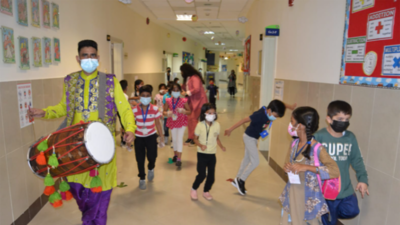
Indian High school -
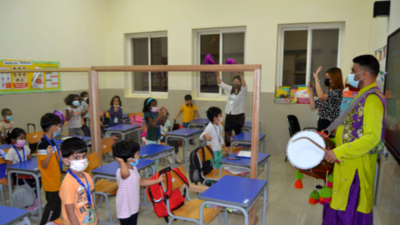


The new directives come after private schools in Dubai ended distance learning on Sunday, apart from for those pupils with exemptions.
High vaccination rates among pupils and school staff coupled with declining infection numbers have led to the return of the pre-pandemic education model. Figures released last month showed 96 per cent of Dubai's private schoolteachers had been vaccinated and 70 per cent of children aged between 12 and 17 had received coronavirus shots.
A one-metre distance between pupils was recommended by the Knowledge and Human Development Authority, the emirate’s private education regulator, as term started in August.
Before then, pupils in a class had to maintain a distance of 1.5 metres.
Pupils at Abu Dhabi’s private and charter schools returned to physical education lessons, sports, and extra-curricular events in August.
Children's play areas, common areas and canteens were also reopened.

