

The UAE’s new astronauts, Mohammed Al Mulla and Nora Al Matrooshi, visited the Nasa Johnson Space Centre in Houston ahead of the start of an intense 30-month training programme in December.
They joined Hazza Al Mansouri, the first Emirati astronaut to go to space, and reserve astronaut Sultan Al Neyadi at the centre, both of whom have already completed half of their training, including learning how to perform spacewalks and flying supersonic jets.
It is the first time all four Emirati astronauts have gathered together since the two new recruits were announced earlier this year.
Mr Al Mulla and Ms Matrooshi, the Arab world’s first woman astronaut, have been honing their skills at the Mohammed bin Rashid Space Centre in Dubai while they waited for the next stage of their journey at Nasa to begin.
“Nora Al Matrooshi and Mohammad Al Mulla visited Nasa’s Johnson Space Centre, accompanied by the UAE Astronaut Programme’s team,” the Mohammed bin Rashid Space Centre said.
“Al Matrooshi and Al Mulla will join astronauts Hazza Al Mansouri and Sultan Al Neyadi in December for the 2021 Nasa Astronaut Candidate Class.”
The training at Nasa is intense and astronauts-in-training are required to master the systems of the International Space Station (ISS) and fly T-38 jets, which move faster than the speed of sound.
Once the astronauts graduate, they will be eligible for Nasa-led missions.
While, the UAE’s first two astronauts are familiar with the hardships that come with space training, it would be a new experience for Ms Al Matrooshi and Mr Mulla.
Maj Al Mansouri, who spent eight days on the ISS, and Dr Al Neyadi also spent one year training in Russia from 2018 to 2019.
Ms Matrooshi, a mechanical engineer, said she was thrilled about her upcoming training, as she likes pursuing adventurous tasks.
“I feel prepared and excited, because I like to think of myself as a very adventurous person. I love the fact that I'll be put in situations I'm not used to. So, I'll be pushed out of my comfort zone. I feel like that's very exciting,” she told The National previously.
Mr Al Mulla, a helicopter pilot for Dubai Police, said he hopes to complete the training successfully, as he is eager to venture to space soon.
He said his previous experience as a helicopter pilot would serve him well during the rigorous Nasa training regime.
“In the past 15 years as a helicopter pilot, I’ve been through a lot of emergencies. This is not something new to me – emergencies and procedures,” he said.
“I have the experience in terms of fear. I also have the experience regarding fear control, plus emergencies. Hopefully, after training I’ll be very good.”
Emirati astronauts learn how to perform spacewalks - in pictures
-
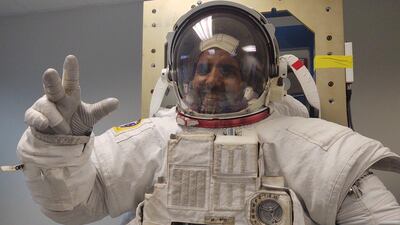
Hazza Al Mansouri, first Emirati man in space, wears a 130 kilogram-heavy extravehicular activities suit for spacewalk training. All photos courtesy of Mohammed bin Rashid Space Centre -
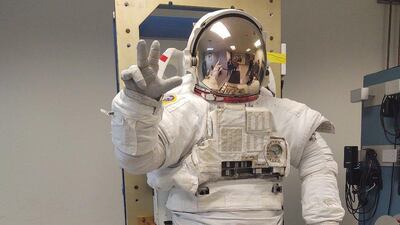
The suit is worn during spacewalks outside of the International Space Station and for training at the world's largest indoor pool at the Johnson Space Centre in Houston, Texas -
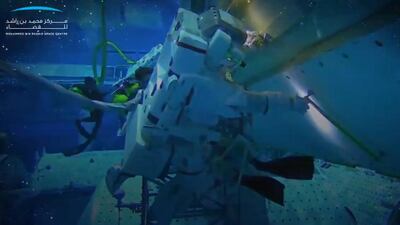
Located at the Neutral Buoyancy Lab (NBL), the indoor pool is 12-metres deep and has 2.4 million litres of water. It helps simulate microgravity and allows astronauts to work on a replica of the International Space Station placed underwater -
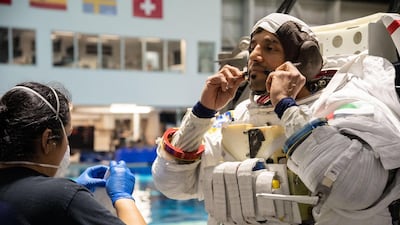
Sultan Al Neyadi, part of the UAE astronaut corps, wears his EVA suit for spacewalk training in the indoor pool -
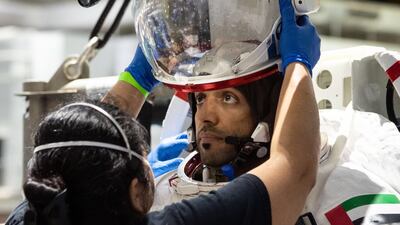
Sultan Al Neyadi puts his helmet on for spacewalk training under water. Mr Al Neyadi was one of two people selected from 4,022 candidates to become the first Emirati astronauts. Mbrsc -
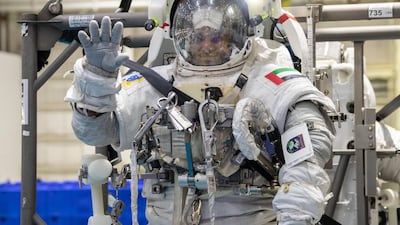
Mr Al Neyadi prepares to go underwater -
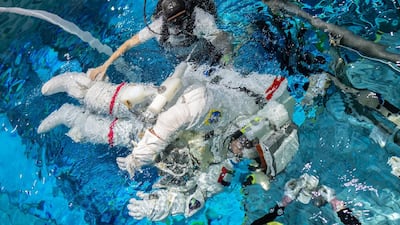
Mr Al Neyadi goes underwater with his EVA suit on for spacewalk training -
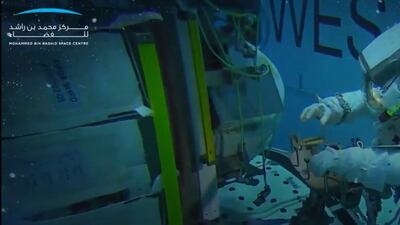
Astronauts can spend up to 10 hours per day at the bottom of the pool to practise maintenance work on the space station model and refine spacewalk techniques. -
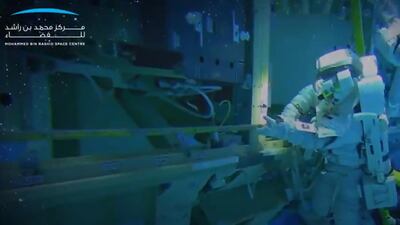
An Emirati astronaut underwater, refining his spacewalk technique. Performing a spacewalk is an extremely dangerous task and requires practise and skill. In 2013, Italian astronaut Luca Parmitano nearly drowned when water leaked into his helmet during a spacewalk. In 2019, Nasa astronaut Chris Cassidy’s wrist mirror broke off, releasing thousands of pieces of space junk -
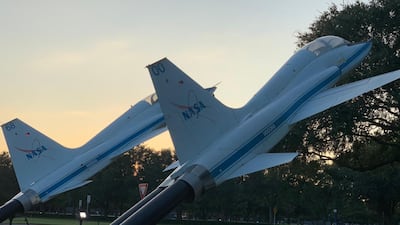
The Emirati astronauts are training for long-haul space missions at the Johnson Space Centre in Houston, Texas. They are also training on T-38 jets, which helps a pilot experience seven G-forces because of the speed. It can fly up to Mach 1.6 and 12,000 metres high – that is 3,000m higher than average airliners.



