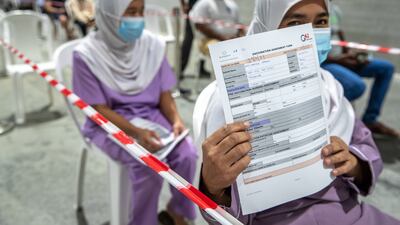
Unvaccinated people who work in federal government departments must be tested every 48 hours from August 29

PCR tests every two days for unvaccinated UAE federal government staff


  • English
  • Arabic

Latest: Coronavirus blog updates

Related: How UAE pupils are preparing for new academic year

Federal government employees who are not vaccinated must now take a coronavirus PCR test every two days.

The decision, announced by the Federal Authority for Government Human Resources on Sunday, will come into effect on August 29.

Previously the requirement was for a test every seven days.

The rule affects employees of all ministries and federal government departments. Local government departments are not necessarily affected by the decision.

In addition, any outsourcing companies and public contractors must ensure any unvaccinated employees entering federal offices are tested every two days, at the expense of the employer.

At 73 per cent, the vast majority of the population in UAE has been vaccinated.

Vaccine clinics see rush as Abu Dhabi rules come into effect - in pictures

  • Abu Dhabi residents wait to be vaccinated against Covid-19 at the Biogenix Labs at G42 in Masdar City. Victor Besa / The National
    Abu Dhabi residents wait to be vaccinated against Covid-19 at the Biogenix Labs at G42 in Masdar City. Victor Besa / The National
  • From August 20, most public spaces in the emirates will use the Al Hosn app as official proof of vaccinations and PCR results. Victor Besa / The National
    From August 20, most public spaces in the emirates will use the Al Hosn app as official proof of vaccinations and PCR results. Victor Besa / The National
  • Only people who are considered low-risk will be permitted to enter government department buildings and most public spaces. Victor Besa / The National
    Only people who are considered low-risk will be permitted to enter government department buildings and most public spaces. Victor Besa / The National
  • The UAE is recommending all residents get vaccinated against Covid-19. Victor Besa / The National
    The UAE is recommending all residents get vaccinated against Covid-19. Victor Besa / The National
  • Booster shots can now be taken without prior appointment at any Seha vaccination centre, the Department of Health - Abu Dhabi has said. Victor Besa / The National
    Booster shots can now be taken without prior appointment at any Seha vaccination centre, the Department of Health - Abu Dhabi has said. Victor Besa / The National
  • Mirza Zaib, from Pakistan, gets vaccinated at Biogenix Labs G42 in Masdar City. Victor Besa / The National
    Mirza Zaib, from Pakistan, gets vaccinated at Biogenix Labs G42 in Masdar City. Victor Besa / The National
  • Nurse Dennise Docil prepares before administering the Pfizer Covid-19 vaccine at the NMC Royal Hospital DIP in Dubai. Chris Whiteoak / The National
    Nurse Dennise Docil prepares before administering the Pfizer Covid-19 vaccine at the NMC Royal Hospital DIP in Dubai. Chris Whiteoak / The National
  • Nurse Deboral Musthafa gets ready to administer the Pfizer Covid-19 vaccine at the NMC Royal Hospital DIP. Chris Whiteoak / The National
    Nurse Deboral Musthafa gets ready to administer the Pfizer Covid-19 vaccine at the NMC Royal Hospital DIP. Chris Whiteoak / The National
  • Fiji Antony receives her Pfizer Covid-19 vaccine at the NMC Royal Hospital DIP. Chris Whiteoak / The National
    Fiji Antony receives her Pfizer Covid-19 vaccine at the NMC Royal Hospital DIP. Chris Whiteoak / The National


Should late investors consider cryptocurrencies?

Wealth managers recommend late investors to have a balanced portfolio that typically includes traditional assets such as cash, government and corporate bonds, equities, commodities and commercial property.

They do not usually recommend investing in Bitcoin or other cryptocurrencies due to the risk and volatility associated with them.

“It has produced eye-watering returns for some, whereas others have lost substantially as this has all depended purely on timing and when the buy-in was. If someone still has about 20 to 25 years until retirement, there isn’t any need to take such risks,” Rupert Connor of Abacus Financial Consultant says.

He adds that if a person is interested in owning a business or growing a property portfolio to increase their retirement income, this can be encouraged provided they keep in mind the overall risk profile of these assets.

Ten tax points to be aware of in 2026

1. Domestic VAT refund amendments: request your refund within five years

If a business does not apply for the refund on time, they lose their credit.

2. E-invoicing in the UAE

Businesses should continue preparing for the implementation of e-invoicing in the UAE, with 2026 a preparation and transition period ahead of phased mandatory adoption. 

3. More tax audits

Tax authorities are increasingly using data already available across multiple filings to identify audit risks. 

4. More beneficial VAT and excise tax penalty regime

Tax disputes are expected to become more frequent and more structured, with clearer administrative objection and appeal processes. The UAE has adopted a new penalty regime for VAT and excise disputes, which now mirrors the penalty regime for corporate tax.

5. Greater emphasis on statutory audit

There is a greater need for the accuracy of financial statements. The International Financial Reporting Standards standards need to be strictly adhered to and, as a result, the quality of the audits will need to increase.

6. Further transfer pricing enforcement

Transfer pricing enforcement, which refers to the practice of establishing prices for internal transactions between related entities, is expected to broaden in scope. The UAE will shortly open the possibility to negotiate advance pricing agreements, or essentially rulings for transfer pricing purposes. 

7. Limited time periods for audits

Recent amendments also introduce a default five-year limitation period for tax audits and assessments, subject to specific statutory exceptions. While the standard audit and assessment period is five years, this may be extended to up to 15 years in cases involving fraud or tax evasion. 

8. Pillar 2 implementation 

Many multinational groups will begin to feel the practical effect of the Domestic Minimum Top-Up Tax (DMTT), the UAE's implementation of the OECD’s global minimum tax under Pillar 2. While the rules apply for financial years starting on or after January 1, 2025, it is 2026 that marks the transition to an operational phase.

9. Reduced compliance obligations for imported goods and services

Businesses that apply the reverse-charge mechanism for VAT purposes in the UAE may benefit from reduced compliance obligations. 

10. Substance and CbC reporting focus

Tax authorities are expected to continue strengthening the enforcement of economic substance and Country-by-Country (CbC) reporting frameworks. In the UAE, these regimes are increasingly being used as risk-assessment tools, providing tax authorities with a comprehensive view of multinational groups’ global footprints and enabling them to assess whether profits are aligned with real economic activity. 

Contributed by Thomas Vanhee and Hend Rashwan, Aurifer

Updated: August 22, 2021, 10:30 AM