


Pupils were taught in the same manner for about 200 years – from memorising maths tables and foreign language phrases, to cramming facts for exams.
Then, the pandemic came along and the world of learning changed completely.
Schools and universities around the world moved from in-person classes to online learning in a matter of weeks as a result of the pandemic.
Many children were away from face-to-face learning until late 2020, or even early this year.
The pandemic revolutionised education as schools, universities, and nurseries had to quickly adapt.
So what should we hold on to from the pandemic and what should we jettison?
Online learning - but not as you know it
In-person learning was disrupted by the pandemic, which forced classes to move online.
Worst case scenario: pupils were downloading study sheets assigned from some school intranet. Not great.
But the best use of this new technology should be here to stay – for good.
Lisa Johnson, principal at the American Academy for Girls in Dubai, said the way they taught pupils spurred teachers and parents to be more dynamic.
“We were teaching children like they were taught 200 years ago," she said.
"The pandemic forced us to transform our programmes to meet the needs of pupils. The ramp-up for that was incredibly steep but teachers stepped up and learnt how to do it."
-
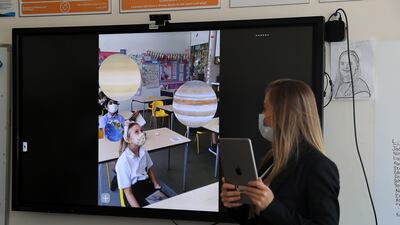
Gems Metropole School in Dubai has brought augmented reality into the classroom, using cutting-edge digital tools to allow for a greater understanding of the world. All images by Pawan Singh / The National -

Grade 1 pupils during the AR class at the Gems Metropole School in Up Town Motor City. -

Sophie Hunter, digital innovation leader at Gems Metropole School, said the technology could be beneficial to all age groups. -
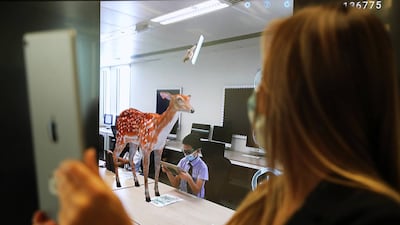
Gems Metropole School in Dubai has brought augmented reality into the classroom, using cutting-edge digital tools to allow for a greater understanding of the world. -
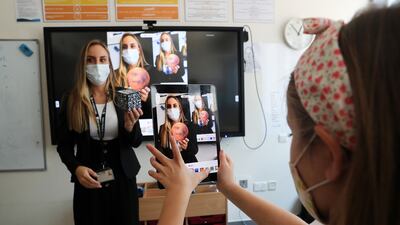
The school started using augmented reality for ages three to 18 in term three in the last academic year, and is set to introduce virtual reality in lessons next year. -

Merge Explorer and Viewer apps provide a library of images and projections, from Egyptian artefacts to human body systems.


She said the change was long overdue.
Concepts such as a flipped classroom, where pupils watch a recorded lesson beforehand and came to class to have a discussion, were not used much before the pandemic, but became popular during this period.
The method is closer to the way university students study before a group session.
When used best, it is how workplace employees come to a meeting to tackle a challenge.
Ms Johnson said she hoped the creativity and improvisation that had been injected into the system would continue post pandemic.
Lulu Akkila, an Emirati working mother of five and chair of the advisory board at the American Academy for Girls in Dubai, said that in the initial days of the pandemic, pupils, parents and schools were not prepared for online learning.
“The school put in effort to help parents with technical issues," Ms Akkila said.
“The technology played a major role in changing things around for parents and pupils, but not all children enjoyed online learning because they missed their friends."
She said online learning had its pros and cons
“While it opened doors for lots of opportunities for them and they could see their friends on Zoom, I was worried about my children spending so much time on their iPads,” she said.
Ms Akkila said she wanted her children to play and enjoy their childhood, not just spend time on their devices.
Mental health must escape its buzzword origins
The pandemic brought health pressures to the fore – in good ways and bad.
For all the recognition that was achieved in countless news articles and social media posts, what changed at the coalface of education?
In September, mental health and well-being studies will be part of the curriculum when Brighton College Dubai begins its sixth form class.
“Pupils and teachers' well-being really came to the fore – particularly teachers who were a long way from home," Richard Drew, principal at Jumeira Baccalaureate School, told The National.
Schools had to support pupils who were stranded abroad and could not come back to the country because of border closures.
Children's well-being became a concern in the region and countries around the world during the past year.
Nearly one in three teenagers in a 2020 US study said their mental health had suffered because of the pressures of the pandemic.
“After a couple of months, we realised that some pupils were thriving while others were crumbling,” Rehab Ali, academic director at Stars of Knowledge School in Riyadh, Saudi Arabia, told The National in March.
“Some teachers felt the pressure because they were supposed to handle the whole curriculum online.”
How teachers and parents talk now
Some schools in the UAE decided to move their parent-teacher-meetings online to help parents, particularly working parents, who struggled to attend sessions.
Parent evenings will be held online across all Taaleem schools after the practice proved popular with families.
"The way in which we communicated and met with pupils and parents changed during the pandemic,' Mr Drew said.
He said that previously parents would have to make appointments and come in and sometimes meetings would overrun or not all the parents would turn up.
Now, parents can book an appointment for a few minutes and need take only that time out of their schedules.
This shift mirrors a global trend to keep parent-teacher meetings online even after the pandemic.
In May, media in the UK reported that parents' evenings were likely to remain online beyond the pandemic.
Ms Johnson, at the American Academy for Girls in Dubai, said the school would offer virtual and in-person options to parents.
How do we help struggling teachers?
Because parents had to be more engaged than ever before in their children's learning, it made them appreciate the hard work teachers put in to educate young people.
In the early days of online learning, parents reported struggling to print worksheets and help children complete assignments.
"The pandemic has certainly led to parents appreciating the work and effort of teachers more," said Sheela Menon, principal at Ambassador School, an Indian curriculum school in Dubai.
"A prolonged model of virtual classes can be frustrating for both the parents and children.
"Neither are parents trained to play the role of a teacher nor is home always the best environment for developing social skills in children when they need to interact with a wider circle of peers."
Ms Johnson also said that parents of pupils in early years had more empathy for teachers now and understood the challenges they face.
"Teachers work incredibly hard and I have heard from parents about the support they received," she said.
Ms Akkila said that parents had to wear many hats during the pandemic, but teachers had it tougher.
"We [parents] did a lot of work that we were not used to. We were teachers as well as technicians for our children," she said.
"The teachers also had it very difficult. In addition to being teachers they were parents. Whatever role we played with our children, they could not be with their families.
Mr Drew said he was conscious about the mental health of his staff during the pandemic.
"The school ensured teachers were cared for and created a buddy system so they did not feel isolated. School officials would call teachers and make sure they felt supported," he said.
"School counsellors and teachers would meet pupils online, offer support or advice. Counselling was provided when needed."
-

Gems Wellington International School student George Moussa, from Egypt, who achieved six grade nines, celebrates his results with his family. -

Pupil Kareem Baloawi discusses his GCSE results with Adrian Frost, Principal of Amity International School in Abu Dhabi -
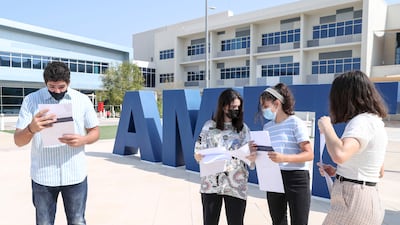
Pupils Kareem Baloawi, 16, Rahaf Teggaz, 16, Maram Chetioui, 15, and Fransio Van Ravenswaay, 16, receive their GCSE results after a long summer of anticipation at Amity International School Abu Dhabi -

Madeline Cranitch, Brighton College Dubai, was delighted with her results. -

Roxanne Dubash, Deira International School, celebrates 10 A* grades with her sister. -

Grace Clarke, Brighton College Al Ain, was thrilled with her results. -

Gayon Ko who joined Brighton College Abu Dhabi in the spring scored a total of nine grade 9s in her GCSEs. -

Brighton College Abu Dhabi pupil Kai Bevan was overjoyed when he realised he had scored 11 grade 9s in his GCSEs. -

Vinuth Ratnayake, from British School Al Khubairat in Abu Dhabi, celebrates achieving 11 grades 8 and 9.


The end of exams - at least for now?
Major summer exams were cancelled for most curricula this year including GCSEs, A Levels and Indian boards.
In the absence of exams, governments, schools, and boards had to rethink how to assess pupils.
This year, unlike in 2020 when an algorithm was used, teacher-assessed grades were given to A-level pupils, verified by exam boards.
Pupils in the UAE did not sit summer exams for the Central Board of Secondary Education this year after Indian authorities cancelled tests.
Children's school work and project work over the course of the year was assessed.
"The very concept of assessments and rewarding of grades underwent a massive change for the good," Sheela Menon sais.
Pearson, a major exam board, in a survey of 1,100 teachers in the UK found that eight of out 10 teachers said high-stake exams should be taken throughout the year.

