Aisha Al Yazeedi, an Emirati astrophysics researcher at NYU Abu Dhabi who has recently published a scientific paper about a galaxy.

Emirati researcher makes discovery on evolution of galaxies


Daniel Bardsley
  • English
  • Arabic

An Emirati astrophysics researcher has published a paper describing the light and radio signals emanating from a galaxy with a supermassive black hole at the centre.

The findings by Aisha Al Yazeedi, 25, of NYU Abu Dhabi, may prove useful to researchers as they try to understand how such enormous black holes influence changes in their galaxies.

Ms Al Yazeedi likes to share a picture that illustrates space through the lens of Nasa’s Hubble Space Telescope.

A composite produced from hundreds of photos, the remarkable image shows about 5,500 galaxies.

This is a tiny portion of the known universe, so tiny that another 30million similar images would be required to show the universe in full.

“This by itself is something that I contemplate all the time,” Ms Al Yazeedi said.

“We’re so lucky to be here. I will always be a student learning about space. This is something phenomenal to me.”

This passion for understanding space and mankind’s place in it led Ms Al Yazeedi and a team of co-researchers to analyse the galaxy, called MaNGA 1-166919, in her first scientific paper.

MaNGA 1-166919, one of an estimated two trillion galaxies in the universe, is characterised by having a particularly active supermassive black hole, a huge type of black hole that draws material into itself.

When a supermassive black hole is particularly active it forms an “accretion disk”, described by one author as a “rotating queue” of material such as gases and stars waiting to be drawn into it.

This accretion disk forms part of what is called the galaxy’s Active Galactic Nucleus (AGN). As the material moves ever faster, it heats up and emits signals of the kind analysed in the paper.

The radio signals were found to consist of two jets emanating from the galaxy’s centre and these signals corresponded well with the optical signals from the galaxy.

A composite produced from hundreds of photos shows about 5,500 galaxies.

“This is the goal: to understand the physics of the SMBH (supermassive black hole) at the centre of the galaxy, and how it influences the galaxy’s evolution,” Ms Al Yazeedi said.

“I picked this galaxy because it has very interesting radio morphology. Simply by looking at the radio morphology, you could tell that this galaxy has an AGN, which tells you that the SMBH at the centre of the galaxy is active and therefore it has an effect on the galaxy.”

Radio morphology is a function of optical identification for the sources for which there are radio images.

The analysis employed specialist software to process vast amounts of data on the galaxy collected by the National Radio Astronomy Observatory in New Mexico, US.

In carrying out this work, the results of which were recently published in The Astrophysical Journal, the researchers hope to gain insights that could lead to a better understanding of our own galaxy, the Milky Way.

“We need to work on a long list of galaxies to see if the same physics applies,” Ms Al Yazeedi said. “We want to take this further with other galaxies.”

The Milky Way does not have an AGN, but research has indicated it may have had one as recently as within the last few million years. When, as predicted, the Milky Way collides with another galaxy called Andromeda in 4.5 billion years, another AGN could form.

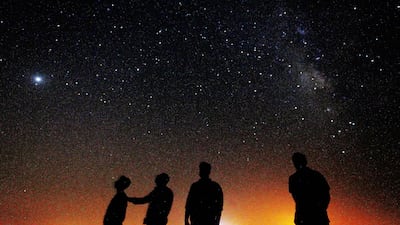
  • People look at the Milky Way galaxy rising in the night sky in Kuwait's Al Salmi desert, 120Km north of the capital.
    People look at the Milky Way galaxy rising in the night sky in Kuwait's Al Salmi desert, 120Km north of the capital.
  • The Milky Way galaxy and various constellations are visible to the naked eye.
    The Milky Way galaxy and various constellations are visible to the naked eye.
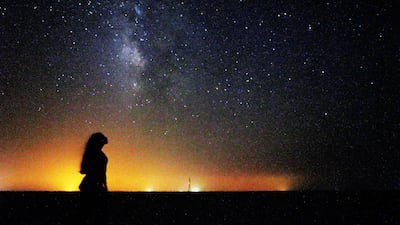
  • A woman looks at the Milky Way rising in the night sky in Kuwait's Al Salmi desert.
    A woman looks at the Milky Way rising in the night sky in Kuwait's Al Salmi desert.
  • People watch as the stars light up the sky over the rolling sand dunes.
    People watch as the stars light up the sky over the rolling sand dunes.
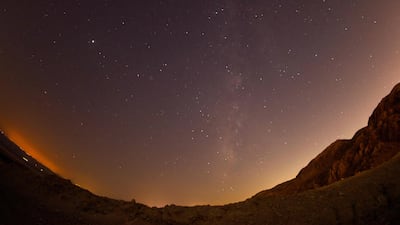
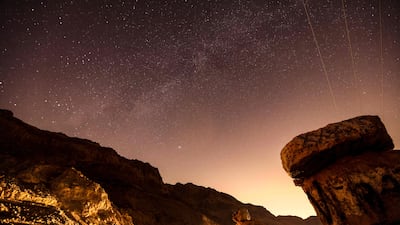
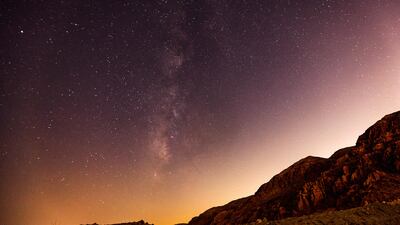
  • The Milky Way galaxy rising above the Judaean mountains between Jericho in the occupied West Bank and Ein Gedi in Israel.
    The Milky Way galaxy rising above the Judaean mountains between Jericho in the occupied West Bank and Ein Gedi in Israel.
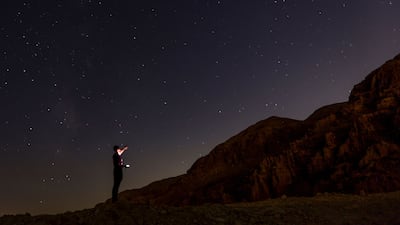
  • A Palestinian man watches stars above the Judaean mountains between Jericho in the occupied West Bank and Ein Gedi in Israel.
    A Palestinian man watches stars above the Judaean mountains between Jericho in the occupied West Bank and Ein Gedi in Israel.
  • The Milky Way galaxy rising above the Judaean mountains between Jericho in the occupied West Bank and Ein Gedi in Israel.
    The Milky Way galaxy rising above the Judaean mountains between Jericho in the occupied West Bank and Ein Gedi in Israel.
  • The Milky Way galaxy rising above the Judaean mountains between Jericho in the occupied West Bank and Ein Gedi in Israel.
    The Milky Way galaxy rising above the Judaean mountains between Jericho in the occupied West Bank and Ein Gedi in Israel.

Ms Al Yazeedi, who is supported by the Mohammed bin Rashid Space Centre, has been conducting research at NYU Abu Dhabi’s Centre for Astro, Particle and Planetary Physics under the supervision of Dr Joseph Gelfand, an associate professor of physics and co-author of the paper, through the university’s Kawader programme.

Aimed at well-qualified graduates and post-doctoral researchers, the scheme aims to build capability within the UAE by offering a three-year salaried programme tailored to the interests of each researcher.

The UAE has become a key player in space exploration, launching the Mars orbiter, Hope, a year after sending one of its own astronauts to the International Space Station.

Next year the country aims to send a rover called Rashid to the Moon.

“It’s like we’re making history with all the milestones we’re taking in space science and the space industry,” Ms Al Yazeedi said.

“It makes me very, very proud and very lucky to be an Emirati in this era.”

A 2017 graduate of Sorbonne University Abu Dhabi, Ms Al Yazeedi hopes to continue her research by going on to study for a PhD.

Space year 2021 - in pictures

  • This is a year of landmark space missions. 'The National' looks at the five most exciting ones.
    This is a year of landmark space missions. 'The National' looks at the five most exciting ones.
  • The UAE's Hope probe (pictured) arrived on Mars in February. It will studied why the planet's atmosphere is being stripped away, making it impossible for life to exist.
    The UAE's Hope probe (pictured) arrived on Mars in February. It will studied why the planet's atmosphere is being stripped away, making it impossible for life to exist.
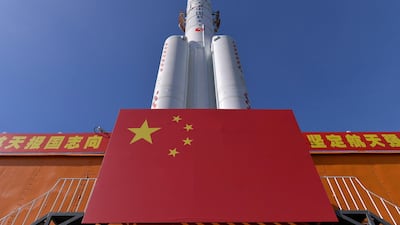
  • China's Tianwen-1 spacecraft includes a Mars orbiter and a rover. Pictured is the Long March-5 rocket that carried Tianwen-1 into space.
    China's Tianwen-1 spacecraft includes a Mars orbiter and a rover. Pictured is the Long March-5 rocket that carried Tianwen-1 into space.
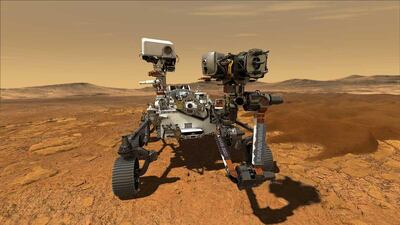
  • Nasa's Perseverance rover landed on Mars on February. The return mission brought back Mars soil and rock samples. This is a computer-generated image of the rover.
    Nasa's Perseverance rover landed on Mars on February. The return mission brought back Mars soil and rock samples. This is a computer-generated image of the rover.
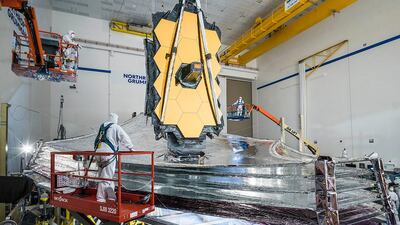
  • The James Webb Space Telescope is set to be the most advanced space observatory. It will orbit the Sun and will be able to see what the universe looked like millions of years ago. It is expected to be launched on October 31.
    The James Webb Space Telescope is set to be the most advanced space observatory. It will orbit the Sun and will be able to see what the universe looked like millions of years ago. It is expected to be launched on October 31.
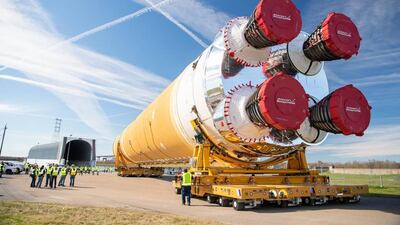
  • Nasa will launch a return mission to the Moon. The Space Launch System, world's most powerful rocket (pictured), will carry the Orion spacecraft into space as part of the Artemis 1 mission. Orion will orbit the Moon for several days. If successful, it will pave the way for a crewed flight to the Moon in 2023. Courtesy: Nasa
    Nasa will launch a return mission to the Moon. The Space Launch System, world's most powerful rocket (pictured), will carry the Orion spacecraft into space as part of the Artemis 1 mission. Orion will orbit the Moon for several days. If successful, it will pave the way for a crewed flight to the Moon in 2023. Courtesy: Nasa
  • 2021 will also be the year of space tourism. Actor Tom Cruise, director Doug Liman and another private citizen will fly to the International Space Station as part of a private space flight with a company called Axiom. Mr Cruise and Mr Liman will film a movie there. Russia will also try to film a move in space around the same time. SpaceX is providing the ride. IMDb
    2021 will also be the year of space tourism. Actor Tom Cruise, director Doug Liman and another private citizen will fly to the International Space Station as part of a private space flight with a company called Axiom. Mr Cruise and Mr Liman will film a movie there. Russia will also try to film a move in space around the same time. SpaceX is providing the ride. IMDb
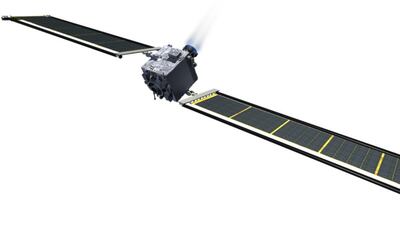
  • In July, Nasa was set to launch a mission that would deliberately crash a spacecraft (artist impression is pictured) into an asteroid's moon to change the space rock's course.
    In July, Nasa was set to launch a mission that would deliberately crash a spacecraft (artist impression is pictured) into an asteroid's moon to change the space rock's course.
While you're here ...

Damien McElroy: What happens to Brexit?

Con Coughlin: Could the virus break the EU?

Andrea Matteo Fontana: Europe to emerge stronger

Tips for taking the metro

- set out well ahead of time

- make sure you have at least Dh15 on you Nol card, as there could be big queues for top-up machines

- enter the right cabin. The train may be too busy to move between carriages once you're on

- don't carry too much luggage and tuck it under a seat to make room for fellow passengers

Ten tax points to be aware of in 2026

1. Domestic VAT refund amendments: request your refund within five years

If a business does not apply for the refund on time, they lose their credit.

2. E-invoicing in the UAE

Businesses should continue preparing for the implementation of e-invoicing in the UAE, with 2026 a preparation and transition period ahead of phased mandatory adoption. 

3. More tax audits

Tax authorities are increasingly using data already available across multiple filings to identify audit risks. 

4. More beneficial VAT and excise tax penalty regime

Tax disputes are expected to become more frequent and more structured, with clearer administrative objection and appeal processes. The UAE has adopted a new penalty regime for VAT and excise disputes, which now mirrors the penalty regime for corporate tax.

5. Greater emphasis on statutory audit

There is a greater need for the accuracy of financial statements. The International Financial Reporting Standards standards need to be strictly adhered to and, as a result, the quality of the audits will need to increase.

6. Further transfer pricing enforcement

Transfer pricing enforcement, which refers to the practice of establishing prices for internal transactions between related entities, is expected to broaden in scope. The UAE will shortly open the possibility to negotiate advance pricing agreements, or essentially rulings for transfer pricing purposes. 

7. Limited time periods for audits

Recent amendments also introduce a default five-year limitation period for tax audits and assessments, subject to specific statutory exceptions. While the standard audit and assessment period is five years, this may be extended to up to 15 years in cases involving fraud or tax evasion. 

8. Pillar 2 implementation 

Many multinational groups will begin to feel the practical effect of the Domestic Minimum Top-Up Tax (DMTT), the UAE's implementation of the OECD’s global minimum tax under Pillar 2. While the rules apply for financial years starting on or after January 1, 2025, it is 2026 that marks the transition to an operational phase.

9. Reduced compliance obligations for imported goods and services

Businesses that apply the reverse-charge mechanism for VAT purposes in the UAE may benefit from reduced compliance obligations. 

10. Substance and CbC reporting focus

Tax authorities are expected to continue strengthening the enforcement of economic substance and Country-by-Country (CbC) reporting frameworks. In the UAE, these regimes are increasingly being used as risk-assessment tools, providing tax authorities with a comprehensive view of multinational groups’ global footprints and enabling them to assess whether profits are aligned with real economic activity. 

Contributed by Thomas Vanhee and Hend Rashwan, Aurifer

Cryopreservation: A timeline
  1. Keyhole surgery under general anaesthetic
  2. Ovarian tissue surgically removed
  3. Tissue processed in a high-tech facility
  4. Tissue re-implanted at a time of the patient’s choosing
  5. Full hormone production regained within 4-6 months
Updated: August 18, 2021, 9:48 AM