



Latest: Dubai residents stuck abroad need GDRFA and ICA approval to return
The UAE's two main airlines are preparing to resume passenger flights from six countries on Thursday after a coronavirus-imposed travel ban was eased.
Emirates and Etihad said they were working on schedules for services from India, Pakistan, Sri Lanka, Nepal, Nigeria and Uganda, but were awaiting clarification from the authorities.
"We will publish details of the latest protocols and requirements on our travel requirements page, as soon as these are available," Emirates said.
Emirates had several flights from India, Pakistan and Sri Lanka to Dubai on its website on Thursday. Most one-way ticket prices started from about Dh1,000.
These included two flights from Chennai, leaving at 4am and 9.50am, and three flights from Mumbai to DXB at 4.30am, 10.10am and 7.20pm. Two flights from Delhi were listed as departing at 11am and 4.15pm on Thursday.
Other Emirates flights from Pakistan are available from Karachi and Peshawar to Dubai on Thursday. One flight leaves Karachi at 3.25am and another at 12.20pm, while a flight from Peshawar is available from 9am, landing in Dubai at 11.20am.
Flights from Sri Lanka are also available with Emirates. Those looking to return to Dubai can book on the 10.05am flight from Colombo on Thursday, or the 3.15am flight on Friday, August 6 arriving at 6am.
Etihad said: "As some restrictions will ease from August 5, we are working to resume flights as soon as possible for eligible guests to travel to the UAE and for transit."
On Tuesday, the government said fully vaccinated UAE residents from those countries can return – as long as they were vaccinated in the Emirates.
In addition, unvaccinated people stuck abroad who are in key job categories, can also apply to return.
Officials referred to an application for permission from the Federal Authority for Identity and Citizenship website.
The ICA permission to return link can be found here. Passengers are required to upload a picture of their residency visa and Emirates ID, along with a recent PCR test and vaccination certificate.
Vaccination certificates can be downloaded from the Seha and Dubai Health Authority applications.
Indian expats travel far and wide to quarantine in green list countries - in pictures
-

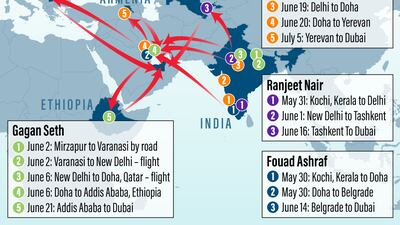
Thousands of travellers like Gagan Seth and his wife Vaishali quarantine in green countries including Ethiopia to reach the UAE from India due to flight restrictions to stem the spread of the coronavirus pandemic. -

Gagan Seth and his wife Vaishali return to Dubai from India after 14-day quarantine in Addis Ababa. -

Gagan and Vaishali Seth flew from Delhi to Addis Ababa where they quarantined for two weeks before returning to Dubai. The couple were in India to take care of Gagan's elderly parents who tested positive for Covid-19. -

Dubai resident Gagan Seth and his wife Vaishali went to India to take care of his parents who contracted Covid-19. They took a break during a 14-day quarantine in Addis Ababa before returning to Dubai. -

Ranjeet Nair and his wife Minnu Balachandran heading to Dubai after spending months in India for a family medical emergency. -

Minnu Balachandran and her husband Ranjeet Nair (not in pic) spent 14 days in Uzbekistan as part of a mandatory quarantine requirement before returning to Dubai. -

Minnu Balachandran and her husband Ranjeet Nair (not in photo) return to Dubai after a two-week quarantine in Uzbekistan. -

UAE residents Ranjeet Nair and his wife Minnu Balanchandran take a break in Uzbekistan. Hundreds of travellers from India are spending mandatory quarantine in green countries deemed safe for travel before returning to the UAE. -

Dubai resident Fouad Ashraf with his family in Serbia before returning to the UAE -

Jeevan D’Mello with his wife Cecilia in Armenia before returning to Dubai. -

Jeevan D’Mello and Cecilia D’Mello in Armenia that is among preferred quarantine locations for Indian travelers returning to the UAE. -

Dubai residents Jeevan and Cecilia D’Mello in Armenia as part of a 14-day stay in a green country considered safe after travel from India. -
.


Emirates reiterated that eligible customers will only be allowed to transit through UAE from the countries below:
Afghanistan
Bangladesh
Indonesia
South Africa
Vietnam
Zambia
Unvaccinated people in certain job categories can also return
There are further exemptions that cover people who are not vaccinated. They include medical workers, teachers at schools and universities in the Emirates, students, residents with extenuating circumstances, patients undergoing medical treatment in the UAE and employees who work for federal or local government agencies.

