• An artist's impression of the UAE's lunar rover called Rashid.
    An artist's impression of the UAE's lunar rover called Rashid.
  • Dr Hamad Al Marzooqi, project manager of the Emirates Lunar Mission at the Mohammed bin Rashid Space Centre. Chris Whiteoak / The National
    Dr Hamad Al Marzooqi, project manager of the Emirates Lunar Mission at the Mohammed bin Rashid Space Centre. Chris Whiteoak / The National
  • An artist's impression of iSpace's Hakuto-Reboot lunar lander. It will carry UAE's Rashid rover to the surface of the Moon in 2022.
    An artist's impression of iSpace's Hakuto-Reboot lunar lander. It will carry UAE's Rashid rover to the surface of the Moon in 2022.
  • The UAE aims to land the Rashid rover on the near side of the Moon due to its smoother surface.
    The UAE aims to land the Rashid rover on the near side of the Moon due to its smoother surface.
  • The far side of the Moon remains largely unexplored, but Nasa is turning its focus back to the lunar surface.
    The far side of the Moon remains largely unexplored, but Nasa is turning its focus back to the lunar surface.
  • The HAKUTO-R lander, which will deliver the UAE's Rashid rover to the lunar surface in 2022, is now in final stages of assembly.
    The HAKUTO-R lander, which will deliver the UAE's Rashid rover to the lunar surface in 2022, is now in final stages of assembly.
  • The ispace team completed the assembly of the lander's structure thermal model in April. Courtesy: ispace
    The ispace team completed the assembly of the lander's structure thermal model in April. Courtesy: ispace
  • The final assembly of the lander is being carried out in co-operation with the Ariane Group GmbH at the Ariane Group facility in Lampoldshausen, Germany. Courtesy: ispace
    The final assembly of the lander is being carried out in co-operation with the Ariane Group GmbH at the Ariane Group facility in Lampoldshausen, Germany. Courtesy: ispace
  • Using a lander and rocket that is already available helps Emirati engineers and scientists get quicker and easier access to space. Courtesy: ispace
    Using a lander and rocket that is already available helps Emirati engineers and scientists get quicker and easier access to space. Courtesy: ispace
  • The initial concept design of the Rashid rover. Courtesy: MBRSC
    The initial concept design of the Rashid rover. Courtesy: MBRSC
  • Rashid rover's thermal imager will analyse the Moon's properties through thermal energy. Courtesy: MBRSC
    Rashid rover's thermal imager will analyse the Moon's properties through thermal energy. Courtesy: MBRSC
  • The Langmuir probes on the rover will analyse the lunar surface charge and electric fields. Courtesy: MBRSC
    The Langmuir probes on the rover will analyse the lunar surface charge and electric fields. Courtesy: MBRSC
  • One of the rover's two high-resolution optical imagers that will take photos of the Moon. Courtesy: MBRSC
    One of the rover's two high-resolution optical imagers that will take photos of the Moon. Courtesy: MBRSC

Lander to take UAE rover to Moon is in final stages of assembly


Sarwat Nasir
  • English
  • Arabic

The Japanese lander that will deliver the UAE’s first rover, Rashid, to the lunar surface, is in the final stages of assembly.

Unspecified technical problems in 2020 delayed the launch of the Hakuto-R lander by a year.

Now, the lunar flight model has reached its final stages of assembly and is on schedule for a launch in the fourth quarter of 2022. It will be carried to space on a Falcon 9 rocket launched from the Kennedy Space Centre in Florida.

Being developed by private space company ispace, the lander has been moved from Japan to Germany for the final stages, the company announced on Wednesday.

“Today, ispace announced that it began the assembly of the flight model for its lunar lander, which is to be used in the company’s first mission, scheduled to launch in 2022,” ispace said.

“This is a major engineering milestone in the development of the lander and part of the final stretch towards our first mission.”

The Rashid rover, which is being developed by a group of start-up companies and engineers from the Mohammed bin Rashid Space Centre (MBRSC), will be one of six payloads on board the lander.

Others include a transformable lunar robot by Japan’s space agency Jaxa, a solid-state battery test module by NGK Spark Plug, an artificial intelligence flight computer by Canada’s Mission Control Space Services, cameras by Canada’s Canadensys and panels engraved with the names of the lander’s crowdfunding supporters.

“Despite setbacks caused by the Covid-19 pandemic, such as delays in the supply chain, personnel limits at testing facilities, remote work communications, travel restrictions, and other issues, ispace’s engineers were steadfast in their operations and managed to remain on schedule,” ispace said.

The final assembly of the lander is being carried out in co-operation with the Ariane Group at its facility in Lampoldshausen, Germany.

The assembly and integration of all the payloads, ispace said, are scheduled to be completed by the end of this year, which suggests the Rashid rover could be completed by December.

After final testing of the lander is completed early next year, it will be shipped to the US in the second half of 2022 for the launch.

Using a lander and rocket that is already available helps Emirati engineers and scientists get quicker and easier access to space.

Last month, the UAE revealed its long-term Moon exploration programme at a global space conference in Russia.

The Emirates plans to send several rovers and orbiters to the Moon, with the second rover scheduled for a launch in 2024 or 2025.

“A lot of people asked the question why we skipped over the Moon when we launched the Hope probe to Mars. But we’ve kicked off our latest project, which is the Rashid rover that will explore the lunar surface,” said Salem Al Marri, deputy director-general of MBRSC.

“Our objective is to build and send a second rover by 2024 or 2025. There are plans [to send] orbiters around the Moon and we do have an eye on human exploration of the Moon in partnership with different players.”

Rashid will explore the near side of the Moon, which offers a smoother surface with fewer craters, but the terrain is still unpredictable.

The four-wheeled rover can climb over obstacles with a maximum height of 10 centimetres and descend a 20-degree slope.

Rashid will study the properties of lunar soil, the geology of the Moon, dust movement and its photoelectron sheath for one lunar day – about two weeks.

It will send back more than 1,000 images of the lunar surface.

Mars images captured by the UAE's Hope probe - in pictures

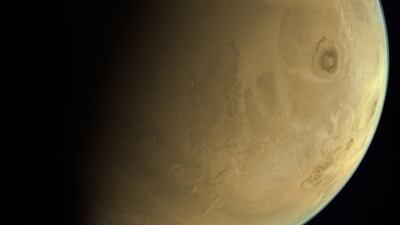
  • The first image of Mars as taken by the UAE's Hope probe, which arrived at the planet on February 9.
    The first image of Mars as taken by the UAE's Hope probe, which arrived at the planet on February 9.
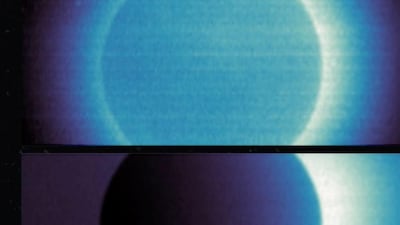
  • This image taken by the Hope probe's ultraviolet spectrometer (one of its three scientific instruments) shows sunlight reflecting off the extended cloud of atomic hydrogen gas that surrounds the planet Mars. The sunlight is visible only as a dark disk hidden inside the fog of gas. The Emirates Mars Mission team said that no other mission have made such kind of recordings before.
    This image taken by the Hope probe's ultraviolet spectrometer (one of its three scientific instruments) shows sunlight reflecting off the extended cloud of atomic hydrogen gas that surrounds the planet Mars. The sunlight is visible only as a dark disk hidden inside the fog of gas. The Emirates Mars Mission team said that no other mission have made such kind of recordings before.
  • The UAE's Hope probe captured a high-resolution photo of Mars.
    The UAE's Hope probe captured a high-resolution photo of Mars.
  • The Hope probe has shared new images from its journey in the orbit of Mars.
    The Hope probe has shared new images from its journey in the orbit of Mars.
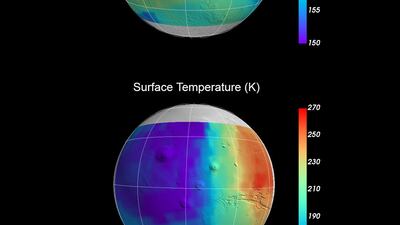
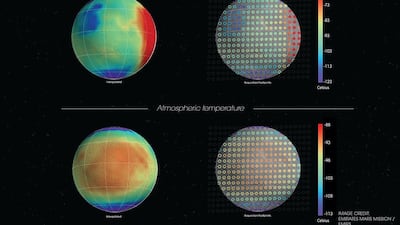
  • This image was taken by the infrared spectrometer, another instrument on the Hope probe, from an altitude of about 15,000 kilometres. The image shows the surface temperature (left), centred on the Tharsis region of Mars. Dawn can be seen towards the right side. The low surface temperatures observed are due to the dusty nature of the Martian surface. An elevated nighttime atmospheric temperature at 25 km altitude (right) is also observed over the Tharsis region.
    This image was taken by the infrared spectrometer, another instrument on the Hope probe, from an altitude of about 15,000 kilometres. The image shows the surface temperature (left), centred on the Tharsis region of Mars. Dawn can be seen towards the right side. The low surface temperatures observed are due to the dusty nature of the Martian surface. An elevated nighttime atmospheric temperature at 25 km altitude (right) is also observed over the Tharsis region.
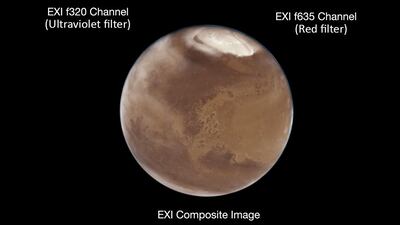
  • These images were captured by the eXploration imager, a high-resolution camera on the Hope probe. The red channel clearly shows the dark and light features of the Martian surface, while the water ice clouds stand out in the ultraviolet channel.
    These images were captured by the eXploration imager, a high-resolution camera on the Hope probe. The red channel clearly shows the dark and light features of the Martian surface, while the water ice clouds stand out in the ultraviolet channel.
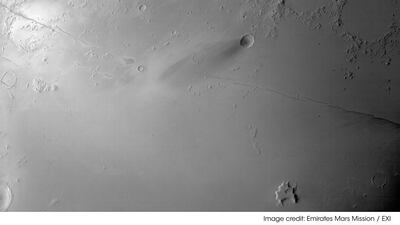
  • Hope probe sent back an image of the Cerberus Fossae, an area on the planet known for 'Marsquakes'.
    Hope probe sent back an image of the Cerberus Fossae, an area on the planet known for 'Marsquakes'.
  • Surface and atmospheric temperature readings collected by the UAE's Hope probe.
    Surface and atmospheric temperature readings collected by the UAE's Hope probe.
  • Discrete aurora on Mars captured by UAE's Hope probe
    Discrete aurora on Mars captured by UAE's Hope probe
  • Discrete aurora on Mars captured by UAE's Hope probe
    Discrete aurora on Mars captured by UAE's Hope probe
Islamophobia definition

A widely accepted definition was made by the All Party Parliamentary Group on British Muslims in 2019: “Islamophobia is rooted in racism and is a type of racism that targets expressions of Muslimness or perceived Muslimness.” It further defines it as “inciting hatred or violence against Muslims”.

Ferrari 12Cilindri specs

Engine: naturally aspirated 6.5-liter V12

Power: 819hp

Torque: 678Nm at 7,250rpm

Price: From Dh1,700,000

Available: Now

PROFILE OF HALAN

Started: November 2017

Founders: Mounir Nakhla, Ahmed Mohsen and Mohamed Aboulnaga

Based: Cairo, Egypt

Sector: transport and logistics

Size: 150 employees

Investment: approximately $8 million

Investors include: Singapore’s Battery Road Digital Holdings, Egypt’s Algebra Ventures, Uber co-founder and former CTO Oscar Salazar

The specs: 2018 Ducati SuperSport S

Price, base / as tested: Dh74,900 / Dh85,900

Engine: 937cc

Transmission: Six-speed gearbox

Power: 110hp @ 9,000rpm

Torque: 93Nm @ 6,500rpm

Fuel economy, combined: 5.9L / 100km

ALRAWABI%20SCHOOL%20FOR%20GIRLS
%3Cp%3ECreator%3A%20Tima%20Shomali%3C%2Fp%3E%0A%3Cp%3EStarring%3A%C2%A0Tara%20Abboud%2C%C2%A0Kira%20Yaghnam%2C%20Tara%20Atalla%3C%2Fp%3E%0A%3Cp%3ERating%3A%204%2F5%3C%2Fp%3E%0A
Updated: July 15, 2021, 6:28 AM