

It’s 10am on a Saturday and I'm at London Heathrow Airport. A blue screen above the Etihad check-in desk reads "sustainable flight", so I know that I'm at the right counter. I’m here to fly on what is one of the most sustainable commercial passenger flights in the world – Etihad’s EY20 eco-flight from London to Abu Dhabi.
Departing the UK’s busiest airport, this flight is taking off only a week before thousands of people descend in the country for Cop26, the UN climate change conference in Glasgow.
Today, in a culmination of two years of research into more sustainable flying, Etihad is operating flight EY20 on a specially planned operation designed to help reduce carbon emissions.
-

Etihad operated one of the world's most sustainable international passenger flights from London to Abu Dhabi via its Boeing 787 'Greenliner'. All photos: Etihad -

Etihad flight EY20 to Abu Dhabi ready for check-in at London Heathrow -
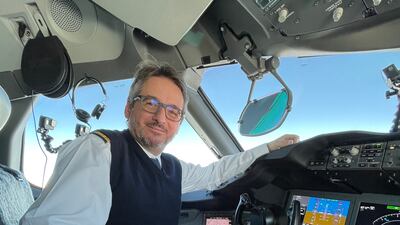
Etihad Captain Mimmo Catalano piloted the eco-flight -
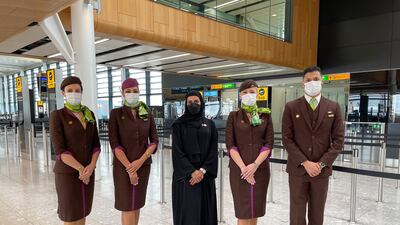
Etihad cabin crew with Mariam Al Qubaisi, centre, Etihad's head of sustainability, at London Heathrow -
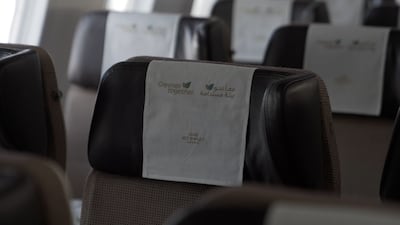
Etihad's eco-flight trialled ways to make flying more sustainable by including plastic-free in-flight products -
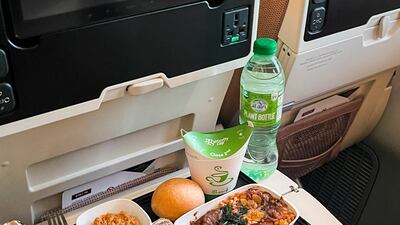
Plant-based water bottles, vegan meal choices and lightweight cutlery constituted the in-flight service -

Upcycled tote bags and cotton bags replaced plastic bags on the eco-flight -

Vegan meals with locally-sourced ingredients were on the business class menu -
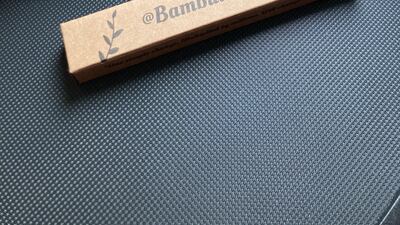
A toothbrush made from bamboo was provided to guests in the amenity kit -
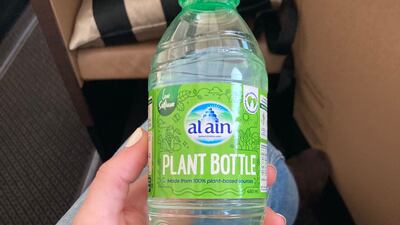
A 100 per cent plant-based water bottle -
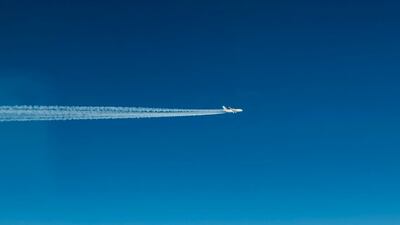
Contrails from a passing jet seen from aboard the Etihad eco-flight EY20 -
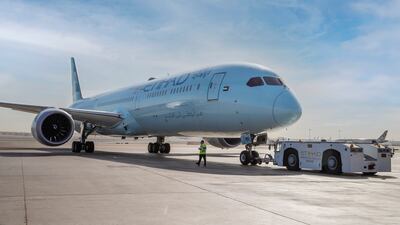
Fully-electric pushback tractors maneuver the Greenliner on ground at Abu Dhabi International Airport


Initiatives being trialled during the flight include contrail forecasting, a high blend of sustainable aviation fuel (SAF) and new plastic-free or sustainable in-flight products.
All passengers on today’s flight, myself included, can earn additional air miles for travelling with lighter luggage and will also be "adopting" a mangrove tree, as part of Etihad’s carbon offsetting programme.
Target: cutting carbon emissions by 72 per cent

The target for today's flight is to slash total carbon emissions by 72 per cent, compared to the previous aircraft operating on the same route in 2019, which was an Airbus A380.
Overall, it sounds like a pretty good plan, but a one-off eco-flight ahead of a high-profile climate change conference is one thing. Putting it into regular practice is quite different and that's something that Mariam Al-Qubaisi, Etihad’s head of sustainability, doesn't shy away from.
“What we're trying to do is test to see what's viable and how we can replicate this type of flight on a daily basis,” she explains, as we wait for our flight at Gate 68 in Terminal 2 at London Heathrow.
“We're not there yet, but we believe that technology is going to pick up very soon. Until then, we need to do our best with what we have available.”
Etihad's Boeing Greenliner

I glance out of the window as Etihad’s Greenliner comes rolling into view on the tarmac at Heathrow. The green and blue-coloured livery on the Boeing 787 Dreamliner sets the jet apart from the rest of Etihad’s fleet, although the aircraft is also used on regular services.
The multimillion-dollar jet is a key part of the sustainable journey for Etihad. “‘We're looking at a very eco-friendly engine here, a very efficient engine in terms of fuel burn which helps to makes a significant reduction,” says Al-Qubaisi.
“Of course, we’re not saying that the Dreamliner is the most efficient aircraft in the world. There’s an A350 coming from Airbus, which is just as efficient."
But sustainable flying is about a lot more than just using an efficient aircraft. In fact, the biggest factor in reducing emissions on today's flight will come from how it is operated.
head of sustainability at Etihad
“Operationality makes a big difference. How we operate the climb, and how we operate descent leads to a reduction in fuel burn. Reducing the weight on the aircraft also reduces fuel burn, as the heavier the aircraft is, the more fuel we need.
“There will be times during today’s flight when we’re going to rely more on gravity and for take-off, there's a special way to utilise Boeing’s autopilot tool for a smoother climb, reducing drag which also reduces fuel burn. This, coupled with using sustainable aviation fuel, will help us to get to our 72 per cent reduction target,” says Al-Qubaisi.
A worldwide operation

Taking the reins on today’s flight is veteran Etihad Captain Mimmo Catalano. “I’ve been flying with Etihad for 16 years, and this is my first eco-flight. I’m feeling excited and honoured, it’s something new,” he tells The National.
Getting ready to steer the jet on its sustainable journey has taken a lot of planning. “Preparation has taken about a week, compared to what would normally be one day for a regular flight, as we’re doing a lot of different procedural adjustments for this eco-flight,” says Catalano.
Part of those plans includes flying an altered route that will allow the jet to take the most sustainable point-to-point path.
“We have coordinated with all the Air Navigation Service Providers for the countries we’re flying over such as Romania, Hungary, Turkey, Iraq – and they know we will fly via guide points which will slightly decrease the total distance we fly, so we’ll use less fuel on the flight,” says the pilot.
Etihad
Air-traffic controllers monitoring screens in the countries that the jet will pass over will see the flight call sign for this journey as "EY20-ECO" – alerting them that the aircraft may not fly as predicted.
“Everyone knows that I might ask for something different, but I told them just give it to me as it's part of the eco-flight programme. And they all said, ‘We’re on board, as long as we emit less carbon dioxide, we grant you anything you want'.”
Captain Catalano will be performing a few unusual manoeuvres during the flight, including a continuous ascent take-off and descent, and using optimised flaps which means relying less on the devices that typically provide jets with extra lift at low speeds.
“Basically we’re trying to do a take-off with less drag. It might mean that we need to use a little bit more runway, but this goes with using less fuel and creating less emissions. We are also going to have an optimised flight where we will reach our cruising altitude in less time when compared to normal flights, we go faster which means at the end we’ll use less fuel – more engine, but less fuel.”
Green ambassadors and a fully booked flight

As I wrap up my chat with the pilot, I notice a team of Etihad cabin crew have arrived at the gate, each of whom is sporting a bright eco-green neckerchief. Among them are Brooke Jeffery and Katie Watkins, two of Etihad’s Green Ambassadors. These specially trained sustainability cabin crew are on hand to advise passengers about new in-flight products and to share more information with travellers on the airline’s sustainable efforts.
“It’s a historical day for us, flying this eco-flight from Heathrow, one of the busiest airports in the world. We’re 100 per cent full today, so it’s going to be a busy flight, we’re excited,” Jeffery tells me before boarding the plane.
Scheduling the eco-flight on a route that Etihad knew would be busy, despite the global pandemic, was all part of the plan. It would not have been fair to compare weight and fuel burn on a flight that was half-empty. This flight will operate with 323 passengers on board.

When passenger boarding begins, I make my way to seat 7C, where a striped tote bag made from upcycled aircraft materials is waiting on my chair, replacing the plastic wrap that usually contains the blankets and headphones given to passengers.
A bamboo toothbrush replaces the normal plastic one in the amenity kit and there’s also a 100 per cent plant-based, refillable water bottle.
Settling into my chair, we push back for take-off. Despite the pilot having given me a detailed overview of what the continuous take-off would involve, I find it hard to notice any discernible difference when compared to any other departure I’ve experienced.
But the in-flight dining service has certainly had some changes. All meals are served on sustainable crockery with lightweight cutlery. And, in what is a first for the airline, there is a vegan meal choice for all passengers. Typically, travellers who don't eat chicken or beef would have to place an order for such a meal 48 hours in advance of travel, so being able to opt for a more sustainable choice on the day should really encourage people to make more eco-friendly eating choices.

Etihad confirms that 80 per cent of all single-use plastics were eliminated on this flight, compared with a regular service on the same route.
Meanwhile, flying through the air on a jet-powered by 38 per cent sustainable aviation fuel feels no different from flying on an aircraft powered by conventional fuel. So why are airlines not using this more often and at a higher capacity?
“Today's SAF blend is the highest SAF blend introduced in our commercial flights,” says Al-Qubaisi. “We did use 50 per cent blend previously, but only on delivery flights with no passengers, never on a commercial flight. But getting it is not easy – it's four or five times more expensive than conventional fuel,” she says. “The challenge is scale and we hope that the prices are going to become more attainable.”
What are contrails and why are they harmful?

In an aviation-industry first for an international commercial flight, Etihad is also using contrail avoidance technology.
The national airline of the UAE has partnered with a UK company called SATAVIA, and the preflight planning team has already earmarked places where the flight might come across areas of high-contrail. Turkey was looking like a prime candidate for this in the planning stages, so the flight path has been altered to allow the pilot to climb higher than normal over the Mediterranean country, to avoid creating the harmful trails.
“Normally, we have no idea where these risk areas are, so this is a huge change. Today we are leaving less of an environmental footprint in the sky,” says Catalano.
And he’s not wrong.
Post-flight data from Etihad shows that bypassing these regions during the seven-hour flight avoided the production of about 64 tonnes of carbon dioxide with a fuel penalty for the extra climbing of only 100 kilograms, which equates to 0.48 tonnes of carbon dioxide.
“Contrails are not emissions, but they contribute to global warming by keeping emissions in the atmosphere longer and reflecting a lot of greenhouse gases. If we know how to operate an aircraft to avoid these, then we can reduce a lot of the secondary emissions,” says Al-Qubaisi.
After nearly seven hours in the air, we are coming close to Abu Dhabi International Airport. I ready myself to take notice of the continuous descent landing, and to my surprise find that it feels a little smoother, with less levelling off of the aircraft as we make our final approach.
How close are we to carbon-neutral flying?

Landing in the UAE capital, Etihad’s new electric vehicles approach the jet to handle the baggage. Any passengers travelling onwards to Dubai are told that the remainder of their journey will continue to be carbon neutral, as the airline has purchased bio-diesel to fuel its transit coach service.
Every passenger on the flight has also "adopted" a mangrove tree on Abu Dhabi’s Jubail Island, and travellers are given free entry tickets to go and visit these natural carbon absorbers in their coastal environment.
Stepping off the jet and making my way into the airport, I conclude that the experience of flying on one of the most sustainable commercial flights in the world is, at least from a passenger's point of view, not that different from taking any other flight. But the knowledge that I had drastically reduced my carbon footprint on my journey from the UK to the UAE was something special.
It will be a good day for the planet when such a journey can be a more regular occurrence and that’s something that Etihad agrees with.
“Our single greatest learning from the past two years has been that even when solutions are available, they are not easily deployed on a regular basis due to constraints throughout the entire aviation ecosystem,” says Mohammad Al Bulooki, chief operating officer at Etihad Aviation Group.
“What was demonstrated on EY20 was the art of the possible; the next step is to work on how these can be deployed sustainably.”

