



In 1885, the British colonial administration began constructing a railway line through the interior of the Malay Peninsula. With most of the country covered in dense rainforest, it is not surprising it took 25 years to lay 500kms of track.
Today, that railway line is known plainly as the East Coast Railway. Yet it has another, more appealing name: the jungle line. And while the railway may not in fact run by the coast, it does pass through snatches of jungle — albeit much less than when the line was originally built.
For some time, I’d been planning to make this rail trip, only for certain global events to intervene. But with Malaysia having recently lifted its entry restrictions — the country was off-limits for two and a half years – I finally have my chance. And so, three years later than planned, I fly into Kelantan state, in the country’s north, where the jungle line officially begins.
Despite being the railhead, the town of Tumpat is little more than a Malay village. Owing to its proximity to Thailand, there are several Buddhist temples nearby — not something one necessarily expects to find in a predominantly Muslim state.

I arrive at the station to find it still under construction. It turns out the whole rail service has been upgraded during the pandemic. Expecting my train to be a hulking old diesel engine, I’m surprised and a little disappointed to see it's a new Chinese import. It’s a minor disappointment, however, and I find myself feeling slightly giddy as the stationmaster flags us off. After what feels like a couple of years of stasis, I’m on the move.
The train fills up at Kota Bharu — the only major city en route. Face masks appear optional, so I do without. As the only foreigner in the carriage, I receive plenty of smiles. The young man in the seat in front asks me where I’m from and if I’m travelling alone (that second question I will hear repeatedly during my trip, my answer mostly met with surprise or pity).
Like most of the passengers, he is travelling to Dabong, a town three hours south, known for its caves and waterfalls. With the suspension of interstate travel during the pandemic, the service became a hit with locals, earning the nickname “the train to Dabong”. Eighty four years after the passenger service was first introduced, it’s nice to see its popularity revived.

For the first leg of the journey, we pass through rice fields, kampongs and the odd rubber plantation. While there’s no jungle, it’s pleasant enough to see the country’s rural life. Cows chew the grass beside the track and children wave to no one in particular as the train passes by. After the past two years, it feels wonderful to let the countryside unfold, like a slowly released, long-held breath.
After a delay — inevitable on a single-track railway — we reach Dabong, where most of the passengers disembark. We back onto a siding and there is another delay to let an oncoming train through. By the time we’re moving again, it’s already dark. If there’s jungle outside, I cannot see it. Further down the carriage, a Malay boy plays a game on his phone and for the next 40 minutes the carriage is filled with the sound of slashing swords and dying orcs. No one seems to mind.
It’s past ten when the train reaches Gua Musang — where I plan to spend the night — and a near-full moon rises up between the silhouette of limestone peaks. I check into my hotel and I’ve barely put my head down, it seems, when my alarm goes off — sitting on a train all day has worn me out.
That morning, I have a couple of hours to spare before my next train, so I walk around a bit. The name Gua Musang translates as “cave of foxes” and there is a legend associated with the town, about magical foxes living in the mountain nearby.
The town itself is rather more ordinary, being but a crossroads of concrete buildings, albeit with an impressive backdrop of karst mountains. A former logging town, there is little reason to stop here unless you’re heading to Taman Negara — the peninsula’s last bit of untouched wilderness. And yet, for a fairly inconsequential place, it does possess a very big, very new mosque.
There’s time to grab a cup of kopi-o at the station (the local brew, sugary and thick) and pet the station cats (there may or may not be any magical foxes, but cats are everywhere in Malaysia), before boarding my next train. With a blast of a horn, the journey resumes.

We pass a hillside full of Chinese tombs and cross rivers rich with sediment. This, I’ve read, is the most impressive part of the journey and as the train passes from Kelantan into Pahang, the morning mist burns off and I see more karst mountains and — finally — thick jungle. It might not be a virgin jungle, but it looks close enough, dark and unruly, covered in a chainmail of ivy. At times it closes in so tightly, we practically tunnel through it.
Yet it appears in only fits and starts. As I’ve seen elsewhere, much of the land has been converted into palm oil plantations. A moment ago we were surrounded by jungle; now the landscape opens up and ranks of oil palm shrubs recede to the horizon on either side of the track. Originally a North African plant, today it covers more than 20 per cent of Malaysia’s surface and about 50 per cent of its planted area, making the country the world’s second-biggest producer of palm oil. The jungle line, it seems, is fast becoming a misnomer.
A couple of hours later, we pull into Kuala Lipis — about halfway along the East Coast Line — where I will break up the journey. The station is another new construction (the original sits nearby, awaiting inevitable demolition). Yet I’m happy to see the town’s historical character remains largely intact and the buildings are gleaming from a fresh coat of paint (black and white, like the Pahang flag). It’s also more Chinese than anywhere I’ve seen so far on my trip. As I pass beneath the colonnades, I smell the sandalwood from the shop-house shrines and hear rapid-fire bursts of Cantonese.
Strategically placed at the confluence of two rivers, Kuala Lipis began life as a gold-mining centre. It was chosen as the capital of Pahang in 1898, but shortly before Malaysia gained independence in 1957, the capital was moved to Kuantan, and the town went into decline.

Today it has a relaxed, unbothered air, and while there’s not much going on, there are several colonial buildings worth visiting. There’s the Clifford School, named after the British Colonial Administrator, Hugh Clifford, one of the overseers of the railway; the neo-classical administrative office; and a number of old mansions on the hill above the town, some of which, despite being the property of the state, are abandoned, the jungle creeping back over them.
I stop by the Pahang Club (built in 1907), hoping to toast the journey so far, to discover it’s closed. Another victim of the pandemic, I assume, only to find out it’s been closed for 20 years.
Leaving Kuala Lipis behind, I board the train for the last leg of my journey. We follow the river for a stretch, clattering over steel bridges and pushing through the thick forest once more. But once we pass the town of Jerantut, an hour-and-a-half south, the landscape becomes overrun with plantations and though they might be pretty in their own way, it gets a bit monotonous.
I’m the only person left in my carriage when, three hours later, the train pulls into Gemas, on the border of Negeri Sembilan and Johor. Here the jungle line ends as the East Coast Line joins with the West Coast Line and continues on to Johor Bahru and Singapore.
Gemas town may be small, but the station is monolithic, towering over the rows of shop-houses. It looks like the kind of station you’d find in a mid-sized Chinese city. Indeed, it wouldn’t surprise me if China had a hand in its construction, for it is already funding a new east coast line and this one will actually run along the coast. Will they eventually have to change the name of the current one?
Here, at the new Gemas station, my Jungle Line adventure comes to a close. Tomorrow morning I have another train to catch, but for now I feel a small measure of accomplishment, having concluded a journey I set my sights on three years earlier. It’s great to see things getting back to normal — the journey is proof of that — and while the world may not be as pristine as when the line was built, I am, all the same, glad to see it.
My love for Lviv: a photojournalist's personal account of the Ukrainian city — in pictures
-

Buskers playing the bandura, a Ukrainian folk instrument, in the streets of Lviv. Photo: Oliver Raw -
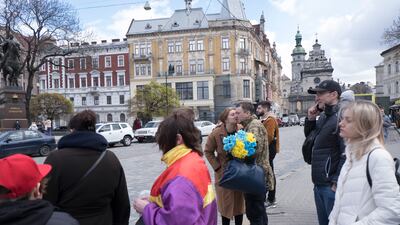
A couple kiss while holding flowers in the colours of the Ukrainian flag. Photo: Oliver Raw -

Cherry blossoms outside the 16th-century arsenal building. Photo: Oliver Raw -

Protected statues outside a church in the city's old town. Lviv has become a safe haven for refugees from all over Ukraine. Photo: Oliver Raw -

Children playing at the Rynok, the city's market square. Photo: Oliver Raw -

Musicians perform in Lviv as the western Ukrainian city prepares for the possibility of a Russian attack. Getty Images -

Lviv is a stopover and shelter for millions of Ukrainians fleeing the Russian invaders. Getty Images -

Lviv is filled with coffee shops. Getty Images -

Busker Oksana Neh plays for passers-by in Lviv. Getty Images -

People outside a Lviv shopping mall after it was evacuated when an air raid siren went off. Getty Images -

Lviv was hit by a series of powerful Russian strikes in April 2022. Getty Images -
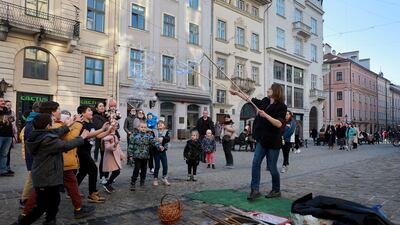
A street performer in Lvin when the city was preparing for the possibility of a Russian attack. -
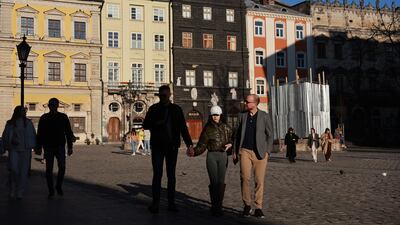
Architecturally, Lviv is considered the equal of Budapest. -
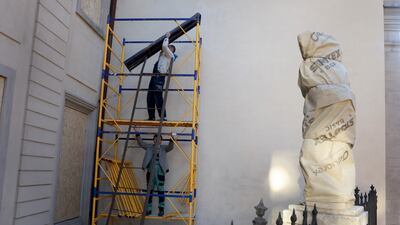
Workers remove scaffolding after covering a statue and windows to try to prevent damage in a Russian attack. -
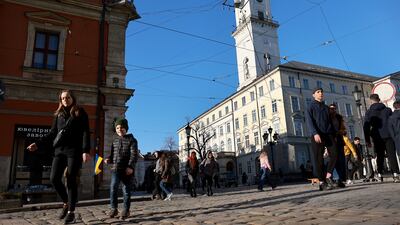
Lviv offers relative security in western Ukraine.



