
Syria will restore most of its 3,000 archaeological and historical landmarks within a decade as it seeks to become one of the best holiday destinations in the Mediterranean, its Tourism Minister said on Tuesday.
Famous archaeological sites – from the ruins of Palmyra to Crac des Chevalier, the Crusader citadel – lured poets, artists and adventurers to the region for centuries. But tourism in Syria had due to the 13-year civil war.
UAE ambassador to the UK
Conservation and recovery work for the country’s most attractive archaeological sites has already started, Mazen Al Salhani told The National. “There are around 3,000 places to be visited in Syria, historical places. So we have a plan and strategy to renovate most of them.”

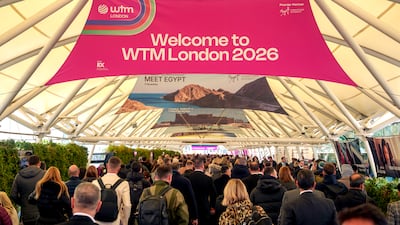
At the World Travel Market (WTM) at the Excel in East London, Mr Al Salhani was confident that because perceptions of Syria have changed, tourists will soon have many reasons to visit the country.
“We are preparing the country to receive tourists and visitors,” he said. “We have a strategy. By 2030, Syria you can see it in different way. In 2035, it would be one of the best destinations in the Mediterranean.”
The Syrian pavilion at the travel trade fair is humble compared to some of its neighbours – reflective of the war-torn country’s devastated economy.

But it is the country’s relative stability compared to its neighbours, after the 2024 overthrow of the brutal dictatorship of former president Bashar Al Assad, that allows for this vast investment in tourism to take place.
“Everything is changing, it’s not like before,” Mr Al Salhani said. “The USA used to send the message to their nationals in Syria, 'if there is a problem, you have to go out of Syria.' Now they send it to all the surrounding countries except Syria.”
A string of new luxury hotels is in the pipeline, including a resort above the capital, Damascus, that is connected to the city by cable cars.
The Beaumont in Mayfair, London, will open its first overseas branch in Damascus, while chains such as the InterContinental and St Regis also have plans to set up shop.
But Mr Al Salhani faces two challenges – the first is having investments transferred to Syria while the banking system remains isolated internationally. Though sanctions affecting the country’s financial sector have been lifted, international banks have been reluctant to establish branches in the country.
“The most challenging thing we have now is financing, because the banking system was closed for a long time and there were no international banks until now in Syria,” he said.
“Next year the banking sector will improve. They will start giving real estate loans, and they will give loans to hotels to build and do their renovations. This will help us grow very fast, because you need money to rebuild Syria.”
The other challenge is convincing western governments to downgrade their official warnings against travel to Syria. Last month, the Tourism Minister invited diplomats in the capital to tour the city with him.
Though the transitional government of President Ahmad Al Shara has made counter-terrorism and internal security a priority, attacks persist in the country, as does the risk of Israeli air strikes in the south of the country.
But Mr Al Salhani was undeterred. “Damascus is safe … most of Syria is safe now for tourism. We have to change the grading of Syria because now it's in [among] dangerous places considered and we are trying now to change it.”
Connections to Syria’s neighbours, Lebanon and Jordan, are key to establishing a regional tourist route that could attract more visitors.
Lebanon’s Tourism Minister Laura Lahoud said she hopes a new airport opening on the outskirts of the northern Lebanese city of Tripoli could help attract budget airlines to the country for the first time.
Ms Lahoud has been meeting low-cost European airline representatives at the fair in anticipation of the hub’s opening this month.
She said this could help revive tourism, which has been dramatically diminished by two wars in three years on Lebanese soil between Israel and the Iran-backed militia Hezbollah.
Visits from Lebanon’s large diaspora persists, particularly during holidays. But Ms Lahoud said: “We don’t have the tourism like it should be. There’s nothing like peace and stability to promote tourism.”
Yet the infrastructure in Lebanon remains functional and ready to welcome visitors. “It’s got all the assets intact. It’s got the people’s warmth,” she said.

A key driver could be a shared visa under which tourists could visit Jordan, Syria and Lebanon, a possibility being discussed among the three countries.
Ms Lahoud hopes this will bring a form of religious tourism, as Jordan prepares to mark 2,000 years of the Baptism of Jesus Christ in 2030. The baptism is said to have taken place in what is now Al Maghtas, in modern day Jordan.
“People come from America, they don’t just want to see Lebanon. They love to see Lebanon, Jordan and Syria,” she added.
Gulf countries, which have been targeted by Iran in recent months, also sought to reassure the travel market that their resorts and attractions were resilient.
Saudi Arabia showcased Amaala, an island that is being transformed into a luxury wellness destination.
Ahmed Al Khateeb, Saudi Arabia’s Minister for Tourism, said: “Travel and tourism is growing. Today we have a 1 or 2 per cent growth in the number of tourists at a global level, which is good despite the challenges all over the world. Coast travel has experienced an increase in business even today.”
With several newly built resorts such as the Rosewood and Clinique La Prairie now open, two more are expected in the next year. “Amaala is another paradise, a destination that will attract not only tourism in Saudi Arabia and coastal travel, but also people who want a different experience,” the minister said.
The UAE, which had pavilions for each of its emirates, presented seven experiences including Dar Al Funoon, the Guggenheim, Grove Saadiyat and the Youth Orchestra. “You’re seeing very innovative experiences, a nation that is bringing forward its history and culture,” said Mansour Abulhoul, UAE ambassador to the UK.
“The UK is a major source market for the UAE and will continue to be because we have great connectivity,” he added. “Each of the emirates offers something unique and distinct. As a country we can say to the world 'come to us for these seven unique experiences. We're brought together by this.'”

