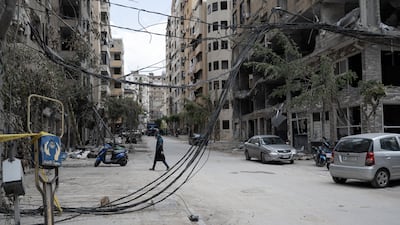
Lebanon's state power provider Electricite du Liban has begun cutting electricity to public institutions that have failed to pay their bills.
The company has followed through on repeated warnings to public sector bodies, some of which it says “have not even taken the initiative to contact EDL to settle their situations”.
Among those believed to be affected is the Ministry of Public Works and Transport, as well as some municipalities and water companies.
The embattled state electricity provider, whose headquarters were torn apart in the 2020 Beirut port blast, is believed to be owed millions of dollars.
EDL said that while some institutions had made contact to resolve the situation, others had not. Defending its decision to cut power, it said the moves “are directed neither against the state nor against any of its institutions”, but instead safeguard government funds.
Hospitals that have not paid their bills are exempted from the move, but water authorities are not, with some villages in the Western Bekaa region affected. Local MP Hassan Mourad criticised the move, saying “water is not a luxury”.
Lebanon's only international airport in Beirut was among the institutions at risk of having its power cut off late last week until it reached an agreement with the EDL over a payment plan.
The country's battered state electricity sector, which for decades has suffered from under-investment and neglect, is only capable of generating a few hours a day of power. Those who can afford it largely rely on expensive private generator subscriptions.
But given the dire state of Lebanon's economy and public finances, many – including state institutions - struggle to pay for costly diesel-guzzling generators.
The import-dependent country is also particularly sensitive to inflation and fuel price hikes stemming from the US-Iran war.

