Little prepares you for someone in a homemade Iron Man costume grabbing your phone for a selfie. But then, few places are like Rainbow Village, a quirky art project devised by an ex-soldier to save former military homes from developers in Taichung.
Bright murals cover the surviving buildings, which are now among Taiwan's popular offbeat tourist attractions, along with their flamboyant, Marvel-loving custodian.
Taichung reveals more colour when we chance upon a vibrant parade en route to Fengchia Night Market, although we become the novelty as face-painted locals request snapshots.


Serendipity strikes regularly during our three weeks in Taiwan, beginning when car rental firms tell us that UAE-issued international driving licences are not accepted. The plus is that we instead use Taiwan's efficient rail network and witness lush greenery and rugged coastlines, without marital disputes over navigation.
Our trip begins in Taipei, before trains speed us to the island’s coastal cities. Services are frequent and tickets bought from counter staff guarantee seats.
In about two hours, an express train (Dh72 a ticket) has us in Hualien, gateway to Taroko Gorge National Park. Billed as the world’s largest marble canyon, the stunning array of rivers and waterfalls made headlines last year after a deadly 7.4-magnitude earthquake.

Many trails remain closed, but we are promised photo opportunities by exuberant guide Udi. In a bow tie and braces, with English acquired by reading Hemingway and Wilde, he improvises a tour via roadside viewing points, indicating hillsides scarred by landslides.
Our host reveals that 100 people died hand-building motorway tunnels through the gorge, but authorities now struggle to secure labour to carry out repairs.
We later admire beautiful Qixingtan Beach, where blue skies contrast with a dramatic grey shoreline honed by the Pacific.
Udi mentions Taiwan's passion for the outdoors, a point endorsed by Hualien’s many parks, including medieval-themed Cikasuan, and Taipingyang, lined with beachside cycling tracks and animal sculptures.

At Meilunshun, paths reach a lofty viewing point where pensioners shimmy hula hoops as some of us catch our breath before indulging in lemongrass tea and pepper pancakes at an indigenous cafe.
Google Maps, Google Translate and plentiful data become our best friends in Taiwan, averting cultural and dining mishaps, as well as troublesome detours.
The former finds Jiang Jun Fu 1936, a peaceful heritage village recalling Taiwan’s Japanese colonial past, and Dongdamen Night Market, a boisterous sprawl of food stalls, rice wine and buskers. Here and elsewhere, we yield to pushchairs occupied by dogs, some fanned by doting owners.

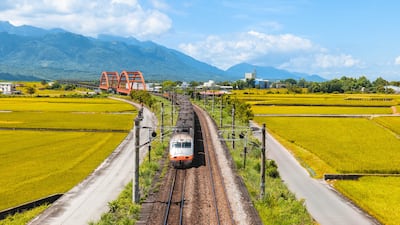
A two-hour, Dh57 train journey to the next destination, Taitung, passes settlements hugged by mountains that bisect Taiwan.
We find the Makapahay indigenous culture festival there, featuring traditionally dressed tribesmen and women chanting and dancing in the streets near a central forest park with steps to city observation points.
Remnants of Typhoon Danas make the next day’s stroll along Seashore Park untenable as marshals direct visitors away from brutal waves. The heavy rain prompts us towards Tianhou Temple, elaborate and increasingly beguiling as myriad lights offset the premature dusk.

Better weather and a half-day taxi tour (Dh240) take in Xiaoyeliu, a scenic seaside trail of sandstone rocks, the natural curiosity that is the Water Running Upward scenic spot and Fugang Geopark, home to spectacular volcanic formations and the calf-testing Sanxiantai Eight-Arch Bridge.
An afternoon train from Taitung winds through impressive mountain scenery to the west coast town of Fangliao where express buses connect to Kenting – Taiwan’s southernmost town – in lieu of trains.
Kenting’s main street becomes energised after dark when food carts, games and pop-up bars rival adjacent restaurants and shops for attention. By day, nearby driftwood-littered beaches are busy with holidaying locals and international tourists.
Our hired scooter takes us further on to Cape Eluanbi, where park trails link lookout spots fringed with volcanic rocks, sweeping coastlines, caves, and Eluanbi Lighthouse. Completed in 1883 following several shipwrecks, it deterred foreigners from landing among truculent locals.

Our search for a reputed Life of Pi movie location, beyond more stunning cliffside stops, instead reveals surfers negotiating gnarled typhoon debris.
The hilly route to Kenting National Park is simpler to find. A vast haven of tropical forests and mountains, enticing paths access lush enclaves accompanied by noisy cicadas and foraging monkeys. Roaming deer and yellow land crabs appear ahead of a viewing tower and cafe.
A shared taxi has us back in Fangliao for a 50-minute train (Dh25) journey to Kaohsiung, a west coast city that blends traditional charm and modern cool.
A favourite of guidebook covers, Lotus Pond contains the intricate Dragon and Tiger pagodas – ancient symbols of yin and yang – Taoist Spring and Autumn Pavilions, and the City Temple of Confucius.

Meanwhile, newer architecture and art installations elevate Pier-2 Art Centre, once part of the world’s third-largest harbour, now a gentrified district hosting trendy shops, restaurants and galleries.
Trams run to Taiwan’s largest shopping mall, a futuristic music arena and ferry terminal, and the testing climb to palatial Shoushan Martyrs’ Shrine and “Love” viewing platform.
Further out, Kaohsiung’s Centre for the Arts overlooks the less formal Weiwu MiMi Village, a cluster of apartment blocks transformed by local and overseas street artists.

One hour away by high-speed rail (Dh92), Taichung does not reveal its personality quite so easily beyond Rainbow Village, but Wen-Xin Forest Park and Shui Temple shine amid the concrete, and a robot serves us ramen in a youthful restaurant.
Uber proves crucial after a hailed driver gets lost reaching our hotel from the city’s single-line metro, but we have better luck on the coach, which trades urban sprawl for paddy fields, mountains and eventually a tourist favourite, the Sun Moon Lake.
Greenery fills our window again the following day as another train races us towards Taipei at 295kph, closing the loop on an eclectic and indelible tour of Taiwan.