

Rafael Nadal believes resuming the tennis tour before all travel restrictions are lifted worldwide would be unfair to the players who won’t be able to make it to tournaments.
In a Zoom press conference call with international media on Thursday, the Spaniard was asked if the tennis circuit should restart if there was one country in the world where players still could not travel from.
“I think we have a worldwide tour. My feeling is we need to be clear, we need to be responsible, we need to be sending strong messages and we need to be a positive example for society,” said Nadal.
“We need to understand that we are suffering unprecedented situations, and my feeling is we need to come back when all the players from all the countries of the world are able to travel under safe circumstances. If not, in my personal opinion, we will come back, yes, and I probably will play, maybe yes, but my feeling will be that we are not being 100 per cent correct and I want to see my sport 100 per cent fair and correct, especially under these circumstances.”
'Situation not ideal'
Tennis is currently suspended until at least July 31. Organisers of the US Open and Roland Garros – the USTA and FFT – are still holding out hope for staging their tournaments later this year but Nadal is skeptical about whether their plans will actually materialise.
“I don’t know if we will be playing tennis again this year or not, that’s something that, today, is not worrying me much, honestly. What really worries me is coming back to normal life, and coming back to a healthy life and a healthy situation for most of the people,” explained the world No 2.
Nadal is the defending champion in both New York and Paris. The USTA are considering all possible scenarios for the US Open, including staging it behind closed doors, with no fans, and potentially limiting players to traveling to the tournament with just one member of their team.
“It’s not the ideal situation. If you ask me today if I want to travel to New York to play a tennis tournament, I will say, ‘No, I will not’. But in a couple of months, I don’t know how the situation is going to improve, hopefully it’s going to improve the right way,” said Nadal about potentially competing in the US Open under these circumstances.
________________
10 future stars of Roland Garros
-

Stefanos Tsitsipas. One of the most exciting talents leading the charge for the next generation, Stefanos Tstsipas looks a major champion in waiting. While that breakthrough is perhaps more likely at the hardcourt Grand Slams of Australia and the US, the Greek world No 6 has proved his credentials on the clay, too, winning the Estoril title in 2019 and reaching the Barcelona Open and Madrid Masters finals in 2018 and 2019 respectively. Given his dedication to the sport, 21-year-old Tsitsipas should be right in the mix for years to come. Getty Images -

Alexander Zverev. With all he has achieved so far, it’s hard to believe Alexander Zverev is still only 22-years old. Winner of 11 titles already, including five on clay, Zverev has also experienced his first career dip but looks to be back on course and is nestled in the top 10 at No 7. The German’s Grand Slam record has been held against him, but a semi-final appearance last time out in Melbourne and successive quarter-finals in Paris suggest he is putting that right. When his game is on point, few can hang with him and the French Open is primed for his major breakthrough. AFP -
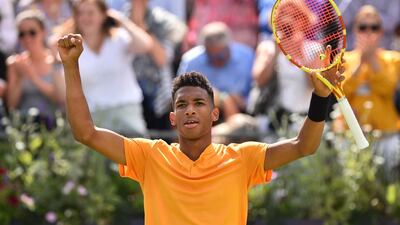
Felix Auger-Aliassime. After a stunning emergence during the first half of 2019 that saw him reach three finals, including two on clay, and his first Masters semi-final, Felix Auger-Aliassime went a bit off the boil for the next six months, although he has rebounded with two finals in 2020 before the season was halted. The 19-year-old Canadian, ranked No 17, has not made much headway in the bigger clay court tournaments just yet, but it is surely a matter of time. He is a supreme talent and athlete whose game should suit all surfaces throughout his career. AFP -
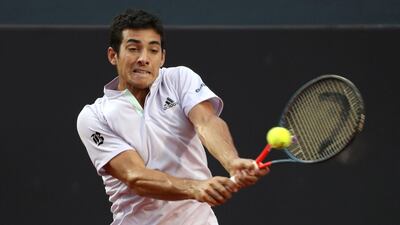
Christian Garin. He looks to be the archetypal South American tennis player. In other words, sublime on the clay but struggles to make the same impact on other surfaces. A winner of four titles already – all on clay, of course – the 23-year-old Chilean has surged up the world rankings since the start of 2019, rising from No 95 to No 17. Does he have the tools to land a major prize? Tough to say, but given his proven credentials on clay, he is one to keep an eye on in the coming years. -
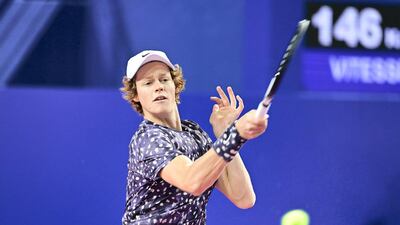
Jannik Sinner. Entered into the 2019 NextGen Finals as host nation Italy’s wildcard, Sinner stormed his way to the title, despite being the youngest player in the field. The 18-year-old has since earned his first win over a top-10 player when he beat David Goffin in Rotterdam in February. Still very much a raw talent, Sinner has remarkable shot-striking ability and if he can refine his game over the next few years, he is in line to be a future French Open contender. Panoramic -

Sofia Kenin. She has certainly proved her pedigree on the hard courts, none more so than her march to a maiden Grand Slam title at the Australian Open. The 21-year-old American, ranked No 4, has not made much of a stamp on clay court events, but given her strong all-round game, fine baseline hitting, and impressive endurance, she appears tailor-made for a run at the French Open in the future. AFP -
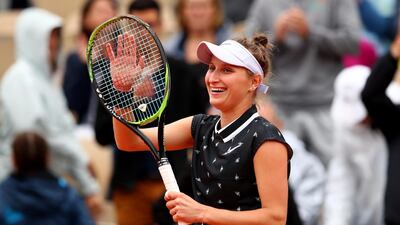
Marketa Vondrousova. She was one win away from excluding herself from this list having reached the 2019 French Open final. While Ashleigh Barty proved too tall an obstacle, the 20-year-old Czech looks set to be a consistent contender at Roland Garros. She accumulated a 15-3 win-loss record on clay during 2019, reaching a further two finals, in Budapest and Istanbul, although her only career title so far came on the Biel/Bienne hard courts in 2017. Vondrousova, ranked No 18, looks set for a long and successful career and the French Open appears her best shot at landing a major title. Getty -
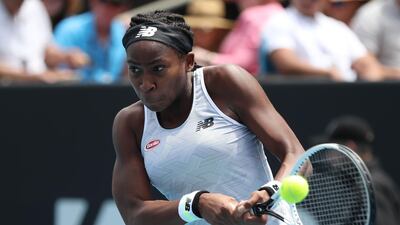
Coco Gauff. The most famous 16-year-old tennis player in the world, Coco Gauff made global headlines for her run to the Wimbledon fourth round as a 15-year-old. While still very young, her maturity on and off the court belies her age and she appears on course to be one of the next big stars of the future. How she handles the pressure and expectations will likely define her career. AFP -
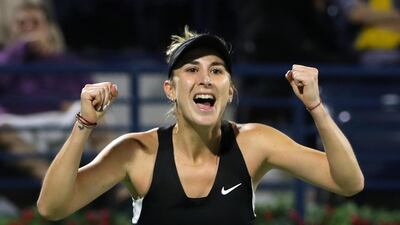
Belinda Bencic. Another of those players who achieved so much so young that it’s hard to believe she is still only 23. Belinda Bencic’s career was almost cut short by long-term injury, but the Swiss has clawed her way back into the top 10 and enjoyed something of a breakthrough 2019, reaching four semi-finals – including her first at a Grand Slam at the US Open – and ending a four-year wait between titles in Dubai. While clay has never been her preferred surface, Bencic’s game is well suited to the red dust and there is a sense that there is another level to her game she can unlock over the next few years. Reuters -

Amanda Anisimova. She became the youngest player in more than a decade to reach the French Open semi-finals when she defeated defending champion Simona Halep in last year’s quarters. It was by no means a fluke: Anisimova, 18, has proved her talent on clay, winning her first career title on the surface in Colombia last April, having reached three ITF finals in 2017 as a 15-year-old. Injuries have become a minor concern, but she is still young and growing. The world No 28 has all the talent to become a future French Open champion. AFP


________________
“And I’m sure that the people who are organising the event, the USTA, want a safe event, the same as the FFT, they want to celebrate the tournament if everybody is safe enough. I am confident that they will make the right decisions in the right moment.”
Back on court
Nadal started practicing again two weeks ago, but only for a couple of times per week, and not exceeding 90 minutes per session. He feels confident he would be ready to compete at a high level whenever the tour resumes, despite the lack of match play, but wants to protec his body in the meantime.
“I need to take things step by step. I am trying to avoid injuries, that’s the main thing today. To avoid injuries I need to practice step by step and increase the amount of work every week,” said the 34-year-old.
“I think the last couple of years I learned how to play good tennis without the need to play a lot of matches. I really think that I understand and found a way to be ready to compete at a very high level without playing a lot of matches before. I played a small amount of tournaments the last couple of years compared to the years before, I think it’s all about making the right preparation.
“I am confident that if I have enough time to prepare myself and to organise a little bit my calendar, I’m going to be competitive from the beginning.”
While some believe the current hiatus spells bad news for the older players, who are losing precious playing time before retiring from the sport, others see it as an advantage that could extend the careers of the 30-somethings club.
“I think the long breaks for the older bodies are tougher than for the younger bodies because it’s more difficult to come back to 100 per cent but at the same time of course we have the experience too,” said Nadal. “So I have the experience of injuries I had the past, so in some way we know how to come back.
“I am passionate about coming back on the tour and keep playing for a couple of years and keep enjoying the things I like the most – enjoying tennis in front of a full stadium with the energy of the crowd. I really hope we’ll be able to come back to this situation and enjoy.”
Lessons learnt
The 19-time Grand Slam champion says his main takeaway from these past few months is not taking things for granted, like being able to spend time with his family and friends.
“Humans have the ability to adapt to situations quick, but at the same we have the ability to forget about the negative things soon when we come back to a normal situation. The only thing that I learned is that we need to try not to complain every single day about stupid things,” said the Mallorcan.
One of the heavily-discussed topics in tennis during the current suspension of the circuit has been the idea of merging the ATP and WTA tours. Billie Jean King, the founder of the WTA, has long been a proponent of having just one governing body for both men's and women's tennis, and her idea has finally received the backing of some of the biggest names in the sport, thanks to a tweet from Roger Federer in April, who suggested it was time the two tours combined.
Nadal, who had been uncertain about his thoughts on a potential merger in the past, endorsed Federer’s post by tweeting: “Hey @rogerfederer. As you know per our discussions I completely agree that it would be great to get out of this world crisis with the union of men's and women's tennis in one only organisation."
Asked about what new information has led him to believe in the merger now, Nadal said: “I don’t have any information about that. It’s just an idea and just a message that Roger left there, and that’s it.
“I support it because I think that working like a single organisation in the perfect world is easier for everything. But that doesn’t mean that we need to play every single event as a combined event.
“The tours can keep working separately but work like in a single organisation. Why not? The feeling is it would be better, and less difficult in terms of organising.”

