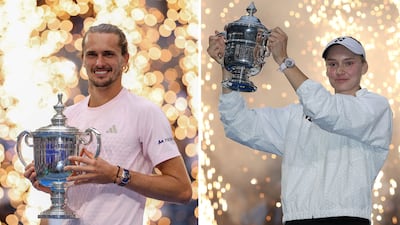

The US Open crowned two new champions over the weekend as Elena Rybakina and Alexander Zverev triumphed at Flushing Meadows for the first time.
Here’s a look at three of the biggest takeaways from the final Grand Slam of the season.
Rybakina is the new World No 1
Her poker face may suggest otherwise, but this must have been one of the most stressful tournaments Rybakina has ever contested and she somehow found a way to be the last woman standing, hoisting the trophy in the end.
The 27-year-old did not hit a ball in the week prior to the US Open as she dealt with an Achilles injury that forced her to retire from her Cincinnati quarter-final.
The US Open has historically been Rybakina’s worst slam – she never made it past the fourth round in seven previous appearances – and there was added pressure at this year’s edition because of the small matter that is the No 1 ranking.
Four women could have left New York as the World No 1 but Rybakina was in the best position to do it because her fate was in her own hands: make the semi-finals and she takes over the top spot from Aryna Sabalenka for the first time in her career.
But being in the best position doesn’t guarantee anything. After winning the Australian Open and Stuttgart earlier this year, Rybakina didn’t have the best results through the remainder of the clay season and the grass swing.
Her form picked up in the North American hard-court stretch but she was injured and had to navigate a tricky draw.
In the third round, she beat the woman who ousted her in the French Open second round, Yuliia Starodubtseva before her path got significantly tougher.
She had to beat four-time Grand Slam winner Naomi Osaka in round four and Olympic gold medallist and ex-world No 4 Zheng Qinwen in the quarters to make the semis and secure the No 1 ranking.
She then knocked out two-time major champion and No 4 seed Coco Gauff to reach her first US Open final, before denying Sabalenka a US Open threepeat with a hard-fought victory over the top seed.
Rybakina now owns three Grand Slam titles, won at three different tournaments (Wimbledon, Australian Open and US Open), and enters the final stretch of the season at the summit of the rankings, making history as Kazakhstan’s first ever top-ranked player.
She has two titles to defend over the next couple of months in Ningbo and the WTA Finals but has a legitimate shot at ending the year as the No 1 player in the world.
The women’s game is in great shape, especially with how consistent the core group at the top have been.
The top four seeds – Sabalenka, Rybakina, Jessica Pegula and Gauff – all reached the semi-finals in New York, a first occurrence in women’s singles since 1975 at the US Open, and the first time since Wimbledon 2009 at any Grand Slam.
Their battle for supremacy will continue moving forward, and the top spot could very much switch hands multiple times over the next 12 months.
Sabalenka has lessons to learn
If you look at it right now, Sabalenka already has a Hall of Fame career: four major trophies, World No 1 for 107 weeks, 24 titles won, and more than $53 million earned in prize money.
That is a dream for any tennis player. Yet one can’t help but feel like she’s still leaving a lot on the table.
The Belarusian power-hitter is 4-5 in career Grand Slam finals; four of those five losses have come in 2025 and 2026.
At 28, she has experience on her side, but it somehow did not serve her well against Rybakina on Saturday. Sabalenka was raging from nearly the first moment of the match and looked stuck in a vicious cycle of hitting an error, getting angry, hitting a winner, getting angry for not doing it more often, and repeat.
Her attitude and body language were negative throughout, which is understandable given she was desperate for the threepeat but wasn’t performing the way she wanted to.
But also not so understandable given she has been in the same situation so many times – this was her ninth major final – and she was facing an incredible rival, one she has battled against 18 times and has lost to in a Grand Slam final just eight months ago.
This is a fierce rivalry in which Sabalenka holds a slight 10-8 edge head-to-head. Why did it seem like it’s unfathomable for her to be struggling against Rybakina in the final? She let rage take over, which limited her ability to problem-solve. And she showed that even at 28, she still has mental challenges to conquer in order to tap into her full potential.
In the quarters, she successfully willed herself to a deciding-set tiebreak victory over Wimbledon champion Linda Noskova. When the stakes got higher in the final, anger did not work in her favour.
Watching the final, I couldn’t stop thinking of something Osaka said in her press conference after she beat Petra Kvitova in the Australian Open final back in 2019.
Osaka had the chance to win in straight sets but Kvitova saved three match points and took five games in a row to clinch the second set before eventually succumbing in three.
Osaka was asked that day how she didn’t let the disappointment of losing the second set rattle her in the third. “I just thought to myself that this is my second time playing a final. I can't really act entitled,” she said.
“To be playing against one of the best players in the world, to lose a set, suddenly think that I'm so much better than her that that isn't a possibility … Yeah, I wanted to enjoy my time here.”
Seeing Sabalenka lose her cool against Rybakina, who plays like she has ice in her veins, made me wonder if the result would have been different had she adopted the mentality Osaka described in that press conference room many years ago.
Players react differently to pressure; that is not lost on me. But in some of her recent finals, Sabalenka has shown that complaining about conditions or a sub-par level of play isn’t really working for her. Mouthing an expletive towards a camera operator isn’t a great look either, irrespective of the circumstances.
Saturday’s final will hopefully serve as an important lesson for her moving forward because the sky is truly the limit for Sabalenka, if she can better navigate her emotions.
With Sinner-Alcaraz rivalry on hold, Zverev takes control
This time last year, Carlos Alcaraz and Jannik Sinner had just faced off in a third consecutive Grand Slam final and were untouchable at the majors.
When Alcaraz completed the career Grand Slam in Australia early this year, it was the ninth major in a row that was won by either Alcaraz or Sinner.
Their duopoly of the big events gave little room for anyone else to shine and we all expected it to continue throughout the season. But then injury struck and Alcaraz missed four and a half months – including two slams – with a wrist problem before Sinner’s right knee gave away and forced him to skip the US Open.
With the rivalry on hold, Zverev took his chances and reached three straight Grand Slam finals and won two of them, at Roland Garros and the US Open.
The 29-year-old is playing with more aggression than ever before and put on a serving masterclass against Ben Shelton in Sunday’s final. With with the Grand Slam monkey off his back, he galloped to the No 1 spot in the ATP Race.
The second-ranked Zverev did not face any top-10 players on his way to the French Open title and he took on just one top-10 player en route to the US Open trophy.
He leads the tour with 25 match wins at the slams this season, but only two of those victories came against top-10 players.
Full credit to the German for being consistent all year (owns a tour-leading 53 wins overall in 2026) and finally banishing his Grand Slam woes.
Zverev has a legitimate shot at challenging Sinner for the year-end No 1 ranking and it will be interesting to see if the confidence he got from winning two majors can help him gain the upper hand when taking on a healthy Sinner or Alcaraz on the big stage in the future.
Has the duopoly been put to bed for good? Or will the pair take over once again when they’re back to full fitness? Not if Zverev has a say in it. Time will tell.

