

Coco Gauff walked off court following a heavy defeat to Elina Svitolina in the Australian Open quarter-finals last month, found what she thought was a private area away from broadcast cameras, and smashed her racket seven times in a moment of raw frustration.
It was an authentic reaction to a difficult loss – except the moment was not private.
One of the many behind-the-scenes cameras installed in the hallways, training areas and tunnels of Rod Laver Arena captured Gauff annihilating her racket and the footage spread like wildfire.
Gauff said she tried to find a private spot where she could vent but her efforts were in vain. At the Australian Open, someone is usually watching, and seldom few places are sacred.
“I feel like certain moments – the same thing happened to Aryna after I played her in the final of US Open – I feel like they don't need to broadcast,” the two-time major champion later said in her press conference.
She was referring to world No 1 Aryna Sabalenka, who in 2023 lost the US Open final to Gauff, went into the players’ cool-down area, grabbed a racket from her bag, slammed it against the ground four times to destroy it, then walked over to a rubbish bin and disposed of it.
‘Content is everything’
Many players empathised with Gauff’s situation in Melbourne and echoed her frustration at what has become an increasingly intrusive experience at tournaments like the Australian Open.
“The question is, are we tennis players, or are we, like, animals in the zoo where they are observed even when they poop, you know?” said world No 2 Iga Swiatek.
A player known for her meticulous routines, Swiatek has been frequently filmed doing mental exercises in the training room before matches, with footage of her lying on the ground with her eyes closed going viral.
“It would be nice to have some privacy. It would be nice also to, I don't know, have your own process and not always be observed,” added the six-time major winner.
The Australian Open – one of tennis’ four major tournaments – was the first to introduce fly-on-the-wall cameras back in 2016.
Along with hot mics transmitting audio, the cameras capture footage from the moment players arrive at the drop-off area at the stadium, through the hallways, to the warm-up and cool-down areas, and stream it live on a YouTube channel.
The hot mics were particularly problematic and were eventually removed, but the idea of capturing these off-court moments and streaming live to fans worldwide became a permanent fixture of Melbourne Park’s broadcast offering and was soon adopted – to a varying extent – by the US Open and other events.
In 2024, the Sydney Morning Herald reported that 45 behind-the-scenes cameras were scattered around the Melbourne Park venue. All rights holders have access to the feed from these cameras, which also provide the majority of the content live-streamed on the Australian Open’s AO Bluezone daily show on YouTube (a few of those streams have nearly 150,000 views).
Some of the moments grabbed from the bowels of Rod Laver Arena could be construed as harmless fun. There was one of Roger Federer a few years back getting stopped at an entrance by security personnel asking for his accreditation.
But then there were other moments that felt like they shouldn’t be shared with the rest of the world. Like when Paula Badosa tried to cheer up then-boyfriend Stefanos Tsitsipas after he had just lost a match and he wasn’t having it.
Or in 2019, when Petra Martic was captured on camera in a hallway, slumped to the ground weeping uncontrollably after losing a match to Sloane Stephens.
‘It’s not comfortable at all’
Conversations around the invasive nature of these cameras have been taking place for a decade but the Gauff incident has reignited the debate: Are tournaments going too far in their quest for more eyeballs at the expense of player privacy?
“It's not comfortable at all,” Swiss world No 11 Belinda Bencic told The National in Abu Dhabi. “You have that in your mind always, but you cannot be free, even in a positive way, but also in a negative way. You always feel watched and it feels almost like you're in a reality show, to be honest.
“I'm not a big fan of it. I know it's super interesting for the fans and for people watching that. And I guess Tennis Twitter can gossip about us, but it's not really what we're here for.”
Bencic cited a viral video that showed her daughter Bella (who turns two in April) playing in the gym at the United Cup, an event also run by Tennis Australia.
“I enjoyed the video myself. But in a way it shouldn't happen – it's too private,” added Bencic. "And Coco deserves her moment of privacy. She just played in a stadium where she had to keep her emotions together. And then she goes outside of the stadium and she has to still keep her emotions together. It's not possible.”
A call for common sense
Badosa believes the issue needs to be addressed and says the cameras add to the overall stress a player experiences at a tournament.
“It's a big concern and so seeing what's happening now, and it's been happening in the last years, like even me when I had my personal life [on display] and it was like everywhere I was walking around,” said the Spanish former world No 2, whose two-year relationship with Tsitsipas ended last year. “It's not easy because at the end of the day people love to judge and people love to comment and if they have more reasons to comment, it's never easy.
“And at the end, I just feel that you're not relaxed, and we already have a lot of pressure and we're already trying to sometimes hold our emotions on court, that if we have to do that all day, 24-7, I think it's very draining.
“I understand people want to see, of course, I'm the first one that when I see [a viral clip], I want to see, we all love that. But there's moments and [there's] moments.”
It's that balance the players feel has been lost. What started with acceptable shots of prematch prep and backstage banter has veered into the unacceptable – footage of complete despair after gut-wrenching losses or heated exchanges with teams and loved ones.
For the younger players, being around so many cameras can be novel and daunting. Indonesian Janice Tjen, a relative newcomer to the WTA Tour, said she often forgets she is being filmed.
“When I remember and see the cameras, I just sometimes think, oh, did I do something? It's a very new experience for me,” she said.
-
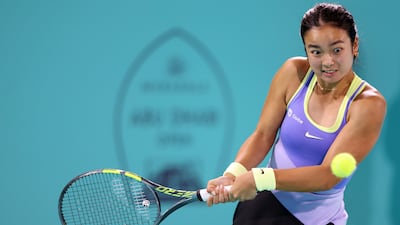
Alexandra Eala in action against Zeynep Sonmez at the Mubadala Abu Dhabi Open. All pictures by Chris Whiteoak / The National -
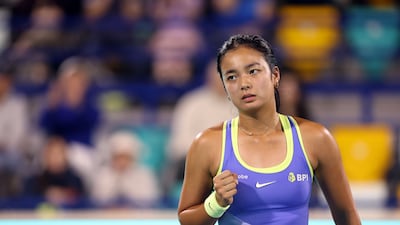
Alexandra Eala celebrates winning a point. -

Alexandra Eala's fans in Abu Dhabi. -
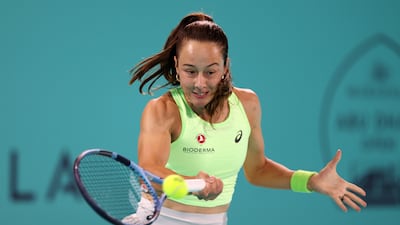
Zeynep Sonmez plays a return. -
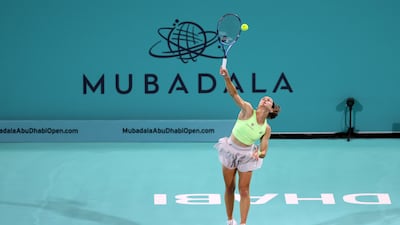
Zeynep Sonmez serves to Alex Eala. -
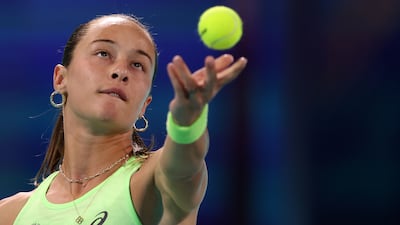
Zeynep Sonmez tosses the ball for a serve. -
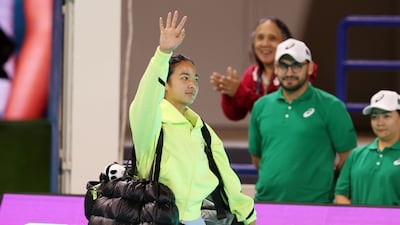
Alexandra Eala before the match. -
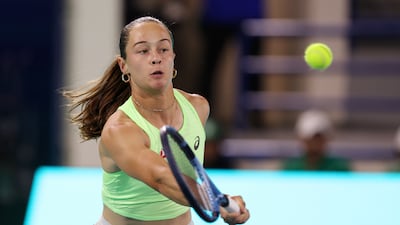
Zeynep Sonmez volleys at the net. -
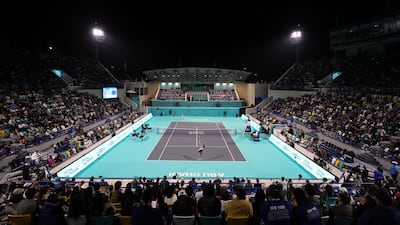
The court lit up at the Mubadala Abu Dhabi Open. -
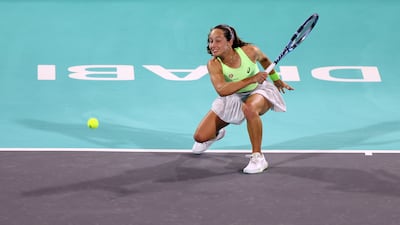
Zeynep Sonmez in action in Abu Dhabi.


Filipina rising star Alex Eala is also still getting accustomed to her new reality. “I am learning to deal with a lot of, you know, these cameras and a lot of the times when people see me, the phone is the first thing they reach out for. Which is something that I have to adjust to,” said the 20-year-old Eala.
“I do value privacy a lot. I think everyone has the right to their own privacy and sometimes being a public figure, the lines are a little bit blurred. Or sometimes I can understand that we don't have the power to draw our own line. I think everybody should have the right to draw the line of privacy.”
In the current environment, drawing the line is not a luxury afforded to the players, even if tournament officials may suggest otherwise.
Australian Open boss Craig Tiley told the Tennis Channel: “We want to listen to the players. We want to really understand what their needs and what their wants are. We'll continue to review it and make sure that the players are comfortable with it, but at the same time, we also want to bring the fan and the player closer. As tennis players, we can really help lift up their value and also the love the fans have for them. But it's a fine line that we've got to keep walking.”
‘We are not being heard’
Jessica Pegula, a long-time member of the WTA Player Council, says the cameras have been a hot topic of discussion “for years” and noted how her fellow American Madison Keys tried to prioritise it on the council’s agenda many times.
While most tournaments have added signs notifying players that cameras are installed in a given area, Pegula says: “This year it feels even worse. It's in every single hallway. I saw online people were zooming in on players' phones and stuff like that. That's so unnecessary. I just think it's really an invasion of privacy. You just feel like you're under a microscope constantly.”
The lack of privacy has opened up a wider conversation on player power – something that has been heavily deliberated between leading stars of both the WTA and ATP Tours and the four grand slams.
Swiatek, who is part of these player power conversations, sounded defeated when asked if they’ve spoken to the Australian Open chiefs about the privacy issue.
“What’s the point?” responded the Polish star. Novak Djokovic seemed equally resigned, saying: “It's really hard for me to see the trend changing in the opposite direction, meaning we take out cameras. If you see, it's only going to be as it is, or even more cameras. It's just something that I guess we have to accept.”
Among the players’ demands – alongside wanting a higher cut from tournament revenue, and slams contributing to player welfare – is to have a bigger say in major decisions taken by tournament organisers.
Bencic says progress has been very slow. “We are not being heard. I don't feel like the slams are really listening to us players," said the Tokyo 2020 Olympic gold medallist.
"And that's something that is in discussion and we're trying to change it and have a little bit more of a voice, because I think as players, we're important, and I think it should matter what we feel like."

