


When Tunisian tennis star Ons Jabeur won the Madrid Open last year and became the first Arab and African woman in history to win a WTA 1000 tournament, no one in the Middle East or North Africa could watch any of her matches on television.
When she stormed to the Rome final the following week, her fans in the Arab world either resorted to following her live scores, or found illegal streams to watch her matches online. Still nothing on TV.
A few months later, Mayar Sherif stunned top-five player Maria Sakkari in the Parma final to become the first Egyptian to win a WTA title. Those matches, too, were nowhere to be seen on any TV screen across the Arab region.
By the end of the year, Jabeur made further history by becoming the first Tunisian, Arab or North African player to qualify for the prestigious season-closing WTA Finals.
She was ranked No 2 in the world, pulling off one unprecedented feat after the other, but no TV channel in the region felt the urge to buy the rights to air WTA matches and showcase Jabeur’s history-making campaign.
A deal between the WTA (Women’s Tennis Association) and beIN Sports for the Mena rights ended at the start of last year. It was never renewed and those rights have not been acquired since.
With the women’s tour featuring two top-40 Arab players in Jabeur and Sherif, not having a rights deal in place for the Mena region is, quite simply, a disgrace.
“It’s a shame. It’s really frustrating. Are we really that bad to [not] show us on TV?” Jabeur told The National in an interview at Wimbledon last week.
“You have someone from an Arab country making history, for the first time ever and you think that’s not a good enough product? There is a lot of mystery in there. I don’t have all the facts. But it’s definitely frustrating for me.”
Ons Jabeur makes history in Madrid
-

Ons Jabeur celebrates with the Madrid Open trophy following victory in the final against Jessica Pegula at La Caja Magica on May 07, 2022 in Madrid, Spain. Getty -

Ons Jabeur celebrates beating Jessica Pegula in the Madrid Open final. Getty -

Ons Jabeur lifts the Madrid Open trophy after beating Jessica Pegula in the final. AFP -

Ons Jabeur and Jessica Pegula pose for photos during the trophy ceremony. EPA -

Ons Jabeur celebrates with the Madrid Open trophy following victory in the final against Jessica Pegula. Getty -
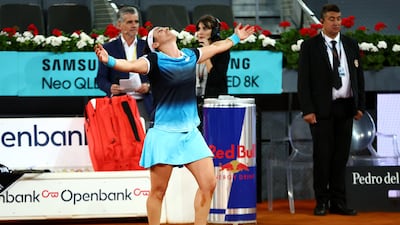
Ons Jabeur celebrates victory over Jessica Pegula in the Madrid Open final. Getty -

Ons Jabeur and Jessica Pegula greet each other at the net following the Madrid Open final. Getty -

Ons Jabeur celebratesbeating Jessica Pegula in the Madrid Open final. EPA -

Ons Jabeur poses for photos with the Madrid Open trophy. AP -

Ons Jabeur pose with the Madrid Open trophy alongside ball kids. Reuters


BeIN refused to make an official statement when asked why their women’s tennis coverage is now limited to the Grand Slams - which negotiate their own rights are not run by the WTA or ATP - and the Billie Jean King Cup.
There are five WTA tournaments taking place in the Middle East and North Africa – Abu Dhabi, Dubai, Doha, Monastir, and Rabat – and those tournaments have had to negotiate their own one-off rights deals due to the lack of a proper agreement covering the whole season for the region.
It is understood that the WTA has been trying to get a fairer value for their broadcast rights and it seems beIN is not willing to pay the suggested sum. For some reason, ATP rights are worth the money but women’s tennis is not worthy of those same airwaves, even though it is the women’s tour that is witnessing the biggest success ever accomplished by an Arab player in the history of the sport.
“The beIN deal ran to term, they haven’t renewed, we hope that they do in the future,” WTA CEO Steve Simon told The National in an interview in February.
“But there are parts in the world where obviously those broadcast agreements, we have to get people to not only talk the talk, but walk the walk; sign up and start covering these events.
“We’ve had a good relationship, I think we’ve delivered and we’ll continue to. They haven’t run away from us, they’re not mad at us, so clearly they’ve got some business reasons that they decided not to do it.
“We need to get them to step back up because we now have, for example in this region, we’ve got Abu Dhabi, you’ve got Doha, you’ve got Dubai, you’ve got Monastir … there may be more that will come as a result of that, which is terrific. And we want to be in all these different places in the world, that’s very important to us.”
Apparently, a Saudi Arabian channel was interested in acquiring the WTA Mena rights but the deal never came to fruition.
WTA Player Council member Jessica Pegula spoke during Wimbledon about the need for the women’s tour to get its money’s worth when it comes to selling its TV rights, but players’ agents – who are thinking of the individual players they represent rather than the big picture – mostly just want their clients on television worldwide and don’t really care about how much the tour is making from such deals.
“I think it's one of those things where clearly the market, the TV, they're not paying us the same as the men. It's just not there,” said the fourth-ranked Pegula.
“So I think this is just a way where we can initiate that, initiate what we think we should be getting paid, which would help with prize money and stuff like that, especially at tournaments.”

The problem with the Mena region missing out on airing WTA matches is that it feeds into the myth that women’s tennis is not as interesting as the men’s. The fact is, if women’s sport is not being shown on television and isn’t getting the same exposure as men’s sport, then how will people know if it’s worth watching?
“People are already judging women’s tennis matches without even watching one single match,” Jabeur said. “Some people are saying, ‘It’s boring’, but how do they know? Have they even watched? I’m not asking for a special privilege or just give us money because we are women. I’m just saying, give us a chance, watch us, and you can see that we’re good at what we’re doing.”
It’s unclear who is to blame for this situation. Is the WTA asking for too much money? Are broadcasters in the region refusing to place any sort of value on women’s tennis? Either way, it is a situation that has been grossly mismanaged and one that requires immediate attention.
Yes, you can watch Jabeur and Sherif at Wimbledon, the US Open, Roland Garros and the Australian Open. But the women’s tour is much more than the four majors and these women are breaking barriers week in, week out.
It’s time for broadcasters to step up and realise this is a moment in sports history that deserves to be witnessed by Arabs across the region.

