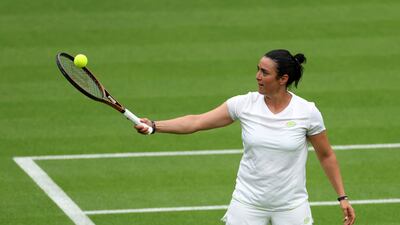
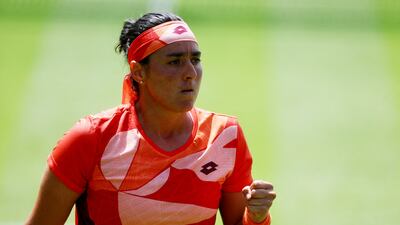
Tunisia's Ons Jabeur during a practice session ahead of the Wimbledon championships. EPA

Ons Jabeur wants level playing field as Arab women take tennis by storm


Reem Abulleil
  • English
  • Arabic

For the first time in history, there are two Arab women seeded in a Grand Slam and Tunisian Ons Jabeur is thrilled to be sharing the spotlight with Egypt’s Mayar Sherif at Wimbledon this fortnight.

Ranked No6 and No31 respectively, Jabeur and Sherif are just two examples of scores of Arab women athletes excelling on the global stage, often outperforming their male counterparts and breaking many barriers along the way.

“I think it’s so great to see. Who would have even thought to see one Arab woman, and now you have two, and possibly more on the way? It’s unbelievable what Mayar is doing for Egypt, for Africa, and we hope to see more,” Jabeur told The National on the eve of the Championships in south-west London.

“Maybe now, with the times, with the more freedom that we have, and also seeing other women doing great in other sports, I think that encourages us,” the 28-year-old says when explaining why women from the region are rising to the top, and not necessarily the men.

“I believe that women are taking advantage more and more of their chances to show who they are and I believe it’s very important to do that. And hopefully we can change that forever.”

Having established herself as a regular fixture in the world’s top 10 over the past two years – rising to a career-high No2 last year – Jabeur feels she has gained a deeper perspective on the state of equality, or inequality, between women and men in tennis and she wants to shed light on the issues she and her fellow WTA players are facing.

“I still believe there is a big gap we should close. I see, maybe now that I’m in the top 10, how women are treated, there’s still a lot more to do,” said the two-time Grand Slam finalist.

The WTA announced last week a pathway to achieve equal prize money at all combined tournaments by the year 2027 and at all non-combined events by 2033. Jabeur is happy the association has taken such a step but feels it should have been in the works a lot sooner.

The Tunisian also believes women’s tennis is unfairly portrayed in a negative light, which possibly makes it unappealing to investors.

“It’s great that the WTA is trying to do that. My question is: Why now? Why didn’t you start this pathway a few years ago?” she asks.

“I’m sure somebody messed up some deals and that’s why we’re in this situation. I don’t believe women’s tennis is that bad, I feel like media [is playing a part]. I’m going to be 100 per cent honest with you. If a top-10 woman player loses to another player, it’s seen as an upset, it’s bad, it’s ‘women’s tennis’.

“But on the men’s side, if they do it, it’s an unbelievable result, it’s an unbelievable achievement. That mindset they have, the way they look at women is always on the negative side.

“I’ve heard some players saying, ‘But you cannot get sponsors’. How would you want us to get sponsored if you’re already making us look bad because you talk bad about us?

“I’m not saying that every match is beautiful, no, there are good and bad matches, and the same thing is happening on the men’s side.

“I’m not asking for free stuff as a woman, never; but give me my chance to prove who I am, give any other woman who is playing in any other sport. It’s very important to give them their chances and the world needs to change because I believe there is a lot to see in women’s sport.”

A recent report in the Financial Times has revealed that Saudi Arabia’s Public Investment Fund (PIF) is exploring investment opportunities into the ATP. Jabeur is “praying” the WTA is being considered as well, especially at a time where Arab women are the ones making history week in, week out, on the tennis tour.

“At the moment, the best Arab players are women. So I pray, I really pray that they [Saudi Arabia] would go for women’s tournaments, not only men,” declared Jabeur.

“If it’s men and women, make it equal, make it equal prize money. For a country like Saudi that is evolving and giving rights to women, I’m actually praying that they would give us our chance.

“I’ve been hearing from Twitter, from everywhere else that [Saudi is interested in] ATP this, ATP that, and it kills me. Hopefully that’s not true [that they are only interested in men’s tennis].

“Hopefully they will really put enough money for women’s tennis and I’m praying for that. To any investor in Saudi, please remember that there are amazing women tennis players playing around the world and they need their chances to show. If you’re thinking of good investments, it’s a great investment there.”

Jabeur’s historic run to the Wimbledon final last year - she is the first Arab player in the Open Era and first African woman to make a major final - took the tennis world by storm and was the subject of one of the episodes in the Netflix docu-series 'Break Point'.

I was always rooting for her, she’s a wonderful person. She’ll open so many doors.
Venus Williams on Jabeur

She followed that up with a second consecutive appearance in a major final at the US Open a couple of months later. By the end of summer, she had earned countless new fans, including one legendary seven-time Grand Slam champion.

“Who didn’t follow her run last year here, and at the US open?” Venus Williams said of Jabeur on Friday.

“I was always rooting for her, she’s a wonderful person. She’ll open so many doors. And you can’t limit people to opening doors just for a certain type of people, she’s opening doors for everyone. That’s one thing about me and my career is I never wanted to be boxed. You can be an inspiration to every single person, man, woman, child and that’s what she is.”

By making it to the semi-finals at Wimbledon last year, Jabeur had already crossed a barrier no Arab-born player had ever crossed; the quarter-final stage so often proving the ultimate hurdle for her and her predecessors at the slams.

She and her husband / fitness trainer Karim Kamoun got “very emotional” watching the Netflix episode telling the story of her journey to the final at SW19 and her face lights up when she reflects on those magical two weeks.

“It was very tough to watch it, it was very emotional for me and Karim because we watched it together. We looked at each other and we both were crying. Unbelievable,” she says.

“I don’t think I could watch it again. But it did bring back a lot of great memories and maybe in a way I felt a little bit sorry for myself. Like I should have done something for that woman crying over there, maybe I should have won that final. It is what it is, everything happens for a reason and I’m trying to move on.

“The story is unbelievable. It’s like a movie that you wanted to finish with a happy ending. It wasn’t the case, but then you see all the support and how the Tunisians were supporting me, it did bring a lot of great memories. And that’s why if you know me, you know the story, you would feel emotional about that episode.”

Jabeur credits her love for playing on grass and being mentally prepared for the tournament for her great result here last year. She also says she drew energy from the massive support she received from the crowd, which allowed her to play freely, and flaunt her creative game.

Arabic chants were ringing around the All England Club throughout the fortnight, with many non-Tunisians learning the words and joining in on the celebrations after every match.

“Every time I did press here at the balcony they were shouting and singing. I remember just after the trophy ceremony, it felt like The Lion King, I put my trophy up and they were like screaming,” she recalls, referring to a famous scene from the popular animated movie.

“It was honestly so amazing. Hopefully we can see a lot of Arabs this year supporting us, me and Mayar, and that it will be a great tournament for both of us hopefully.”

Jabeur begins her campaign at the All England Club on Tuesday against Poland’s Magdalena Frech.

Having reached the finals in two of her last four Grand Slams, she is feeling the pressure to deliver and is hoping her sub-par results on grass coming in – she won just one match on the surface this year – will not stop her from performing well at her favourite major.

“I feel like people are expecting me to go to the final every time I play a Grand Slam, which is difficult,” she says.

“Not because I made two finals that means I should win a Grand Slam right now. But it’s a mindset, it’s a lot of things going on. You should know what’s going on with the players. I believe that people are judging more than they should be but again, I’m trying not to listen to everybody and also not to listen to anybody except my team around me.”

There may be a significant amount of pressure on her, but watching Jabeur prepare for these Championships, you can see she is still her playful, fun-loving self, joking around with her team and forcing her coach Issam Jellali to do push-ups on the practice court because he lost a bet during their hitting session.

“I’m very excited to just play and enjoy my time. There is a lot of pressure, yes. Maybe a lot more than I expected. It’s new for me and I’m trying to manage it. It’s part of tennis. I’m looking for Ons that is playing free on the court and enjoying the game no matter what the outcome will be,” she concludes.


Farage on Muslim Brotherhood

Nigel Farage told Reform's annual conference that the party will proscribe the Muslim Brotherhood if he becomes Prime Minister.
"We will stop dangerous organisations with links to terrorism operating in our country," he said. "Quite why we've been so gutless about this – both Labour and Conservative – I don't know.
“All across the Middle East, countries have banned and proscribed the Muslim Brotherhood as a dangerous organisation. We will do the very same.”
It is 10 years since a ground-breaking report into the Muslim Brotherhood by Sir John Jenkins.
Among the former diplomat's findings was an assessment that “the use of extreme violence in the pursuit of the perfect Islamic society” has “never been institutionally disowned” by the movement.
The prime minister at the time, David Cameron, who commissioned the report, said membership or association with the Muslim Brotherhood was a "possible indicator of extremism" but it would not be banned.

A Cat, A Man, and Two Women
Junichiro
Tamizaki
Translated by Paul McCarthy
Daunt Books 

Who's who in Yemen conflict

Houthis: Iran-backed rebels who occupy Sanaa and run unrecognised government

Yemeni government: Exiled government in Aden led by eight-member Presidential Leadership Council

Southern Transitional Council: Faction in Yemeni government that seeks autonomy for the south

Habrish 'rebels': Tribal-backed forces feuding with STC over control of oil in government territory

The National Archives, Abu Dhabi

Founded over 50 years ago, the National Archives collects valuable historical material relating to the UAE, and is the oldest and richest archive relating to the Arabian Gulf.

Much of the material can be viewed on line at the Arabian Gulf Digital Archive - https://www.agda.ae/en

Kandahar%20
%3Cp%3E%3Cstrong%3EDirector%3A%3C%2Fstrong%3E%20Ric%20Roman%20Waugh%3C%2Fp%3E%0A%3Cp%3E%3Cstrong%3EStars%3A%C2%A0%3C%2Fstrong%3EGerard%20Butler%2C%20Navid%20Negahban%2C%20Ali%20Fazal%3C%2Fp%3E%0A%3Cp%3E%3Cstrong%3ERating%3A%3C%2Fstrong%3E%202.5%2F5%3C%2Fp%3E%0A
UAE currency: the story behind the money in your pockets
The alternatives

• Founded in 2014, Telr is a payment aggregator and gateway with an office in Silicon Oasis. It’s e-commerce entry plan costs Dh349 monthly (plus VAT). QR codes direct customers to an online payment page and merchants can generate payments through messaging apps.

• Business Bay’s Pallapay claims 40,000-plus active merchants who can invoice customers and receive payment by card. Fees range from 1.99 per cent plus Dh1 per transaction depending on payment method and location, such as online or via UAE mobile.

• Tap started in May 2013 in Kuwait, allowing Middle East businesses to bill, accept, receive and make payments online “easier, faster and smoother” via goSell and goCollect. It supports more than 10,000 merchants. Monthly fees range from US$65-100, plus card charges of 2.75-3.75 per cent and Dh1.2 per sale.

2checkout’s “all-in-one payment gateway and merchant account” accepts payments in 200-plus markets for 2.4-3.9 per cent, plus a Dh1.2-Dh1.8 currency conversion charge. The US provider processes online shop and mobile transactions and has 17,000-plus active digital commerce users.

• PayPal is probably the best-known online goods payment method - usually used for eBay purchases -  but can be used to receive funds, providing everyone’s signed up. Costs from 2.9 per cent plus Dh1.2 per transaction.

Mercer, the investment consulting arm of US services company Marsh & McLennan, expects its wealth division to at least double its assets under management (AUM) in the Middle East as wealth in the region continues to grow despite economic headwinds, a company official said.

Mercer Wealth, which globally has $160 billion in AUM, plans to boost its AUM in the region to $2-$3bn in the next 2-3 years from the present $1bn, said Yasir AbuShaban, a Dubai-based principal with Mercer Wealth.

Within the next two to three years, we are looking at reaching $2 to $3 billion as a conservative estimate and we do see an opportunity to do so,” said Mr AbuShaban.

Mercer does not directly make investments, but allocates clients’ money they have discretion to, to professional asset managers. They also provide advice to clients.

“We have buying power. We can negotiate on their (client’s) behalf with asset managers to provide them lower fees than they otherwise would have to get on their own,” he added.

Mercer Wealth’s clients include sovereign wealth funds, family offices, and insurance companies among others.

From its office in Dubai, Mercer also looks after Africa, India and Turkey, where they also see opportunity for growth.

Wealth creation in Middle East and Africa (MEA) grew 8.5 per cent to $8.1 trillion last year from $7.5tn in 2015, higher than last year’s global average of 6 per cent and the second-highest growth in a region after Asia-Pacific which grew 9.9 per cent, according to consultancy Boston Consulting Group (BCG). In the region, where wealth grew just 1.9 per cent in 2015 compared with 2014, a pickup in oil prices has helped in wealth generation.

BCG is forecasting MEA wealth will rise to $12tn by 2021, growing at an annual average of 8 per cent.

Drivers of wealth generation in the region will be split evenly between new wealth creation and growth of performance of existing assets, according to BCG.

Another general trend in the region is clients’ looking for a comprehensive approach to investing, according to Mr AbuShaban.

“Institutional investors or some of the families are seeing a slowdown in the available capital they have to invest and in that sense they are looking at optimizing the way they manage their portfolios and making sure they are not investing haphazardly and different parts of their investment are working together,” said Mr AbuShaban.

Some clients also have a higher appetite for risk, given the low interest-rate environment that does not provide enough yield for some institutional investors. These clients are keen to invest in illiquid assets, such as private equity and infrastructure.

“What we have seen is a desire for higher returns in what has been a low-return environment specifically in various fixed income or bonds,” he said.

“In this environment, we have seen a de facto increase in the risk that clients are taking in things like illiquid investments, private equity investments, infrastructure and private debt, those kind of investments were higher illiquidity results in incrementally higher returns.”

The Abu Dhabi Investment Authority, one of the largest sovereign wealth funds, said in its 2016 report that has gradually increased its exposure in direct private equity and private credit transactions, mainly in Asian markets and especially in China and India. The authority’s private equity department focused on structured equities owing to “their defensive characteristics.”

Results:

Women:

1. Rhiannan Iffland (AUS) 322.95 points
2. Lysanne Richard (CAN) 285.75
3. Ellie Smart (USA) 277.70

Men:

1. Gary Hunt (GBR) 431.55
2. Constantin Popovici (ROU) 424.65
3. Oleksiy Prygorov (UKR) 392.30

Our legal consultant

Name: Dr Hassan Mohsen Elhais

Position: legal consultant with Al Rowaad Advocates and Legal Consultants.

Sly%20Cooper%20and%20the%20Thievius%20Raccoonus
%3Cp%3E%3Cstrong%3EDeveloper%3A%3C%2Fstrong%3E%20Sucker%20Punch%20Productions%3Cbr%3E%3Cstrong%3EPublisher%3A%3C%2Fstrong%3E%20Sony%20Computer%20Entertainment%3Cbr%3E%3Cstrong%3EConsole%3A%3C%2Fstrong%3E%20PlayStation%202%20to%205%3Cbr%3E%3Cstrong%3ERating%3A%3C%2Fstrong%3E%205%2F5%3C%2Fp%3E%0A
The specs

Engine: 2.0-litre 4cyl turbo

Power: 261hp at 5,500rpm

Torque: 405Nm at 1,750-3,500rpm

Transmission: 9-speed auto

Fuel consumption: 6.9L/100km

On sale: Now

Price: From Dh117,059

Islamophobia definition

A widely accepted definition was made by the All Party Parliamentary Group on British Muslims in 2019: “Islamophobia is rooted in racism and is a type of racism that targets expressions of Muslimness or perceived Muslimness.” It further defines it as “inciting hatred or violence against Muslims”.

Conservative MPs who have publicly revealed sending letters of no confidence
  1. Steve Baker
  2. Peter Bone
  3. Ben Bradley
  4. Andrew Bridgen
  5. Maria Caulfield​​​​​​​
  6. Simon Clarke 
  7. Philip Davies
  8. Nadine Dorries​​​​​​​
  9. James Duddridge​​​​​​​
  10. Mark Francois 
  11. Chris Green
  12. Adam Holloway
  13. Andrea Jenkyns
  14. Anne-Marie Morris
  15. Sheryll Murray
  16. Jacob Rees-Mogg
  17. Laurence Robertson
  18. Lee Rowley
  19. Henry Smith
  20. Martin Vickers 
  21. John Whittingdale
Dubai Bling season three

Cast: Loujain Adada, Zeina Khoury, Farhana Bodi, Ebraheem Al Samadi, Mona Kattan, and couples Safa & Fahad Siddiqui and DJ Bliss & Danya Mohammed 

Rating: 1/5

POSSIBLE ENGLAND EURO 2020 SQUAD

Goalkeepers: Jordan Pickford, Nick Pope, Dean Henderson.
Defenders: Trent Alexander-Arnold, Kieran Trippier, Joe Gomez, John Stones, Harry Maguire, Tyrone Mings, Ben Chilwell, Fabian Delph.
Midfielders: Declan Rice, Harry Winks, Jordan Henderson, Ross Barkley, Mason Mount, Alex Oxlade-Chamberlain.
Forwards: Harry Kane, Raheem Sterling, Marcus Rashford, Jadon Sancho, Tammy Abraham, Callum Hudson-Odoi.

The specs

Engine: 2.0-litre 4-cyl turbo

Power: 247hp at 6,500rpm

Torque: 370Nm from 1,500-3,500rpm

Transmission: 10-speed auto

Fuel consumption: 7.8L/100km

Price: from Dh94,900

On sale: now

The specs: 2018 Jaguar E-Pace First Edition

Price, base / as tested: Dh186,480 / Dh252,735

Engine: 2.0-litre four-cylinder

Power: 246hp @ 5,500rpm

Torque: 365Nm @ 1,200rpm

Transmission: Nine-speed automatic

Fuel consumption, combined: 7.7L / 100km

The specs: 2018 Harley-Davidson Fat Boy

Price, base / as tested Dh97,600
Engine 1,745cc Milwaukee-Eight v-twin engine
Transmission Six-speed gearbox
Power 78hp @ 5,250rpm
Torque 145Nm @ 3,000rpm
Fuel economy, combined 5.0L / 100km (estimate)

WITHIN%20SAND
%3Cp%3EDirector%3A%20Moe%20Alatawi%3C%2Fp%3E%0A%3Cp%3EStarring%3A%20Ra%E2%80%99ed%20Alshammari%2C%20Adwa%20Fahd%2C%20Muhand%20Alsaleh%3C%2Fp%3E%0A%3Cp%3ERating%3A%203%2F5%3C%2Fp%3E%0A
DUBAI%20BLING%3A%20EPISODE%201
%3Cp%3E%3Cstrong%3ECreator%3A%20%3C%2Fstrong%3ENetflix%3C%2Fp%3E%0A%3Cp%3E%3Cstrong%3EStars%3A%20%3C%2Fstrong%3EKris%20Fade%2C%20Ebraheem%20Al%20Samadi%2C%20Zeina%20Khoury%3C%2Fp%3E%0A%3Cp%3E%3Cstrong%3ERating%3A%3C%2Fstrong%3E%202%2F5%3C%2Fp%3E%0A
UAE currency: the story behind the money in your pockets
SEMI-FINAL

Monterrey 1 

Funes Mori (14)

Liverpool 2

Keita (11), Firmino (90 1)

How much do leading UAE’s UK curriculum schools charge for Year 6?
  1. Nord Anglia International School (Dubai) – Dh85,032
  2. Kings School Al Barsha (Dubai) – Dh71,905
  3. Brighton College Abu Dhabi - Dh68,560
  4. Jumeirah English Speaking School (Dubai) – Dh59,728
  5. Gems Wellington International School – Dubai Branch – Dh58,488
  6. The British School Al Khubairat (Abu Dhabi) - Dh54,170
  7. Dubai English Speaking School – Dh51,269

*Annual tuition fees covering the 2024/2025 academic year

Our Time Has Come
Alyssa Ayres, Oxford University Press

UAE's final round of matches
  • Sep 1, 2016 Beat Japan 2-1 (away)
  • Sep 6, 2016 Lost to Australia 1-0 (home)
  • Oct 6, 2016 Beat Thailand 3-1 (home)
  • Oct 11, 2016 Lost to Saudi Arabia 3-0 (away)
  • Nov 15, 2016 Beat Iraq 2-0 (home)
  • Mar 23, 2017 Lost to Japan 2-0 (home)
  • Mar 28, 2017 Lost to Australia 2-0 (away)
  • June 13, 2017 Drew 1-1 with Thailand (away)
  • Aug 29, 2017 v Saudi Arabia (home)
  • Sep 5, 2017 v Iraq (away)


Brief scoreline:

Liverpool 5

Keita 1', Mane 23', 66', Salah 45' 1, 83'

Huddersfield 0

The specs

Engine: 2.9-litre, V6 twin-turbo

Transmission: seven-speed PDK dual clutch automatic

Power: 375bhp

Torque: 520Nm

Price: Dh332,800

On sale: now

Director: Laxman Utekar

Cast: Vicky Kaushal, Akshaye Khanna, Diana Penty, Vineet Kumar Singh, Rashmika Mandanna

Rating: 1/5

Updated: July 03, 2023, 4:15 PM