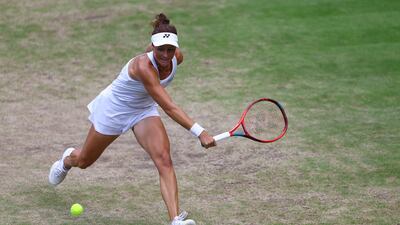
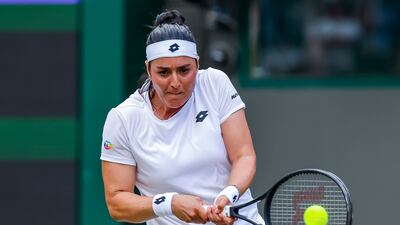
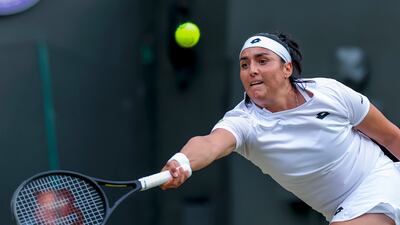
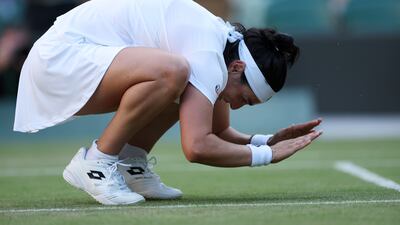
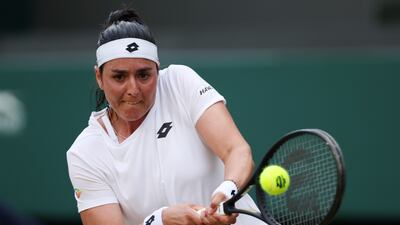
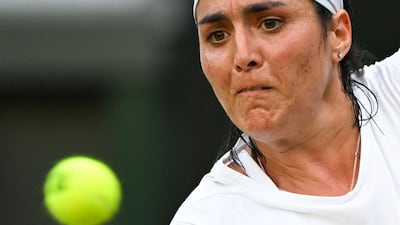
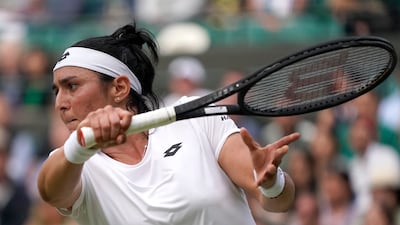
• Ons Jabeur of Tunisia plays a forehand during a training session on the eve of the Wimbledon 2022 women's final at All England Lawn Tennis and Croquet Club on July 08, 2022 in London, England. Getty Images
    Ons Jabeur of Tunisia plays a forehand during a training session on the eve of the Wimbledon 2022 women's final at All England Lawn Tennis and Croquet Club on July 08, 2022 in London, England. Getty Images
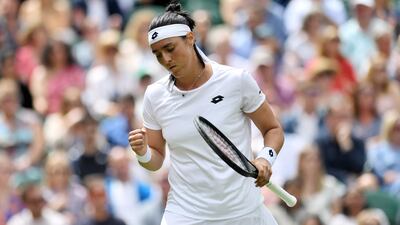
  • Ons Jabeur smiles during a training session. The Tunisian is the first Arab to reach a Grand Slam singles final. Getty Images
    Ons Jabeur smiles during a training session. The Tunisian is the first Arab to reach a Grand Slam singles final. Getty Images
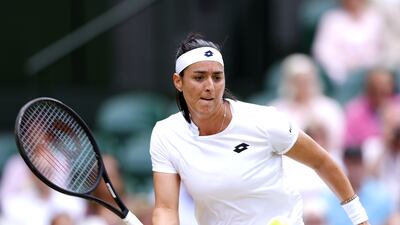
  • Ons Jabeur of Tunisia faces Elena Rybakina in the 2022 Wimbledon women's final on Saturday, July 9. Getty Images
    Ons Jabeur of Tunisia faces Elena Rybakina in the 2022 Wimbledon women's final on Saturday, July 9. Getty Images
  • Ons Jabeur of Tunisia shakes hands with her coach at the net. Getty Images
    Ons Jabeur of Tunisia shakes hands with her coach at the net. Getty Images
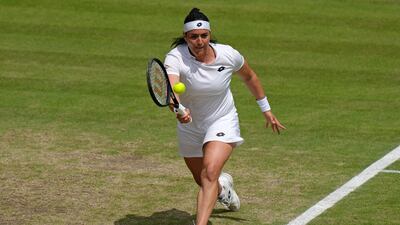
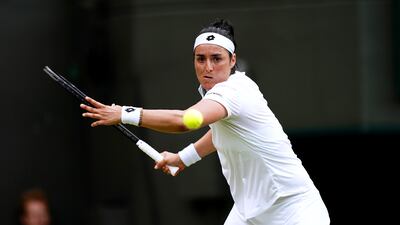
  • Ons Jabeur plays a forehand. Getty Images
    Ons Jabeur plays a forehand. Getty Images
  • Ons Jabeur leaves the practice court. Getty Images
    Ons Jabeur leaves the practice court. Getty Images
  • Ons Jabeur of Tunisia plays a forehand during a practise session. Getty Images
    Ons Jabeur of Tunisia plays a forehand during a practise session. Getty Images
  • Ons Jabeur of Tunisia. Getty Images
    Ons Jabeur of Tunisia. Getty Images
  • Ons Jabeur uses her phone after a training session. Getty Images
    Ons Jabeur uses her phone after a training session. Getty Images
  • Ons Jabeur of Tunisia makes her way to a practice session at All England Lawn Tennis and Croquet Club. Getty Images
    Ons Jabeur of Tunisia makes her way to a practice session at All England Lawn Tennis and Croquet Club. Getty Images
  • Ons Jabeur of Tunisia. Getty Images
    Ons Jabeur of Tunisia. Getty Images

Ons Jabeur: A 'ball of sunshine' who stands on the brink of greatness at Wimbledon


Reem Abulleil
  • English
  • Arabic

I met Ons Jabeur for the first time a decade ago when she was a 17-year-old given wildcards to play the WTA tournaments in Doha and Dubai.

The Tunisian had won the 2011 Roland Garros junior title the previous season and was looking to make the step up to the women’s tour, while simultaneously studying for her French baccalauréat in high school.

Several things struck me immediately from our first meeting.

She was a ball of sunshine, warm towards everyone around her and was joking with every individual on-site at the tournament – be it the barista serving her coffee in the players’ lounge, the security guard escorting players to their matches, tournament officials, fellow players.

She was making her tour debut yet somehow everyone knew her and wanted to chat with her.

She was also supremely talented. She played a creative game that wasn’t common on the WTA circuit. She had all these different shots and spins that surprised her opponents, and made for entertaining viewing.

It was a cerebral game style that relied on finesse, but one that wasn’t fully developed yet; she didn’t always know which shot to use at the right moment. She was still only 17 after all.

The most obvious thing I noticed was how ambitious she was. Jabeur was very clear in what she wanted to achieve in tennis. “I want to be a top-10 player,” she told me in our first interview back then. She acknowledged she had things she had to figure out. She said she had breathing problems and needed to work on her fitness. She had a niggling ankle injury that required surgery. And she changed coaches and training bases a few times, searching for the right team, and place, that could help her translate her junior success to the women’s tour.

Jabeur was a teenager but sounded like someone who understood the meaning of responsibility from a very young age. She can switch from playful mode to serious talk very quickly, and can eloquently discuss the challenges of striving to make it on tour and her experience as a Tunisian trying to excel in a sport few Arabs have succeeded in.

Unlike other top juniors from her generation, Jabeur took her time breaking through.

After winning the girls’ title at Roland Garros, it took her six years to break into the WTA’s top 100, achieving that feat in August 2017, just shy of her 23rd birthday.

From then on, every step she took on court broke some kind of record for Tunisian, Arab or African tennis. She was constantly fielding questions about being a trailblazer for her region and she took a decision early on in her career to see that role as a privilege, rather than added pressure.

Today, she is the first African woman to reach a Grand Slam final, and the first Tunisian and Arab player – male or female – to make it to a major final in the Open era, thanks to her exploits at Wimbledon.

“I’ve always had that since the beginning of my junior days,” Jabeur told me in another interview.

“I’m trying to be humble about it. When I go to Fed Cup and I see some players from African countries how they congratulate me, how so many want to take pictures with me, I see how important I am for African tennis.

“And when I go to Arab countries I see Arabs how they react to me, and obviously Tunisia as well. Seeing young kids, how I can inspire them, for me it’s not a heavy weight, it’s an unbelievable privilege.”

If I had to pinpoint when or how things started to really come together for Jabeur, it would have to be around 2018 and 2019, when she finally created a stable team around her that included fellow Tunisians Issam Jellali, her head coach, and Karim Kamoun, her husband and fitness trainer. Her sports psychologist Melanie Maillard is also a key pillar in her camp.

Jabeur got married end of 2015 when she was just 21. Her wedding came on the heels of her appearance at the WTA Rising Stars event in Singapore that featured Jabeur and Naomi Osaka, among others, on the sidelines of the tour’s showpiece WTA Finals tournament.

We had a Mexican dinner in Singapore that doubled as a pseudo-bachelorette party for her, and she spoke about her decision to get married so young.

“It’s a choice to get married at this age,” she told me. “I’m 21, yes, but I don’t see myself like any other 21-year-old who is going to college and having a regular life. I started travelling at a very young age and I feel I’m ready to get married.

“My future husband is an athlete [fencer] so he can really help me and support me. A lot of people have told me that I’m too young to get married but I don’t want to waste my time. If I want to be with him for the rest of my life, I just want to start now.”

That’s the thing about Jabeur; she never shied away from taking full ownership over her decisions, whether in her professional or personal life. She knows she can make mistakes, but always said that even if she did, at least they were hers to make.

Maillard, her mental coach, recently told me in an interview for The National that Kamoun “brought stability” to Jabeur's gruelling life on tour.

Besides stability and support and the obvious ways Kamoun has helped Jabeur, the team as a whole shares a lot more than just tennis-related goals. They have common values – they are the kindest group out there – and share a sense of humour and zest for life.

I once joined them on an early morning trip to the Great Wall of China during the tournament in Beijing. We were up there around 7am and the whole Jabeur team was singing and dancing, playing music on a portable speaker and having an absolute blast.

In Wuhan one time, I was meeting Jabeur and Kamoun at their hotel and we ended up playing cards and chatting to the woman who was performing each night in the lobby. Jabeur knew everything about the singer; from why she wanted to relocate from Wuhan, to her hopes and dreams for the future. She had befriended her in a matter of two days.

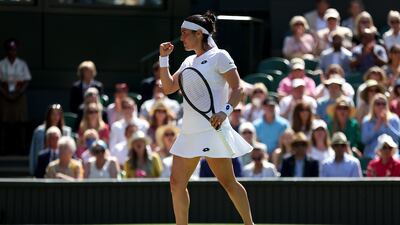
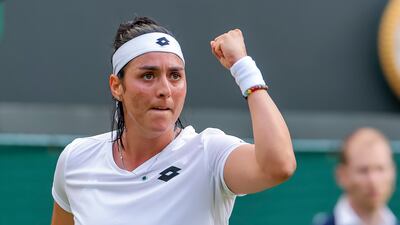
  • Ons Jabeur (R) of Tunisia celebrates after winning the women's Wimbledon semi-final against Tatjana Maria of Germany on July 7, 2022. EPA
    Ons Jabeur (R) of Tunisia celebrates after winning the women's Wimbledon semi-final against Tatjana Maria of Germany on July 7, 2022. EPA
  • Ons Jabeur celebrates her victory . PA
    Ons Jabeur celebrates her victory . PA
  • Ons Jabeur in action against Tatjana Maria. Getty
    Ons Jabeur in action against Tatjana Maria. Getty
  • Ons Jabeur of Tunisia on her way to victory. EPA
    Ons Jabeur of Tunisia on her way to victory. EPA
  • Tunisia's Ons Jabeur returns to Germany's Tatjana Maria. AP
    Tunisia's Ons Jabeur returns to Germany's Tatjana Maria. AP
  • Germany's Tatjana Maria in action. Reuters
    Germany's Tatjana Maria in action. Reuters
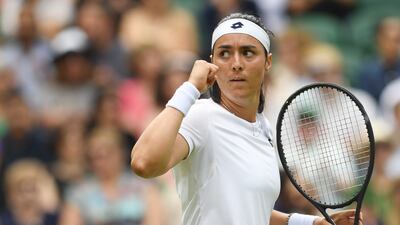
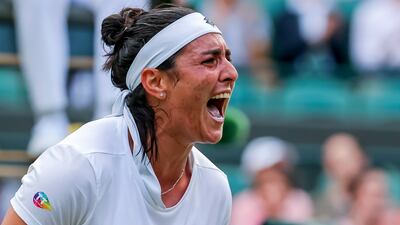
  • Ons Jabeur of Tunisia celebrates winning a point in the semi-final. EPA
    Ons Jabeur of Tunisia celebrates winning a point in the semi-final. EPA
  • Ons Jabeur in action on Centre Court. PA
    Ons Jabeur in action on Centre Court. PA
  • Tatjana Maria in action. EPA
    Tatjana Maria in action. EPA
  • Ons Jabeur celebrates a point against Tatjana Maria. Getty
    Ons Jabeur celebrates a point against Tatjana Maria. Getty
  • Kazakhstan's Elena Rybakina celebrates winning against Romania's Simona Halep. AFP
    Kazakhstan's Elena Rybakina celebrates winning against Romania's Simona Halep. AFP
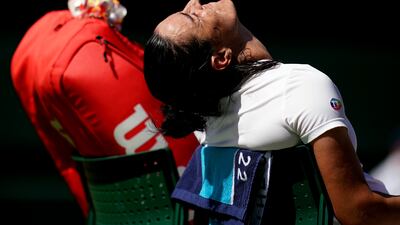
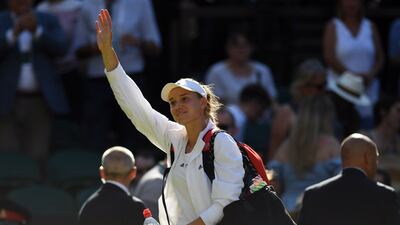
  • Elena Rybakina leaves the court after her victory. EPA
    Elena Rybakina leaves the court after her victory. EPA
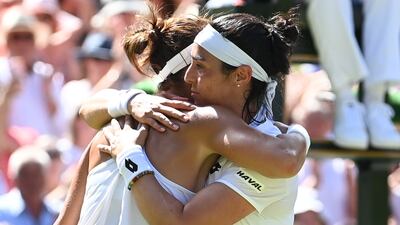
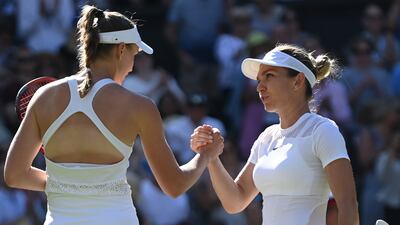
  • Elena Rybakina (L) and Simona Halep shake hands at the ened of the match. EPA
    Elena Rybakina (L) and Simona Halep shake hands at the ened of the match. EPA

Whether she is sharing a laugh with Novak Djokovic, or babysitting her fellow players’ kids at tournaments, Jabeur has stayed true to herself from her junior days ranked outside the top 1000, all the way to now, as a world No 2 ready to contest a Wimbledon final.

“I think Ons is an amazing role model already where she's coming from for all this part, how she plays, how she is outside of the court. It doesn't matter if she's No 2 in the world, I mean, she never changed; that's impressive because that also makes her an amazing person,” said Germany’s Tatjana Maria, the woman Jabeur defeated in the Wimbledon semi-finals on Thursday.

“I think she deserves it. I hope she can go to the end.”

The magnitude of the response to Jabeur’s Wimbledon run this fortnight has been something I have never seen before from the Arab world towards a woman athlete. It’s comparable to how the region has been reacting to Mohamed Salah, who has transcended sport these past few years.

Celebrities, politicians, and people from all walks of life are saluting Jabeur through social media messages. She’s shown them that a young girl from a middle class family from Tunisia can one day make it to a Wimbledon final.

As is the case with football’s "Egyptian King", Jabeur is admired for her sporting achievements, but is truly loved for her character and humility.

She has repeatedly said she hopes to inspire people across the Arab world and the African continent to look past obstacles and barriers and believe in themselves.

Whether she wins Wimbledon on Saturday or not, it’s certainly mission accomplished for the Tunisian Queen.

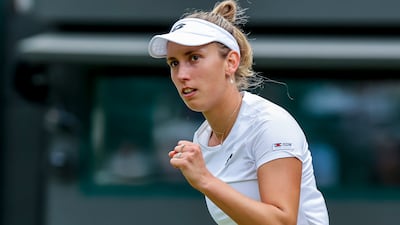
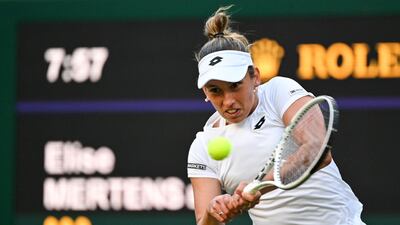
  • Ons Jabeur of Tunisia celebrates her victory over Elise Mertens of Belgium during their fourth-round match at the Wimbledon Championships. EPA
    Ons Jabeur of Tunisia celebrates her victory over Elise Mertens of Belgium during their fourth-round match at the Wimbledon Championships. EPA
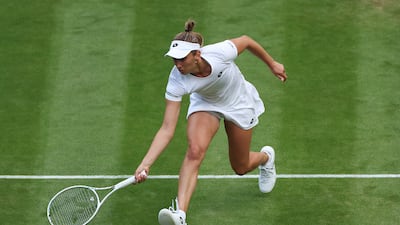
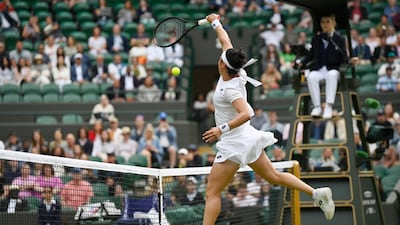
  • Ons Jabeur of Tunisia in action against Elise Mertens of Belgium. EPA
    Ons Jabeur of Tunisia in action against Elise Mertens of Belgium. EPA
  • Ons Jabeur hits a forehand to Elise Mertens. EPA
    Ons Jabeur hits a forehand to Elise Mertens. EPA
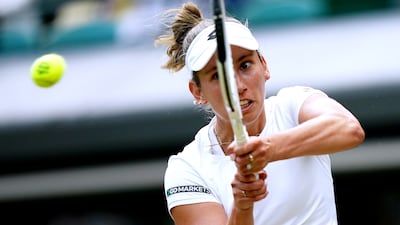
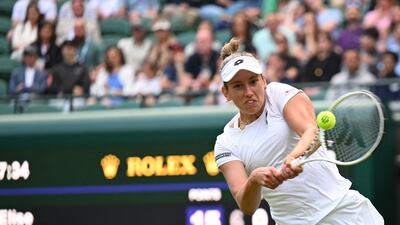
  • Elise Mertens of Belgium in action against Ons Jabeur of Tunisia. EPA
    Elise Mertens of Belgium in action against Ons Jabeur of Tunisia. EPA
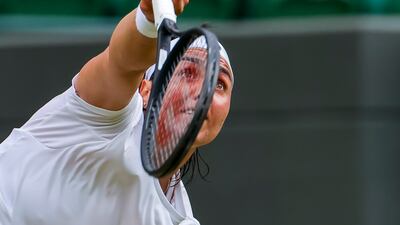
  • Ons Jabeur serves to Elise Mertens. EPA
    Ons Jabeur serves to Elise Mertens. EPA
  • Elise Mertens returns to Ons Jabeur. EPA
    Elise Mertens returns to Ons Jabeur. EPA
  • Ons Jabeur of Tunisia in action. EPA
    Ons Jabeur of Tunisia in action. EPA
  • Ons Jabeur of Tunisia celebrates winning against Elise Mertens of Belgium. Getty
    Ons Jabeur of Tunisia celebrates winning against Elise Mertens of Belgium. Getty
  • Elise Mertens in action during her fourth-round match against Ons Jabeur on Court 1. PA
    Elise Mertens in action during her fourth-round match against Ons Jabeur on Court 1. PA
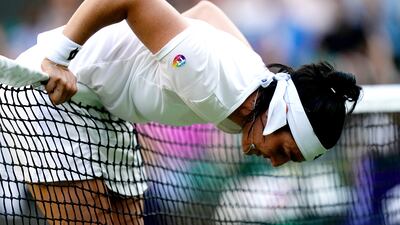
  • Ons Jabeur collides with the net. PA
    Ons Jabeur collides with the net. PA
  • Ons Jabeur of Tunisia plays a backhand against Elise Mertens of Belgium. Getty
    Ons Jabeur of Tunisia plays a backhand against Elise Mertens of Belgium. Getty
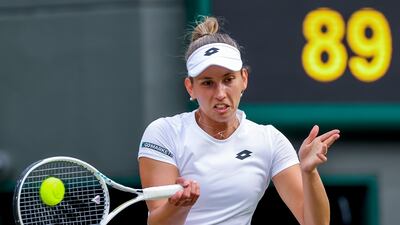
  • Elise Mertens of Belgium plays a forehand against Ons Jabeur of Tunisia. Getty
    Elise Mertens of Belgium plays a forehand against Ons Jabeur of Tunisia. Getty
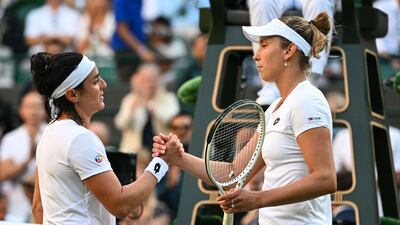
  • Tunisia's Ons Jabeur and Belgium's Elise Mertens shake hands at the end of their match. AFP
    Tunisia's Ons Jabeur and Belgium's Elise Mertens shake hands at the end of their match. AFP
  • Ons Jabeur in action. PA
    Ons Jabeur in action. PA
  • Belgium's Elise Mertens returns the ball to Tunisia's Ons Jabeur. AFP
    Belgium's Elise Mertens returns the ball to Tunisia's Ons Jabeur. AFP
  • Tunisia's Ons Jabeur eyes the ball as she returns it to Belgium's Elise Mertens. AFP
    Tunisia's Ons Jabeur eyes the ball as she returns it to Belgium's Elise Mertens. AFP
  • Belgium's Elise Mertens returns the ball to Tunisia's Ons Jabeur. AFP
    Belgium's Elise Mertens returns the ball to Tunisia's Ons Jabeur. AFP
  • Tunisia's Ons Jabeur in action. Reuters
    Tunisia's Ons Jabeur in action. Reuters
  • Tunisia's Ons Jabeur reacts during her fourth-round match against Belgium's Elise Mertens. Reuters
    Tunisia's Ons Jabeur reacts during her fourth-round match against Belgium's Elise Mertens. Reuters
  • Tunisia's Ons Jabeur returns the ball to Belgium's Elise Mertens. AP Photo
    Tunisia's Ons Jabeur returns the ball to Belgium's Elise Mertens. AP Photo
The specs

Engine: 2-litre 4-cylinder and 3.6-litre 6-cylinder

Power: 220 and 280 horsepower

Torque: 350 and 360Nm

Transmission: eight-speed automatic

Price: from Dh136,521 VAT and Dh166,464 VAT 

On sale: now

Global state-owned investor ranking by size

1.

United States

2.

China

3.

UAE

4.

Japan

5

Norway

6.

Canada

7.

Singapore

8.

Australia

9.

Saudi Arabia

10.

South Korea

Ten tax points to be aware of in 2026

1. Domestic VAT refund amendments: request your refund within five years

If a business does not apply for the refund on time, they lose their credit.

2. E-invoicing in the UAE

Businesses should continue preparing for the implementation of e-invoicing in the UAE, with 2026 a preparation and transition period ahead of phased mandatory adoption. 

3. More tax audits

Tax authorities are increasingly using data already available across multiple filings to identify audit risks. 

4. More beneficial VAT and excise tax penalty regime

Tax disputes are expected to become more frequent and more structured, with clearer administrative objection and appeal processes. The UAE has adopted a new penalty regime for VAT and excise disputes, which now mirrors the penalty regime for corporate tax.

5. Greater emphasis on statutory audit

There is a greater need for the accuracy of financial statements. The International Financial Reporting Standards standards need to be strictly adhered to and, as a result, the quality of the audits will need to increase.

6. Further transfer pricing enforcement

Transfer pricing enforcement, which refers to the practice of establishing prices for internal transactions between related entities, is expected to broaden in scope. The UAE will shortly open the possibility to negotiate advance pricing agreements, or essentially rulings for transfer pricing purposes. 

7. Limited time periods for audits

Recent amendments also introduce a default five-year limitation period for tax audits and assessments, subject to specific statutory exceptions. While the standard audit and assessment period is five years, this may be extended to up to 15 years in cases involving fraud or tax evasion. 

8. Pillar 2 implementation 

Many multinational groups will begin to feel the practical effect of the Domestic Minimum Top-Up Tax (DMTT), the UAE's implementation of the OECD’s global minimum tax under Pillar 2. While the rules apply for financial years starting on or after January 1, 2025, it is 2026 that marks the transition to an operational phase.

9. Reduced compliance obligations for imported goods and services

Businesses that apply the reverse-charge mechanism for VAT purposes in the UAE may benefit from reduced compliance obligations. 

10. Substance and CbC reporting focus

Tax authorities are expected to continue strengthening the enforcement of economic substance and Country-by-Country (CbC) reporting frameworks. In the UAE, these regimes are increasingly being used as risk-assessment tools, providing tax authorities with a comprehensive view of multinational groups’ global footprints and enabling them to assess whether profits are aligned with real economic activity. 

Contributed by Thomas Vanhee and Hend Rashwan, Aurifer

Tamkeen's offering
  • Option 1: 70% in year 1, 50% in year 2, 30% in year 3
  • Option 2: 50% across three years
  • Option 3: 30% across five years 
Our legal columnist

Name: Yousef Al Bahar

Advocate at Al Bahar & Associate Advocates and Legal Consultants, established in 1994

Education: Mr Al Bahar was born in 1979 and graduated in 2008 from the Judicial Institute. He took after his father, who was one of the first Emirati lawyers

How to wear a kandura

Dos

  • Wear the right fabric for the right season and occasion 
  • Always ask for the dress code if you don’t know
  • Wear a white kandura, white ghutra / shemagh (headwear) and black shoes for work 
  • Wear 100 per cent cotton under the kandura as most fabrics are polyester

Don’ts 

  • Wear hamdania for work, always wear a ghutra and agal 
  • Buy a kandura only based on how it feels; ask questions about the fabric and understand what you are buying
Other workplace saving schemes
  • The UAE government announced a retirement savings plan for private and free zone sector employees in 2023.
  • Dubai’s savings retirement scheme for foreign employees working in the emirate’s government and public sector came into effect in 2022.
  • National Bonds unveiled a Golden Pension Scheme in 2022 to help private-sector foreign employees with their financial planning.
  • In April 2021, Hayah Insurance unveiled a workplace savings plan to help UAE employees save for their retirement.
  • Lunate, an Abu Dhabi-based investment manager, has launched a fund that will allow UAE private companies to offer employees investment returns on end-of-service benefits.
Dengue%20fever%20symptoms
%3Cp%3EHigh%20fever%20(40%C2%B0C%2F104%C2%B0F)%3Cbr%3ESevere%20headache%3Cbr%3EPain%20behind%20the%20eyes%3Cbr%3EMuscle%20and%20joint%20pains%3Cbr%3ENausea%3Cbr%3EVomiting%3Cbr%3ESwollen%20glands%3Cbr%3ERash%26nbsp%3B%3C%2Fp%3E%0A
Jetour T1 specs

Engine: 2-litre turbocharged

Power: 254hp

Torque: 390Nm

Price: From Dh126,000

Available: Now

Pathaan
%3Cp%3E%3Cstrong%3EDirector%3A%3C%2Fstrong%3E%20Siddharth%20Anand%C2%A0%3C%2Fp%3E%0A%3Cp%3E%3Cstrong%3EStars%3A%3C%2Fstrong%3E%20Shah%20Rukh%20Khan%2C%20Deepika%20Padukone%2C%20John%20Abraham%C2%A0%3C%2Fp%3E%0A%3Cp%3E%3Cstrong%3ERating%3A%3C%2Fstrong%3E%203%2F5%3C%2Fp%3E%0A
Panipat

Director Ashutosh Gowariker

Produced Ashutosh Gowariker, Rohit Shelatkar, Reliance Entertainment

Cast Arjun Kapoor, Sanjay Dutt, Kriti Sanon, Mohnish Behl, Padmini Kolhapure, Zeenat Aman

Rating 3 /stars

Updated: July 09, 2022, 4:54 AM