

Follow the latest news on the 2024 Paris Olympics
Algeria's Djamel Sedjati remained on track for Olympic glory as he sealed his spot in Saturday’s men’s 800m final.
Sedjati, one of the big favourites for gold in Paris, won his semi-final heat in a time of 1:45.08 to ease into the medal round.
The Algerian comfortably finished ahead of Thepiso Masalela of Botswana, who also qualified for the final.
He is likely to face the biggest challenge from Kenya's Emmanuel Wanyonyi, who looked in great shape on Friday as he won his semi-final in commanding fashion.
Wanyonyi, silver medallist at last year’s world championship, was pushed at the end by American Bryce Hoppel but ensured he crossed the line first in 1:43.32. He will be aiming to continue Kenya's dominance in the event.
With none of the Tokyo medallists in the field and the eight finalists all coming from different countries, it looks to be one of the most unpredictable races of the Games.
Sedjati earlier said he has two aims in Paris - a medal for Algeria and a shot at the Kenyan David Rudisha's 800m world record.
Algeria's failure to medal at the Covid-hit Tokyo Games was a major disappointment as it came after Taoufik Makhloufi had won 1500m gold in London in 2012 and double 800-1500m silvers in Rio four years later.
Sedjati looks primed to go for one of the toughest world records on Saturday (9.05pm UAE time).
Best photos from the Olympics
-
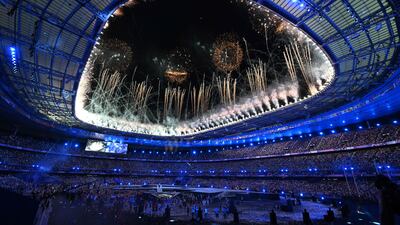
Fireworks go off during the closing ceremony of the Paris 2024 Olympic Games at the Stade de France. AFP -
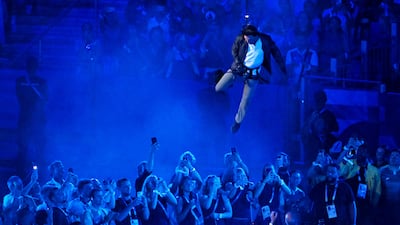
Tom Cruise is lowered from the roof of Stade de France during the Closing Ceremony. Getty Images -
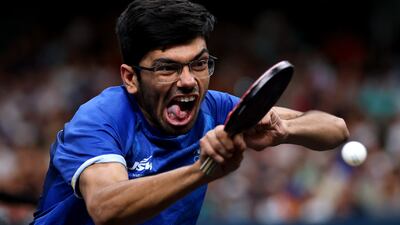
Manav Vikash Thakkar of Team India competes during the Men's Team Round of 16 match between Team People’s Republic of China and Team India. Getty Images -
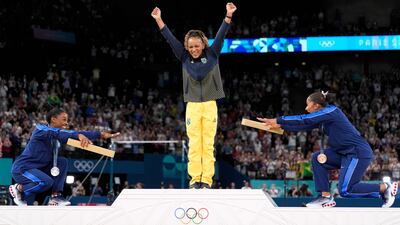
Silver medalist Simone Biles, of the United States, left, and bronze medalist Jordan Chiles, of the United States, right, bow to gold medalist Rebeca Andrade, of Brazil, during the medal ceremony for the women's artistic gymnastics individual floor finals. AP -
Kim Yeji of Team Republic of Korea prepares to shoot during the Women's 10m Air Pistol Final. Getty Images -
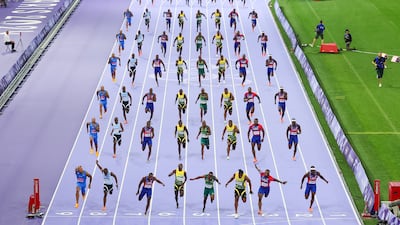
A composite image of Noah Lyles of Team United States winning the Men's 100m Final on day nine. Getty Images -

A composite image of the Wrestling Women's and Wrestling Men's Greco-Roman final Matches on day thirteen. Getty Images -
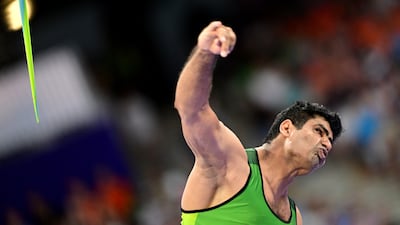
Arshad Nadeem of Pakistan competes in the Men Javelin Throw final event. EPA -
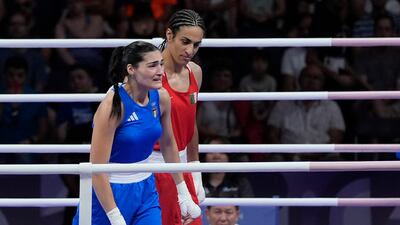
Algeria's Imane Khelif, right, defeated Italy's Angela Carini in their women's 66kg preliminary boxing match. AP -

Snoop Dogg (R) attends the Artistic Gymnastics Women's Qualification on day two. Getty Images -
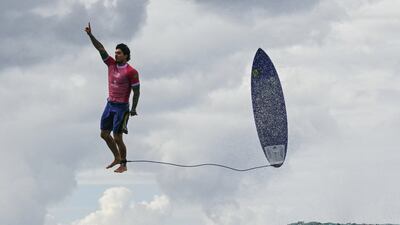
Brazil's Gabriel Medina reacts after getting a large wave in the 5th heat of the men's surfing round 3. AFP -
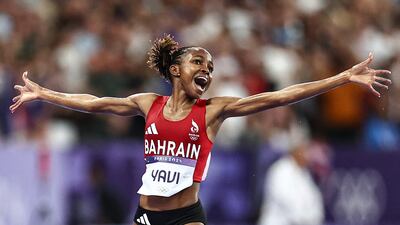
Bahrain's Winfred Mutile Yavi celebrates winning the women's 3,000m steeplechase final at the Paris 2024 Olympic Games at Stade de France in Saint-Denis on August 6. AFP -

South Korea's Yi Jae-gyeong competes in the men's 3m springboard diving semi-final the Aquatics Centre in Saint-Denis, north of Paris, on August 7. AFP -
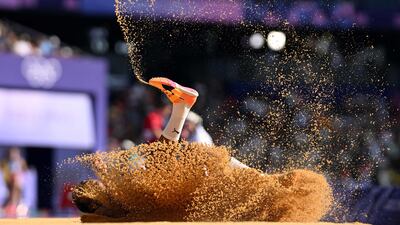
Cuba's Liadagmis Povea in the women's triple jump qualification at the Stade de France on August 2. AFP -
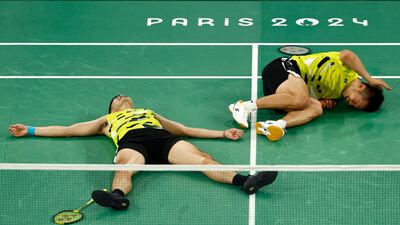
Taiwan's Wang Chi-lin and Lee Yang after winning the men's doubles badminton final match against China at Porte de la Chapelle Arena on August 4. AFP -
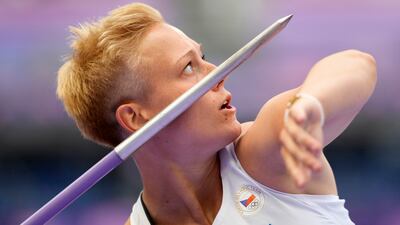
Petra Sicakova, of Czechia, prepares to hurl the javelin in women's qualification in Saint-Denis, France. AP -
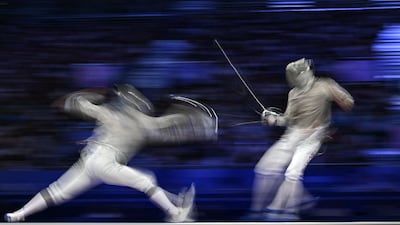
Hungary's Andras Szatmari, left competes against South Korea's Gu Bon-gil in the men's sabre team gold medal bout at the Grand Palais in Paris, on July 31. AFP -

French surfer Kauli Vaast reacts after riding a wave during the men's gold medal match in Tahiti. Reuters -

France's Marie-Julie Bonnin has a soft landing in the women's pole vault final on August 7. AFP -
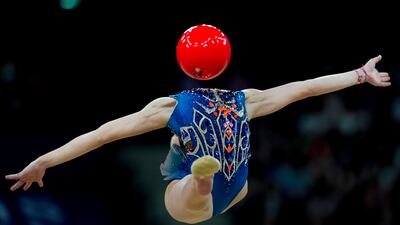
Stiliana Nikolova of Bulgaria performs in the rhythmic gymnastics individuals all-round qualification round, at La Chapelle Arena, Paris. AP -

Alain Kortabitarte of Spain in action in the men's park preliminaries skateboarding at La Concorde 4, Paris, on August 7. Reuters -
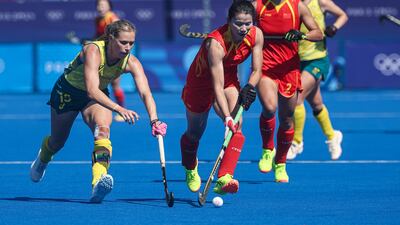
Jiaqi Zhong of China, centre, guards the ball from Australia's Kaitlin Nobbs in the women's quarter-final field hockey match at the Stade Yves du Manoir in Colombes, France, on August 5. EPA -

Gold medallist Kellie Harrington of Ireland celebrates on the podium after her win in the women's 60kg boxing division at Roland-Garros Stadium, Paris, on August 6. Reuters -

Brazilian gymnast Rebeca Andrade in action in the balance beam final at the Bercy Arena, Paris, on August 5. Reuters -
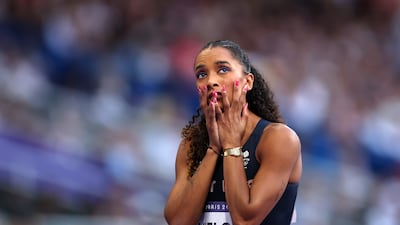
Britain's Lina Nielsen shows her disappointment after the women's 400m hurdles semi-final at the Stade de France on August 6. Getty Images -
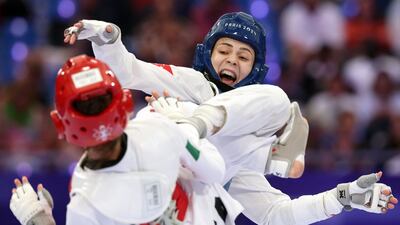
Turkey's Merve Kavurat, right, and Italy's Ilenia Matonti compete in the taekwondo women's 49kg round of 16 bout at the Grand Palais on August 7. AFP -
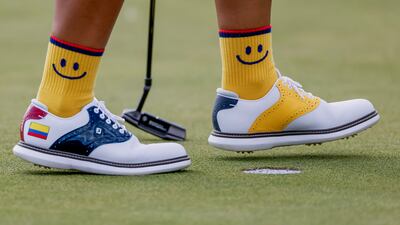
Happy feet ... Mariajo Uribe of Colombia on the 18th green during the first round of the women's individual stroke play golf at Le Golf National in Guyancourt, France, on August 7. EPA -

Brazil's Almir dos Santos competes in the men's triple jump qualification at the Stade de France on August 7. AFP -
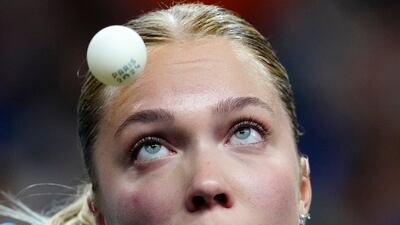
Sweden's Christina Kallberg plays Hong Kong's Doo Hoi Kem during the women's teams round of 16 table tennis match in Paris. AP -

Quincy Hall of the US crosses the line to win gold in the final of the men's 400m at the Stade de France on August 7. Reuters -
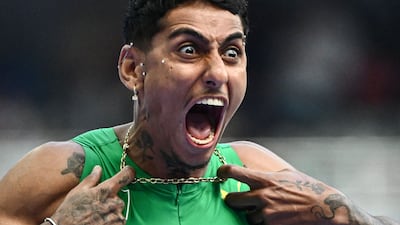
Brazil's Gabriel Dos Santos reacts after running in the men's 4x100m relay heat at the Stade de France on August 8. AFP -

The men's 5,000m heat one at the Stade de France on August 7. Reuters -

Paris 2024 Olympics - Volleyball - Women's Quarterfinals- Brazil vs Dominican Republic - South Paris Arena 1, Paris, France - August 06, 2024. Gabriela Braga Guimaraes of Brazil and Niverka Dharlenis Marte Frica of the Dominican Republic in action. REUTERS/Siphiwe Sibeko TPX IMAGES OF THE DAY -
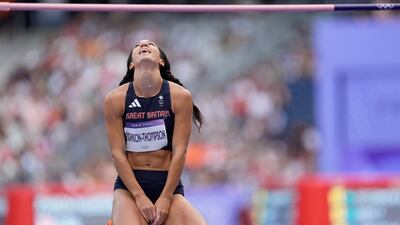
Katarina Johnson-Thompson, of Britain, reacts after an attempt in the heptathlon high jump at the 2024 Summer Olympics, Thursday, Aug. 8, 2024, in Saint-Denis, France. (AP Photo/Martin Meissner) -
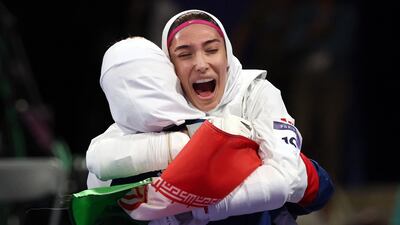
Iran's Mobina Nematzadeh celebrates beating Saudi Arabia's Dunya Ali M Abutaleb in the taekwondo women's -49kg bronze medal bout of the Paris 2024 Olympic Games at the Grand Palais in Paris on August 7, 2024. (Photo by David GRAY / AFP) -
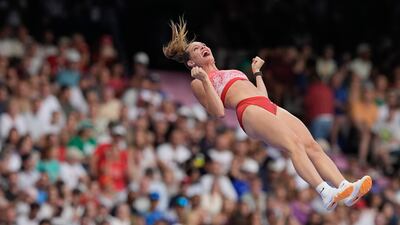
Alysha Newman, of Canada, celebrates a successful vault as she competes in the women's pole vault final at the 2024 Summer Olympics, Wednesday, Aug. 7, 2024, in Saint-Denis, France. (AP Photo/Rebecca Blackwell)


Rudisha set the mark of 1min 40.91sec while winning gold in the London Olympics in 2012.
This year has been a real breakthrough season for 25-year-old Sedjati, born in the northern Algerian city of Tiaret.
He broke Makhloufi's national record at the Paris Diamond League meeting this month, clocking 1:41.56 to become the third fastest athlete in the history of the race after Rudisha and Denmark's Wilson Kipketer (1:41.11).
Sedjati improved his time to 1:41.46, a Diamond League record and new world leading time, just five days later in Monaco.
"I am now thinking of the world record, I hope to run it at the Olympic Games," said the Algerian, who claimed silver at the 2022 Eugene world championships.
"I will focus on that and put in the necessary work so that I can achieve my goal.
"It's the fourth time I've run a world lead and the second time an Algerian record, I have worked really hard for that."
"I will keep the preparation the same. My mindset is that the hard work I have put in will pay off."

