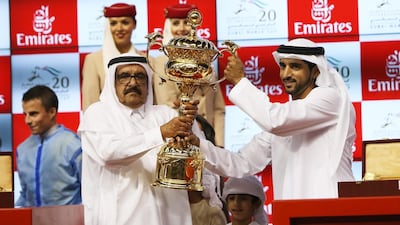
Tadhg O’Shea has crossed a few milestones in his 20 years of riding in the UAE that are unlikely to be visited again.
It has been two decades of remarkable success on the racecourse. However, the Irishman has dedicated all those feats to the man who first brought him to the country – the late Sheikh Hamdan bin Rashid, one of the leading owner-breeders of thoroughbred and Purebred Arabian race horses in the world.
O'Shea first arrived on a scholarship presented to the champion apprentice in Ireland by Sheikh Hamdan, the UAE minister of Finance and Deputy Ruler of Dubai who passed away last week.
O’Shea was 19 when he first visited Dubai and he rode for four different trainers – Erwan Charpy, Paddy Rudkin, Kiaran McLaughlin and John Sadler – in four months.
He returned on the same scholarship in the following year having won the apprentice championship again.
Fast forward a couple of decades and O’Shea is now on the verge of winning the UAE jockey’s championship for the ninth time. He is on 43 winners and is 18 ahead of his closest challenger Antonio Fresu with five meetings left.
The record-breaking champion jockey dedicated all his successes to the late Sheikh Hamdan.
“All credit really goes to the late His Highness Sheikh Hamdan who brought me here for the first time in 2001 on a scholarship with all expenses paid for the champion apprentice,” he said.
“I dedicate all my achievements to His Highness for the huge influence he had in my career.”
O’Shea is also four short of another milestone – the first jockey to reach 600 winners in the UAE.
Adding to his records this season is his first thoroughbred success in the Dubai World Cup meeting, on board the Satish Seemar-trained Secret Ambition in the Group 2 Godolphin Mile.
“That has to be the highlight of the season,” he said of his success on board Secret Ambition.
________________________________________________
Sheikh Hamdan bin Rashid at Dubai World Cup
________________________________________________
It has been another fantastic season and hopefully a ninth championship in the bag with a very good lead.
“Look, I have a lot of people to thank. First of all my boss Khalid Khalifa Al Naboodah and his trainer Ernst Oertel, for whom I have ridden a lot of Purebred Arabians winners.
“Satish and Bhupath Seemar [assistant trainer] for the thoroughbreds. The two combined for two very powerful stables.”
O’Shea narrowly missed winning the Group 1 Dubai Kahayla Classic, the Arabian showpiece and traditional opener of the Dubai World Cup meeting, on the same night.
He was runner up on Oertel’s AF Alwajel in the silks of Al Naboodah, a prize he had previously won on board AF Maher in 2019 for the same connection and the Eric Lemartinel-trained Mizzna in 2008.
O’Shea is the all-time leading jockey in the UAE. He surpassed the record seven UAE championship titles of Ted Durcan and crossed the 504-winner mark of Richard Hills in March 2019.
O’Shea hasn’t made any immediate plans for the summer because of the prevailing Covid situation.
“The focus is to complete the UAE season [in the next two weekends] with as many winners we can and then recharge and recuperate to come fresh for the new season,” he said.
O’Shea is booked to ride 17 horses from 19 races at Al Ain, Sharjah and Abu Dhabi across three days from Friday to Sunday.

Brief scoreline:
Manchester United 1
Mata 11'
Chelsea 1
Alonso 43'
Fresh faces in UAE side
Khalifa Mubarak (24) An accomplished centre-back, the Al Nasr defender’s progress has been hampered in the past by injury. With not many options in central defence, he would bolster what can be a problem area.
Ali Salmeen (22) Has been superb at the heart of Al Wasl’s midfield these past two seasons, with the Dubai club flourishing under manager Rodolfo Arrubarrena. Would add workrate and composure to the centre of the park.
Mohammed Jamal (23) Enjoyed a stellar 2016/17 Arabian Gulf League campaign, proving integral to Al Jazira as the capital club sealed the championship for only a second time. A tenacious and disciplined central midfielder.
Khalfan Mubarak (22) One of the most exciting players in the UAE, the Al Jazira playmaker has been likened in style to Omar Abdulrahman. Has minimal international experience already, but there should be much more to come.
Jassim Yaqoub (20) Another incredibly exciting prospect, the Al Nasr winger is becoming a regular contributor at club level. Pacey, direct and with an eye for goal, he would provide the team’s attack an extra dimension.
Moral education needed in a 'rapidly changing world'
Moral education lessons for young people is needed in a rapidly changing world, the head of the programme said.
Alanood Al Kaabi, head of programmes at the Education Affairs Office of the Crown Price Court - Abu Dhabi, said: "The Crown Price Court is fully behind this initiative and have already seen the curriculum succeed in empowering young people and providing them with the necessary tools to succeed in building the future of the nation at all levels.
"Moral education touches on every aspect and subject that children engage in.
"It is not just limited to science or maths but it is involved in all subjects and it is helping children to adapt to integral moral practises.
"The moral education programme has been designed to develop children holistically in a world being rapidly transformed by technology and globalisation."
Race card
6.30pm: Emirates Holidays Maiden (TB), Dh82,500 (Dirt), 1,900m
7.05pm: Arabian Adventures Maiden (TB), Dh82,500 (D), 1,200m
7.40pm: Emirates Skywards Handicap (TB), Dh82,500 (D), 1,200m
8.15pm: Emirates Airline Conditions (TB), Dh120,000 (D), 1,400m
8.50pm: Emirates Sky Cargo (TB), Dh92,500 (D)1,400m
9.15pm: Emirates.com (TB), Dh95,000 (D), 2,000m
The specs
Engine: 3.6 V6
Transmission: 8-speed auto
Power: 295bhp
Torque: 353Nm
Price: Dh155,000
On sale: now
Ten tax points to be aware of in 2026
1. Domestic VAT refund amendments: request your refund within five years
If a business does not apply for the refund on time, they lose their credit.
2. E-invoicing in the UAE
Businesses should continue preparing for the implementation of e-invoicing in the UAE, with 2026 a preparation and transition period ahead of phased mandatory adoption.
3. More tax audits
Tax authorities are increasingly using data already available across multiple filings to identify audit risks.
4. More beneficial VAT and excise tax penalty regime
Tax disputes are expected to become more frequent and more structured, with clearer administrative objection and appeal processes. The UAE has adopted a new penalty regime for VAT and excise disputes, which now mirrors the penalty regime for corporate tax.
5. Greater emphasis on statutory audit
There is a greater need for the accuracy of financial statements. The International Financial Reporting Standards standards need to be strictly adhered to and, as a result, the quality of the audits will need to increase.
6. Further transfer pricing enforcement
Transfer pricing enforcement, which refers to the practice of establishing prices for internal transactions between related entities, is expected to broaden in scope. The UAE will shortly open the possibility to negotiate advance pricing agreements, or essentially rulings for transfer pricing purposes.
7. Limited time periods for audits
Recent amendments also introduce a default five-year limitation period for tax audits and assessments, subject to specific statutory exceptions. While the standard audit and assessment period is five years, this may be extended to up to 15 years in cases involving fraud or tax evasion.
8. Pillar 2 implementation
Many multinational groups will begin to feel the practical effect of the Domestic Minimum Top-Up Tax (DMTT), the UAE's implementation of the OECD’s global minimum tax under Pillar 2. While the rules apply for financial years starting on or after January 1, 2025, it is 2026 that marks the transition to an operational phase.
9. Reduced compliance obligations for imported goods and services
Businesses that apply the reverse-charge mechanism for VAT purposes in the UAE may benefit from reduced compliance obligations.
10. Substance and CbC reporting focus
Tax authorities are expected to continue strengthening the enforcement of economic substance and Country-by-Country (CbC) reporting frameworks. In the UAE, these regimes are increasingly being used as risk-assessment tools, providing tax authorities with a comprehensive view of multinational groups’ global footprints and enabling them to assess whether profits are aligned with real economic activity.
Contributed by Thomas Vanhee and Hend Rashwan, Aurifer
Voices: How A Great Singer Can Change Your Life
Nick Coleman
Jonathan Cape
Upcoming games
SUNDAY
Brighton and Hove Albion v Southampton (5.30pm)
Leicester City v Everton (8pm)
MONDAY
Burnley v Newcastle United (midnight)
How to avoid crypto fraud
- Use unique usernames and passwords while enabling multi-factor authentication.
- Use an offline private key, a physical device that requires manual activation, whenever you access your wallet.
- Avoid suspicious social media ads promoting fraudulent schemes.
- Only invest in crypto projects that you fully understand.
- Critically assess whether a project’s promises or returns seem too good to be true.
- Only use reputable platforms that have a track record of strong regulatory compliance.
- Store funds in hardware wallets as opposed to online exchanges.
The Melbourne Mercer Global Pension Index
Mazen Abukhater, principal and actuary at global consultancy Mercer, Middle East, says the company’s Melbourne Mercer Global Pension Index - which benchmarks 34 pension schemes across the globe to assess their adequacy, sustainability and integrity - included Saudi Arabia for the first time this year to offer a glimpse into the region.
The index highlighted fundamental issues for all 34 countries, such as a rapid ageing population and a low growth / low interest environment putting pressure on expected returns. It also highlighted the increasing popularity around the world of defined contribution schemes.
“Average life expectancy has been increasing by about three years every 10 years. Someone born in 1947 is expected to live until 85 whereas someone born in 2007 is expected to live to 103,” Mr Abukhater told the Mena Pensions Conference.
“Are our systems equipped to handle these kind of life expectancies in the future? If so many people retire at 60, they are going to be in retirement for 43 years – so we need to adapt our retirement age to our changing life expectancy.”
Saudi Arabia came in the middle of Mercer’s ranking with a score of 58.9. The report said the country's index could be raised by improving the minimum level of support for the poorest aged individuals and increasing the labour force participation rate at older ages as life expectancies rise.
Mr Abukhater said the challenges of an ageing population, increased life expectancy and some individuals relying solely on their government for financial support in their retirement years will put the system under strain.
“To relieve that pressure, governments need to consider whether it is time to switch to a defined contribution scheme so that individuals can supplement their own future with the help of government support,” he said.
Living in...
This article is part of a guide on where to live in the UAE. Our reporters will profile some of the country’s most desirable districts, provide an estimate of rental prices and introduce you to some of the residents who call each area home.
Tips for taking the metro
- set out well ahead of time
- make sure you have at least Dh15 on you Nol card, as there could be big queues for top-up machines
- enter the right cabin. The train may be too busy to move between carriages once you're on
- don't carry too much luggage and tuck it under a seat to make room for fellow passengers
Key findings
- Over a period of seven years, a team of scientists analysed dietary data from 50,000 North American adults.
- Eating one or two meals a day was associated with a relative decrease in BMI, compared with three meals. Snacks count as a meal. Likewise, participants who ate more than three meals a day experienced an increase in BMI: the more meals a day, the greater the increase.
- People who ate breakfast experienced a relative decrease in their BMI compared with “breakfast-skippers”.
- Those who turned the eating day on its head to make breakfast the biggest meal of the day, did even better.
- But scrapping dinner altogether gave the best results. The study found that the BMI of subjects who had a long overnight fast (of 18 hours or more) decreased when compared even with those who had a medium overnight fast, of between 12 and 17 hours.