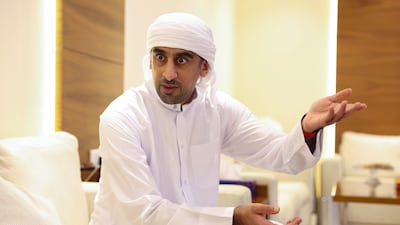

When the bus arrived outside Hamdan Al Kamali's childhood home to take him to training at Al Wahda Football Club, his older brothers would turn it away. They told the driver there were no footballers at their house. The boy who struggled to get to practice would go on to help his boyhood club win a league championship, make history as the first Emirati to join a top European club, and represent the UAE at the Olympics.
Now the former defender wants to help develop the next generation of footballers. Al Kamali, 37, has joined UAE Second Division club Arabian Falcons as a director of regional development, working with the academy and young players in his first move into coaching.
Al Kamali sat down with The National for an exclusive interview to discuss his new role, his journey to becoming one of the UAE's most accomplished players and his hopes for the next generation.

"My brothers and my late father didn't want me to be a footballer, to be completely honest," he tells The National. "They wanted me to become an engineer or to do better than my brothers."
The eighth of 23 children, Al Kamali was the eldest son of his mother, his father's second wife. His older siblings had established successful careers, and the hope was that he would follow suit. Training at Al Wahda was scheduled three times a week, but he often only managed one or two sessions if he was lucky.
"When I was little, the club bus used to come past our house. My older brothers would tell the driver, 'We don't have any footballers here. Go.'"
His mother supported his ambitions, but it was the late Sheikh Saeed bin Zayed Al Nahyan, then president of Al Wahda, who helped keep his childhood dream alive. When Al Kamali's poor grades at school kept him away from training, Sheikh Saeed noticed his absences and sent his office manager to speak to his father.
"Al Wahda stood by me in a way I'll never forget," he said. "They brought tutors to help me study after training. They cared about my education too."
Al Kamali eventually established himself in the first team and became part of the UAE age-group teams that won the 2008 Asian Under-19 Championship, reached the 2009 Under-20 World Cup quarter-finals and qualified for the London Olympics in 2012.

Together with the likes of Omar Abdulrahman, Ahmed Khalil and Ali Mabkhout, he progressed to the senior team and was part of the much-vaunted "Golden Generation" of Emirati footballers who won the 2013 Arabian Gulf Cup and finished third at the 2015 Asian Cup under Mahdi Ali.
His success with the UAE attracted interest from Europe and in 2012, Al Kamali became the first Emirati footballer to sign for a major European club when Lyon took him on a six-month loan. He trained with the senior squad, which at the time included the likes of Alexandre Lacazette, Samuel Umtiti and Hugo Lloris. But his competitive appearances came with the reserves, where coach Remi Garde, who had scouted him personally, sent him to adapt to the climate and rigours of the French game.
He recalls missing a potential first-team debut when injuries to several senior defenders left Lyon short of options, but a red card in a reserve team match ruled him out of contention.
"I thought the red card was in the reserves and wouldn't count towards the professional league. It turned out it did count and I missed my chance."
Al Kamai recalls that, before a Lyon v Paris Saint-Germain match, PSG president Nasser Al Khelaifi asked to meet with him in person. Al Khelaifi told Al Kamali that he was delighted to see a player from the Gulf region playing professionally at Lyon, and that he had been following the player's progress with the UAE national team.
"He said that even though they were PSG, they would support me in Lyon too," Al Kamali recalled. "He told me they followed my news and hoped I would carry on in the French league. Those were big words from a great man, one of the most prominent club presidents in Europe today."

He had hoped to stay on for another year, but Lyon refused to meet Al Wahda's valuation. He respected the decision but believes more Emirati players of his generation should have been given opportunities abroad.
"We weren't given the opportunity to go abroad," he said. He argued that players from countries such as Japan, South Korea and Australia continued to develop because they were given opportunities to play in Europe.
Al Kamali wants more Emirati youngsters to pursue playing careers overseas. At Arabian Falcons, a club backed by foreign investors and based in Dubai, he has been brought in to help develop young local talent.
"They brought me to Arabian Falcons to develop the young players and change the mindset of the academy players, because I understand our culture," he said.
He wants the youngsters to progress beyond the club to the UAE's best teams, represent the national side and potentially pursue professional careers in other leagues. "The Emirati player shouldn't be limited to the UAE," he explains.
Al Kamali believes football in the UAE has developed enormously since his childhood, when players had only one kit they had to take home to wash. Today, youngsters have access to facilities and equipment his generation could only dream of.
Asked whether Emirati families could be persuaded to encourage their children's footballing ambitions rather than steer them towards traditional careers, he remains hopeful.
"Football has become a profession," he said. "A talented young child in your home could change the life of an entire family."
For Al Kamali, his new role also allows him the chance to give back to a country that has supported his own career.
"The UAE has given Hamdan so much and the time has come for me to give something small back to the country."
As for the Arabian Falcons, he hopes they can eventually compete at a higher level. "I hope this club won't be just a name. I hope it will be a competitor in the UAE."